
Last updated: July 2026 · Written by the team at Badminton House
Quick Answer: Badminton Doubles Front Player Positioning
Start around the front service line, stay central with a small bias, and adjust only when your rear partner is clearly attacking or under pressure.
Service-line base
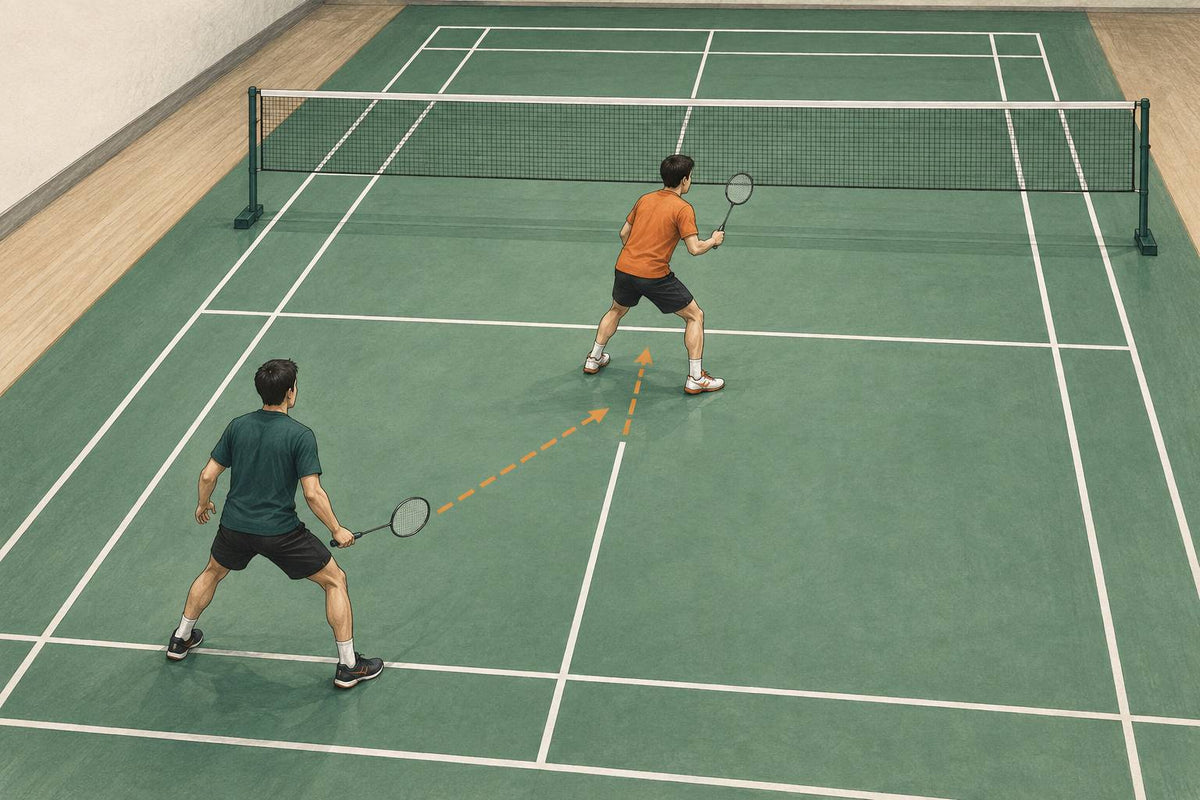
Best choice: begin near the front service line, not glued to the net, so you can see opponents and move forward, sideways, or back.
Half-step shadow
Mirror your rear partner’s attacking side with a small lateral bias; expect more straight replies without opening the opposite court.
Cross-court cover
If your partner is under rear-court pressure, leave the straight-side bias and shift slightly opposite to protect the likely gap.
If your partner is smashing and you feel useless at the net, the problem usually isn’t “slow hands.” It’s that your starting spot gives you no real choices. Too many doubles front players creep right onto the tape, freeze in the middle, or turn their head to check what the rear player just hit. By then the reply is already past them.
In This Guide
Start Around the Front Service Line, Not Glued to the Net
The biggest front-court positioning mistake is standing pinned to the tape. From there, your movement becomes mostly side-to-side along the net. If the opponents drive the shuttle hard, you have almost no time between the shuttle crossing the net and your contact point, so interceptions become rushed or impossible. You also see less of the court, which makes it harder to judge whether the reply is killable, liftable, or better left. Deciding which replies to touch, leave or kill is its own skill, and our doubles front-court net play guide covers it shot by shot.
Use the front service line as your rough default depth instead. You are still close enough to threaten loose net replies, but far enough back to read the shuttle flight and move forward, diagonally, or sideways before committing. Think of it as a ready depth, not a fixed spot. If your first step often feels late from this position, review broader movement timing in our badminton split step timing guide.
Use a Half-Step Shadow, Not a Full-Side Drift
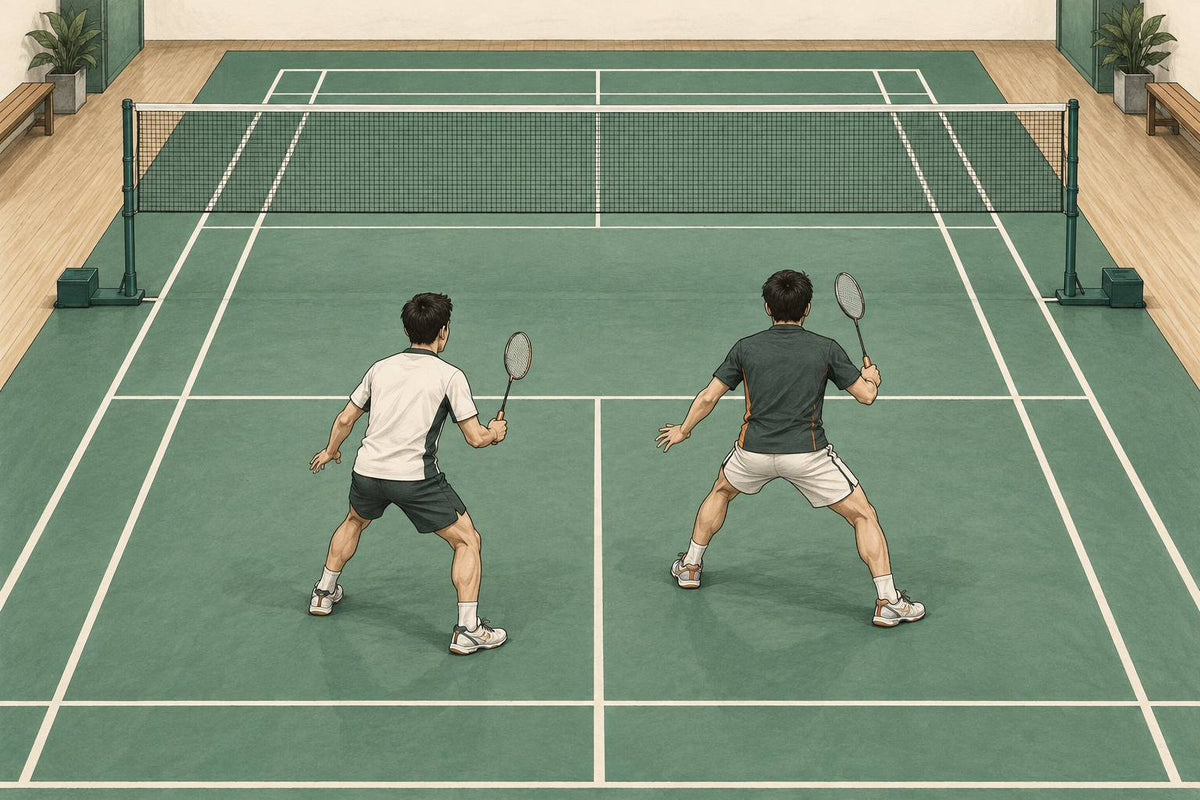
Shadowing means mirroring the side your rear partner is attacking from while still staying basically central. If your partner attacks from the rear forehand corner, your base should bias slightly to that same side; if they attack from the rear backhand corner, you shade the other way. Think half step, not full lane change.
The reason is simple: a strong smash is more likely to produce a straight block, drive, or lift. By leaning a half step toward the attacking side, you arrive earlier for that straight reply without abandoning the middle or leaving the cross-court side wide open.
This is also a partnership habit. The rear attacker can help by aiming the smash toward the front player’s side, reducing the direct down-the-line block gap and making the forecourt interception more realistic.

Read the Rear Shot Without Turning Around
The front player’s worst habit is glancing back to check what the rear partner is hitting. It feels reassuring, but it costs the exact things you need most: safety, opponent awareness, and reaction time. While your head is turned, you cannot see the block, drive, or counter-push coming at your body.
Use contact sound as one cue while keeping your eyes forward, then confirm with the shuttle’s flight and the opponents’ position. A louder string sound usually means your partner has hit a smash, so expect a faster, harder reply and keep the racket up for an interception. A softer sound usually means a drop shot, so make a small forward adjustment and prepare to cover the net reply.
Keep your chest facing the opponents and let your ears do the first read. Your eyes belong on the hitters in front of you, not the partner behind you.
Commit, Leave, Then Recover Your Spacing
After your rear partner contacts the shuttle, make a clear choice: step in to hunt the straight block, hold your lane for the drive, or release the shuttle and reset. Freezing in the middle is worse than occasionally choosing wrong, because your movement tells the rear player what you are covering. If you take away the straight reply, they can prepare for the next lift or cross-court shuttle instead of guessing behind you.
The deliberate exception is when your rear partner is under pressure. If their contact is late or weak, opponents can step in, and the dangerous space is often cross-court to the opposite side. In that moment, leave your normal shadow slightly and shift out to plug that gap. Once the shuttle passes, recover like you are connected by elastic: not crowding your partner, not stranded miles away. An observed 1.7–3.4 m spacing range is a useful situational reference, not a rule to measure during play.
Which Front-Player Position Should You Choose?
Use the opponent’s pressure level, the visible flight and your partner’s contact sound to choose your next position. The goal is not to guess perfectly; it is to make a clear coverage decision, then recover your spacing.
| Condition | Choose this position | Why |
|---|---|---|
| Neutral attack | Around the front service line | You keep time to react, see the court, and move toward the net in any direction. |
| Partner attacks from one side | Half-step shadow to that side | A strong smash is more likely to draw a straight reply, but over-shifting opens gaps. |
| Softer contact sound | Move slightly forward | A softer sound usually signals a drop, so your interception zone moves closer to the net. |
| Rear partner under pressure | Shift to cover the cross-court gap | A weaker rear shot gives opponents time to step in and attack the open opposite side. |
Get 10% off your first order
Join the Badminton House list and we’ll email you a 10% welcome code — plus training guides, technique advice, and badminton updates.
By subscribing, you agree to receive Badminton House emails and can unsubscribe anytime.
Good front-court positioning should feel active, not frantic: small bias, clear commitment, and fast recovery into useful space. We play badminton too, so if you are unsure whether your movement problem is positioning, timing, or footwear grip, contact us and tell us how your rallies break down.
Move better in the front court
Shop Badminton FootwearStable court shoes help your split step, lunge, and recovery feel controlled.

Leave a comment
This site is protected by hCaptcha and the hCaptcha Privacy Policy and Terms of Service apply.