Last updated: July 2026 · Written by the team at Badminton House
Quick Answer: Badminton Half Smash
A half smash is a controlled overhead attack below full power. Keep your full-smash preparation, stable base, high contact, and coordinated swing, but reduce the final acceleration. It trades some threat for placement, a tempo change, and faster recovery.
Half Smash
Best choice: use controlled acceleration for placement and quick recovery.
Full Smash
Choose it from a stable position when maximum threat justifies slower recovery.
Drop/Slice
Choose it when a softer disguised change will punish a defender leaning back.
If your smash only has one gear, good defenders start sitting on it: they block, drive, or let your overhit do the work. The badminton half smash gives you an attacking option that still looks dangerous without demanding a full commitment on every overhead. Think of it as disciplined pace control: enough acceleration to make the shuttle bite downward, but enough restraint that your base, grip pressure, and next movement stay organized.
In This Guide
What a Badminton Half Smash Is
A badminton half smash is a forehand smash played below maximum effort; “50–75%” is a coaching shorthand, not a measured requirement: not a drop shot, not a full kill attempt, but a smash variant with controlled striking power. A University of Miyazaki shot classification places the half smash inside the smash family alongside straight, cross, cut, jumping, and backhand smashes, which is the key idea: it keeps its smash identity even when the pace is reduced.
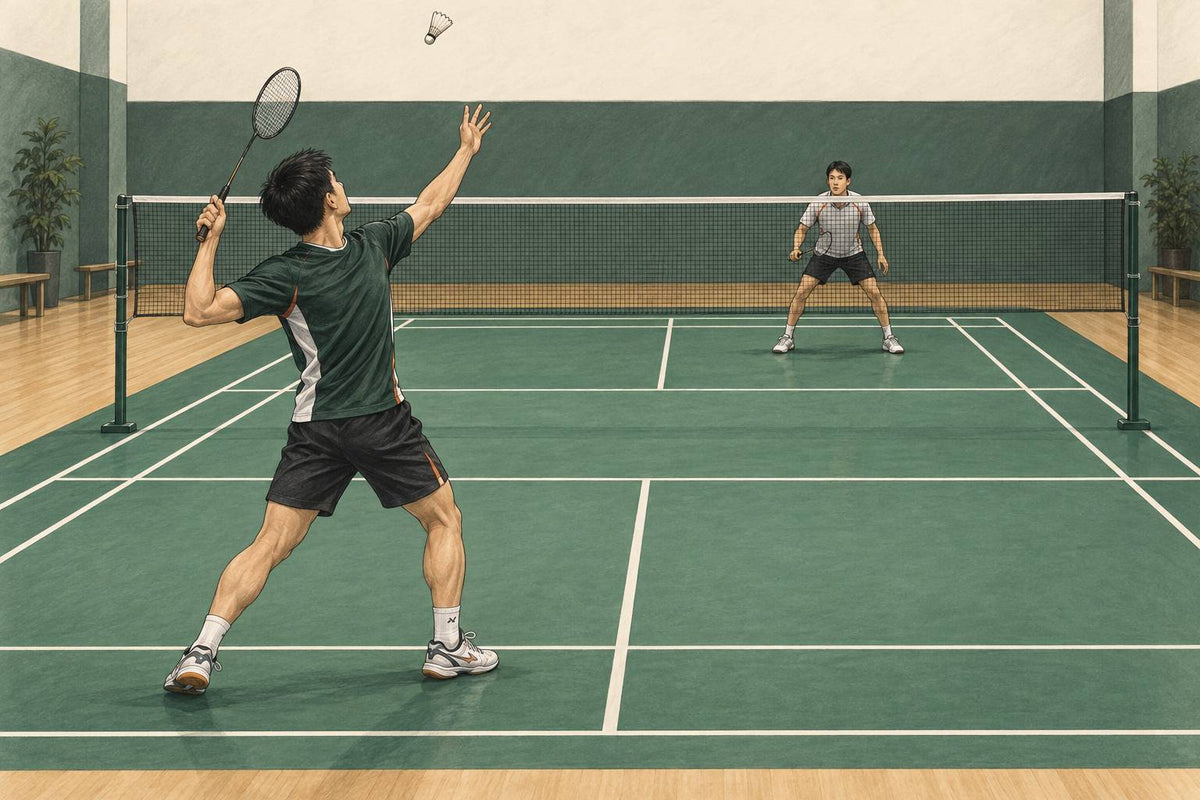
That identity comes from the flight path and preparation. The shuttle is still struck from an overhead forehand position and sent on a straight, sharply angled downward trajectory into the opponent’s court. The difference is how much acceleration you release into contact. A good half smash uses the same organized setup, stable base, and clean racket path as a harder smash, then trims the final force so you can change pace without losing balance or recovery shape.
Keep the Same Shape With Less Force
The half smash works because it looks like your normal overhead for as long as possible. Keep the same preparation: shoulder turned, non-racket arm helping balance, racket up, and contact point in front. Then reduce the hit to controlled acceleration instead of a full commitment. A slower attacking shot is harder to read when the form resembles your clear, cut, drop, or full smash.
Do not make it a lazy arm swing. Smash power comes through the legs, core, shoulder, forearm, and wrist, so a controlled half smash still uses the chain; it simply stops short of maximum output. If that idea is new, see the badminton kinetic chain power guide.
The base matters most. Arrive behind the shuttle, plant in a stable stance, and stay balanced enough to recover. If reducing force lets you keep your shape, the shot becomes faster to reset from and more believable tactically.
When the Half Smash Wins Points
A badminton half smash is most dangerous when the opponent has settled into your rally rhythm. Instead of trying to end the point immediately, you use a controlled attacking speed to change pace, disrupt their timing, and make the same overhead preparation produce a different answer. That speed change can catch defenders leaning too early for a full smash or waiting too comfortably for a drop.
Think of it as pressure-building, not point-ending only. Aim at defensive weaknesses: the racket-side hip, the outside shoulder near the tramline, or the open space between partners in doubles. Good placement and speed can force a weak block, create a net-kill chance, push the opponent deeper, throw them off balance, and make them hesitate to lift again. For a broader look at mixing fast and slow attacks, read Badminton Change of Pace Tactics.

Trade-Offs and Practice Cues
The honest trade-off is threat level. A half smash is easier to control because you are not committing the same bodyweight as a full smash, but that also means a ready defender may step in, block flat, or counter before you reset. The half smash is not trying to win a speed contest. Its value is a sharper, earlier hit that keeps your base intact.
- Trim the turn only when already positioned: a compact, stick-like half smash can reduce the body turn for faster execution when you are balanced under the shuttle. From deeper or later positions, keep enough turn and whole-body coordination to preserve clean contact rather than forcing an arm-only hit.
- Recover on contact: settle as the shuttle leaves the strings, so the next push, block, or lift does not catch you leaning.
- Judge the defender: use it when their feet are still adjusting; avoid feeding it to someone already balanced and waiting.
Which Smash Should You Choose?
Pick the shot by the defender’s readiness and your recovery need, not by how hard you feel you can hit.
| Choice | Choose it when | Watch for |
|---|---|---|
| Half smash | You want controlled striking power, placement, and a pace change while staying balanced for the next shot. | If the opponent is ready, the reduced threat can give them a counterattack window. |
| Full smash | You have a clear attacking chance and can still control speed, angle, and recovery. | Pure force without shape makes the next movement harder. |
| Drop or cut | You can sell the same overhead preparation and make the defender guess between speed and softness. | A slower shot needs disguise and placement, or it becomes easy to read. |
Get 10% off your first order
Join the Badminton House list and we’ll email you a 10% welcome code — plus training guides, technique advice, and badminton updates.
By subscribing, you agree to receive Badminton House emails and can unsubscribe anytime.
The badminton half smash rewards players who can accelerate under control, keep their preparation believable, and recover before the reply. We play badminton ourselves, so if you’re unsure whether your technique, strings, or racket setup is helping that pattern, send us a note through our contact page and we’ll point you in the right direction.
Refining your attacking overheads?
Browse Astrox RacketsAttack-oriented, head-heavy Astrox rackets suit players building controlled overhead power; compare the range after your technique is consistent.

Leave a comment
This site is protected by hCaptcha and the hCaptcha Privacy Policy and Terms of Service apply.