
Last updated: July 2026 · Written by the team at Badminton House
Quick Answer: Badminton Footwork Fatigue
When your movement gets sloppy, first separate technical quality from conditioning fatigue; they break down differently and need different fixes.
Technical quality
Best choice: look for late split steps, heavy landings, poor recovery, and balance loss before assuming you are simply unfit.
Conditioning fatigue
Use this lens when repeated rallies make accelerations, lunges, and jumps feel progressively slower or weaker.
No universal collapse point
Stronger players may hold speed longer; judge your own movement quality instead of chasing a fixed rally length.
If your first few rallies feel sharp but your feet turn heavy halfway through a game, the problem is not always “bad footwork.” Badminton footwork fatigue often shows up as a split step that gets late, lunges that land noisier, and recoveries that stop a step short of centre. Because badminton is built around repeated accelerations, braking, direction changes, jumps, and lunges, your legs and timing can degrade before you feel completely exhausted.
This guide separates conditioning from movement quality. You will see why fatigue builds quickly, what clean footwork looks like before it breaks down, how landing and recovery mechanics change, and why there is no single point where every player’s footwork collapses.
In This Guide
Why Badminton Footwork Fatigue Builds So Quickly
Badminton footwork fatigue builds quickly because the sport rarely lets the legs settle into one rhythm. A point is a burst: accelerate, brake, change direction, lunge or jump, then repeat. Match patterns reflect that stop-start stress: rallies average about 7 seconds, rests about 15 seconds, effective playing time is around 31%, and average heart rate can sit above 90% of maximal heart rate.
That demand is not purely “cardio.” During games, roughly 60–70% of energy yield comes from the aerobic system and about 30% from anaerobic contribution, especially the alactic system for repeated explosive actions. Elite male singles players cover about 1,862 m per game, while elite male doubles players cover about 1,108 m. Singles also carries more jumping and lunging demand: about 40% more jumps and 250% more lunges than doubles, with forward lunges making up roughly 37% of singles movement. Each hard lunge can load the dominant limb up to about 2.5 times body weight.
What Good Footwork Quality Looks Like Before Fatigue
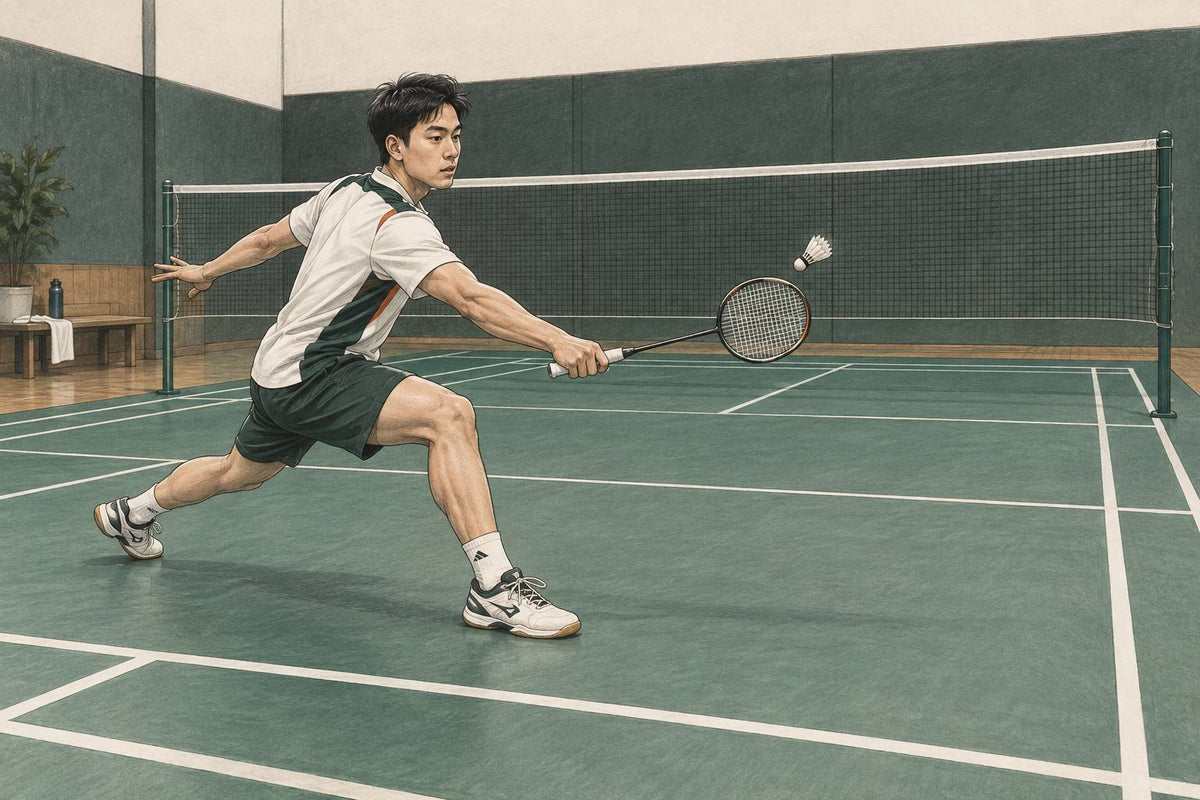
Before you judge badminton footwork fatigue, define the clean version first. A solid baseline has five pieces: a ready basic stance, a split step, short shuffling steps, controlled lunges, and recovery back toward the centre after the shot. The split step should land lightly on the balls of the feet, roughly shoulder-width, as the opponent is about to hit; if it lands too early, too late, or flat, your first push is already compromised.
Good movement is not frantic movement. The aim is to arrive early enough that the shuttle is in front of you and your body is balanced at contact. Shuffles should be quiet and economical, lunges should be braced rather than collapsing, and recovery should begin as soon as the shot is played. Heavy stomping steps waste energy, while flat-footed waiting makes the next split step harder.
For the technical foundation, see Badminton Footwork Basics and Split Step Timing.
Badminton Footwork Fatigue: How Movement Breaks Down
First, separate fitness fatigue from footwork-quality breakdown. After simulated singles matches, dominant-leg knee-extensor maximal voluntary contraction torque dropped by about 12% immediately and about 16% one hour later, then returned to baseline by 24 hours. In elite young players, a fatigue protocol reduced jump height by about 4 cm and was linked with signs that fatigue may reduce voluntary control of active muscles. That is the engine losing output.
Technical breakdown is what the body does to keep playing with that weaker engine. After fatigue, centre-of-pressure sway increased in medial-lateral and anterior-posterior directions, especially side-to-side. After ankle dorsiflexor fatigue, loading rates rose in backhand landings. After quadriceps fatigue, scissor-jump landings showed changes in knee flexion, ankle plantarflexion, power and joint reaction forces. Single-leg landing fatigue is also associated with poorer coronal-plane control: more trunk lean, less hip abduction and greater knee valgus. For the stopping mechanics behind those changes, see Badminton Footwork Braking.

Why There Is No Universal Footwork Collapse Point
The key nuance: badminton footwork fatigue does not create one predictable moment where everyone suddenly slows down. In top athletes, footwork speed can stay relatively stable at about 2.2–2.6 m/s even in long rallies. That does not mean they are not tired; it means better players often absorb fatigue through cleaner spacing, earlier preparation, and less wasted braking.
A more useful definition of fatigue-resistant footwork is the ability to repeat high-intensity actions while keeping technical precision: split, push, lunge, land, recover, and read the next shot without the pattern getting noisy. For the conditioning side of that equation, see our badminton stamina guide.
The warning signs may be subtle before they are obvious. In fatiguing play, end-stage gaze behaviour can change, with more fixations that last for shorter durations. Combined with reduced anticipation and lower-limb loading accumulation, that is where ankle and knee risk rises; for the ankle-specific side, read our ankle sprain prevention guide.
Which Should You Prioritize?
Use the pattern you notice under fatigue to choose your next training focus. Do not assume every player has the same collapse point; the useful question is what changes first in your movement quality.
| Choice | Choose this if... | Main target |
|---|---|---|
| Conditioning | Your legs lose repeat power late in rallies, jumps feel smaller, or recovery between high-speed efforts drops. | Repeated high-intensity actions with less fatigue. |
| Technical quality | You get flat-footed, land heavily, lose lunge control, or stop recovering cleanly to centre. | Split-step timing, lighter steps, safer braking, and controlled landings. |
| Individual threshold | Your speed stays similar, but accuracy, balance, or decision-making fails only near the end of hard play. | Track your personal warning signs instead of chasing a universal fatigue number. |
Get 10% off your first order
Join the Badminton House list and we’ll email you a 10% welcome code — plus training guides, technique advice, and badminton updates.
By subscribing, you agree to receive Badminton House emails and can unsubscribe anytime.
If your footwork falls apart late in games, treat it as useful feedback—not a character flaw. We play badminton too, and we know the difference between conditioning work, cleaner movement habits, and gear that supports repeated lunges and recoveries. If you want a second opinion on your setup or training priorities, contact us and tell us where fatigue shows up.
Court shoes for stable lunges, landings, and recovery steps.

Leave a comment
This site is protected by hCaptcha and the hCaptcha Privacy Policy and Terms of Service apply.