
Last checked: August 2026 · Written by the Badminton House player-led team.
Quick answer: look beneath the footwork pattern
Observe five broad qualities across practice: walking and running; hopping, jumping, and landing; direction change and push-off; eye-hand coordination; and stability or mobility. They form a useful coaching audit before you prescribe more court patterns. The categories guide observation; they are not a diagnosis, ranking, or universal developmental checklist.
A player can know the route to the forecourt and still arrive late, overrun the shuttle, lose balance on landing, or stop tracking the feed. Calling every problem “bad footwork” makes the next practice choice vague. A motor-base audit separates the visible qualities so a coach can simplify the right part.
The audit does not replace badminton technique. It creates a bridge to it. Once the limiting action becomes clearer, use the dedicated badminton footwork basics guide for named court movements and recovery patterns.
What does a motor-base audit add before footwork?
A motor-base audit asks which underlying action first loses quality before it asks for another badminton pattern. It can show that a player starts well but brakes late, tracks a shuttle only while stationary, or lands without a stable next position. That observation gives the next drill a narrower and more useful purpose.
Badminton Denmark's physical-motor guidance groups training into five categories: walking and running; hops, jumps, and landing; direction change and push-off; eye-hand coordination; and stability or mobility. It recommends variety across a season and lowering the pace or task difficulty when the player cannot preserve technical quality.
Use those categories as observation headings, not five tests every player must pass in one day. A young beginner, an adult returning after a break, and a competitive junior may show different solutions. Record what happened in a clearly described task instead of assigning a broad label such as “uncoordinated” or “not athletic.”
Write an observation, not a verdict: “runs past the stopping line twice” is actionable; “slow mover” is not.
The audit also protects the session from random complexity. If the player loses balance on a simple stop, adding colours, multiple shuttles, deceptive feeds, and a score will not reveal more. Reduce the demand until one quality can be observed, then connect that quality to a court action.
What are the five movement categories to observe?
Observe each category with one simple, low-speed task and note the first change in control. Two attempts are enough for an initial coaching snapshot. Do not convert the table into age norms or compare children by a total score; its purpose is to choose a better next activity for the individual player.
| Category | Observation task | Watch for | Useful question |
|---|---|---|---|
| Walk and run | Jog, side-step, and crossover between two lines | Rhythm, posture, and an organized pattern change | Can the rhythm stay steady as the pattern changes? |
| Hop, jump, land | Small two-foot jump and quiet held landing | Balance and readiness for the next movement | Can the landing be held without another step? |
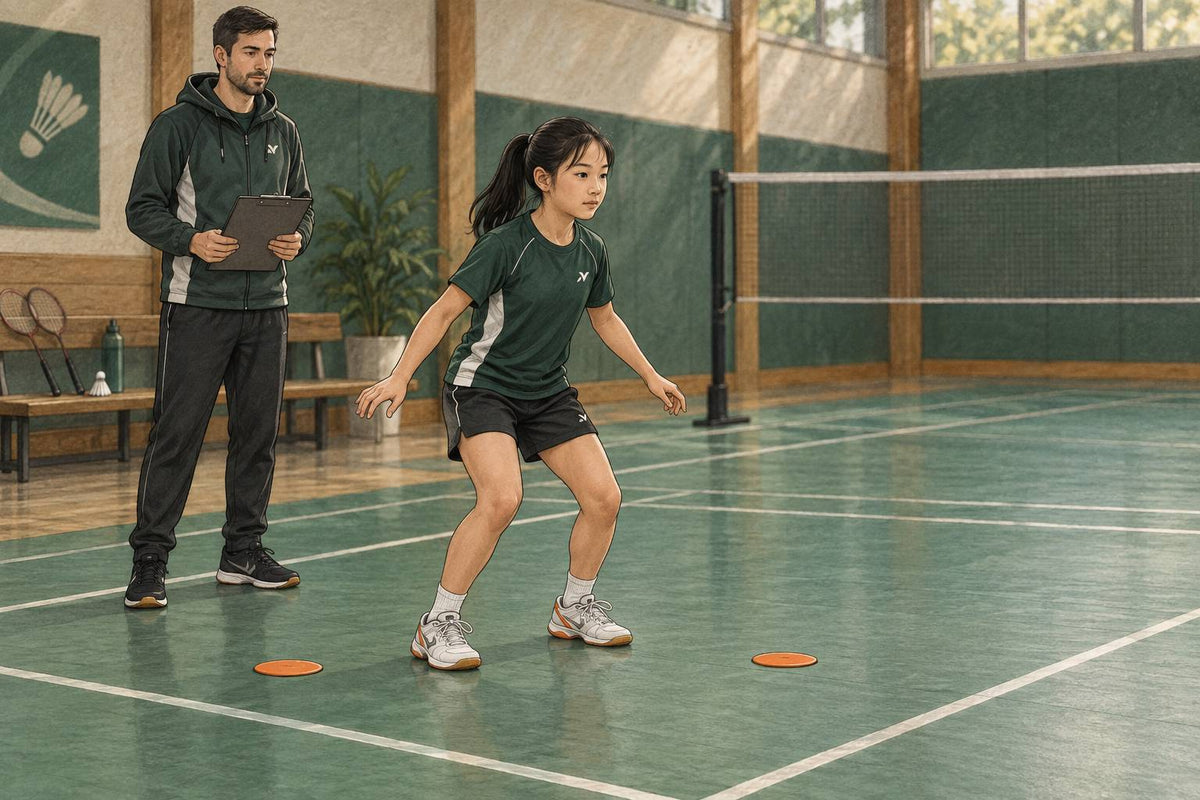
| Change direction | Move to a line, stop, and push back | Where braking begins and whether the player runs through | Where did you need to slow down? |
| Eye-hand coordination | Toss and catch a shuttle while taking one side-step | Tracking while the feet change position | Can you see the shuttle and keep moving? |
| Stability and mobility | Split-stance reach in several directions | A stable base while hips, ankles, and shoulders move | Can you reach and return without collapsing? |
Keep the setup clear and the distance modest. Demonstrate once, give the player room to stop, and change only one variable between attempts. If the first attempt is rushed, repeat it more slowly before deciding that the underlying action is missing.
A useful note might say: “landing stable; direction-change brake late; shuttle tracking accurate when stationary; balance lost during moving catch.” That note points toward braking and moving-object work. It does not claim to measure strength, diagnose an injury, or predict the player's ceiling.
How do you practise the categories without losing quality?
Choose one low-complexity task, give it a single observable cue, and lower speed before adding volume. Variety means revisiting the category through different directions, rhythms, objects, or starting positions across time. It does not mean combining every challenge in one tiring circuit until the movement becomes impossible to interpret.
For walking and running, call a forward jog, side-step, crossover, or backward walk between two lines. Change the pattern only after the player has organized the current one. Later, carry the racket in front and return to a marked base without adding a stroke.
For jumping and landing, use a small jump with a quiet, held finish. Height is not the score. The check is whether the player lands in control and can organize a next step. Add a small split landing only after the simpler finish is repeatable.
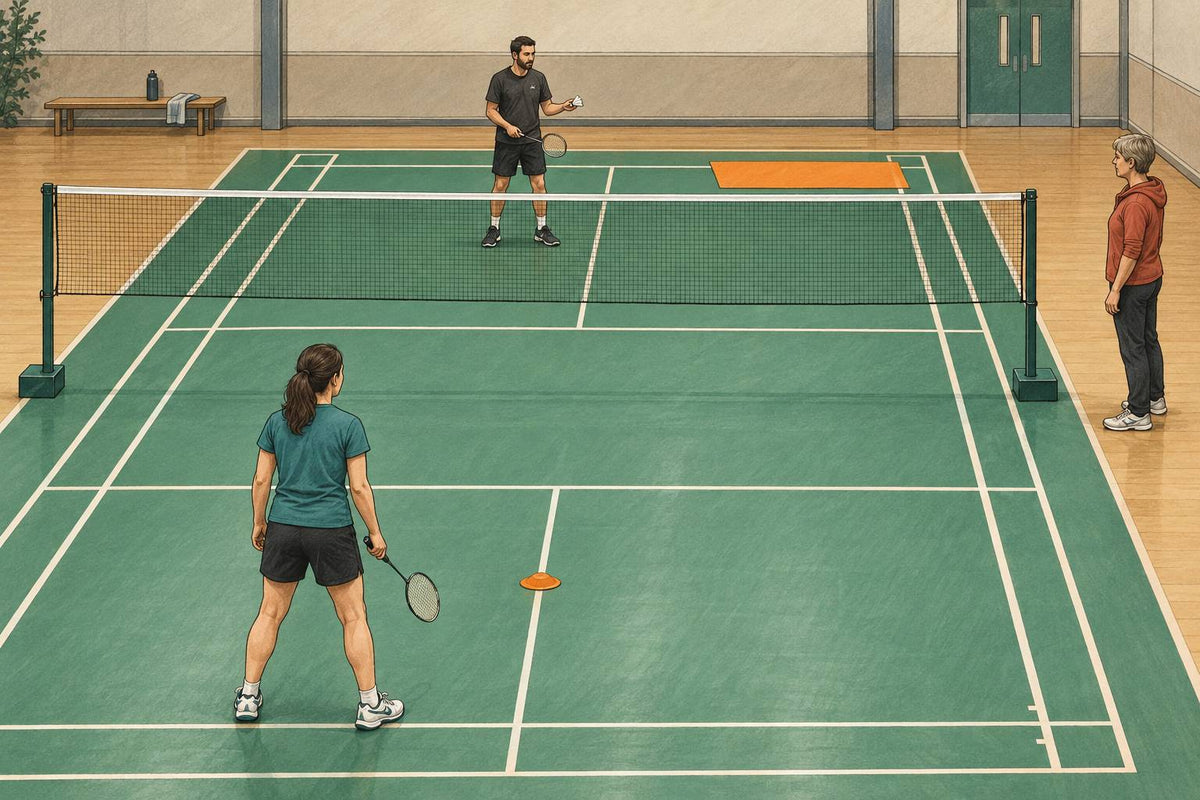
For direction change, place two markers a few metres apart. Move to one, brake before it, and push back. Start with a known direction; later use a clear visual or verbal cue. If the player runs past the marker or needs several recovery steps, reduce pace or distance.
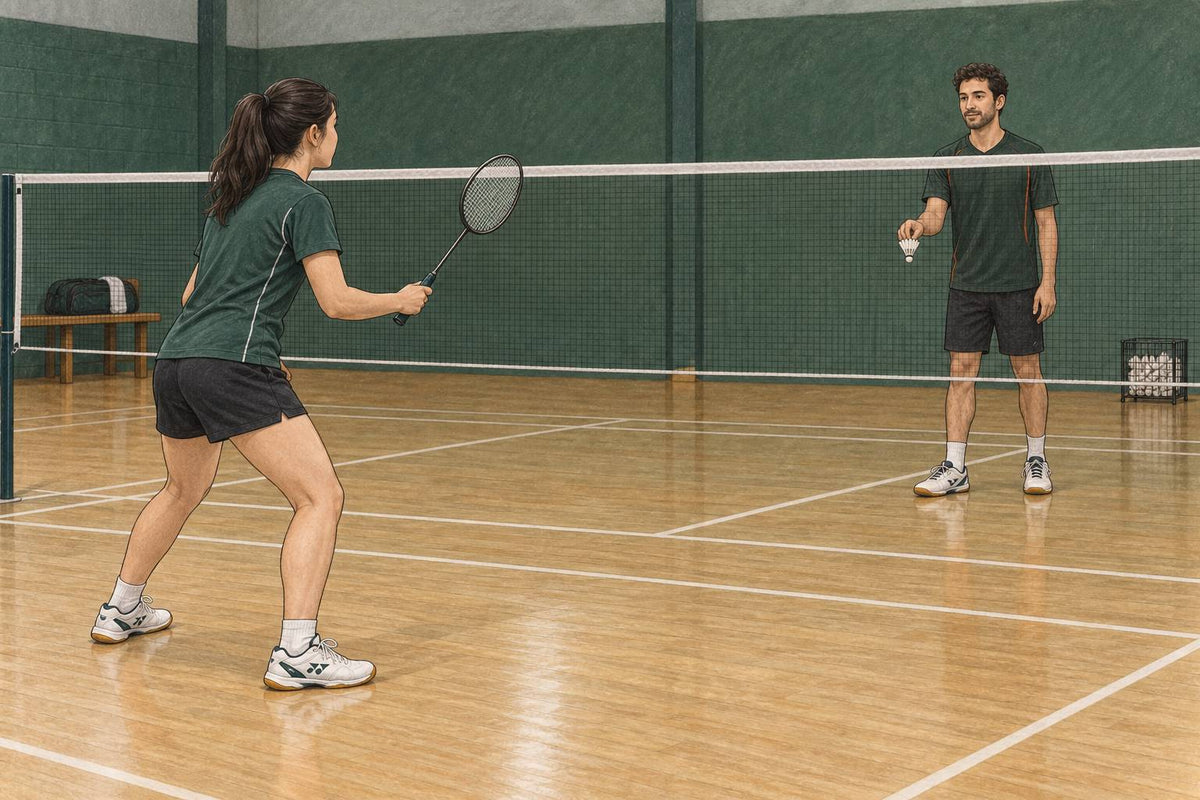
For eye-hand coordination, toss and catch one shuttle, change hands, or take one side-step before the catch. Add a gentle racket tap after tracking remains stable. More objects and faster calls are not automatically better; the player should know whether the challenge is seeing, timing, or moving.
For stability and mobility, reach from a split stance and return to centre. Change reach direction before reach distance. The task should show whether the player can keep a useful base while moving through the available range, not reward the furthest uncontrolled stretch.
Across later sessions, vary one feature inside the selected category. A direction-change task can start from a different stance, use a visual rather than verbal cue, or finish at a different line. Keep the chosen observation constant while one feature changes. If the coach changes the cue, distance, movement pattern, object, and pace together, the result no longer shows which demand helped or disrupted the player.
The quality rule
When posture, balance, spacing, tracking, or the intended rhythm disappears, reduce one demand. Lower the pace, shorten the distance, simplify the cue, or return to a stable start. Add difficulty again only when the target action is visible.
Our junior badminton coordination guide offers more ideas once eye-hand coordination is the selected category. Use it as a follow-up, not as a reason to turn the five-category audit into a long catalogue of drills.
How do you hand the finding back to badminton practice?
Hand the finding back through a three-step chain: simple movement, related court action, then a shuttle decision. The general task is useful only if it clarifies what the player should notice in badminton. Keep the link narrow and record whether the same quality survives when the racket, court position, or feed returns.
For a player who brakes late, practise stopping before a line, then move from base to a forecourt marker, then approach a gentle net feed and recover. You are not claiming the line task fixes footwork on its own. You are checking whether noticing the braking point changes the related court movement.
Research on school badminton programmes is encouraging but does not supply a universal age window. In a six-week, once-weekly study involving 124 children, the 6–7-year-old intervention group showed higher process fundamental-movement scores than controls after the programme and at follow-up, while that process-score difference was not found in the 10–11-year-old comparison. Read the 2020 Shuttle Time study abstract.
A separate six-week study of 76 children aged 9–11 reported improvements in fundamental movement skills and several fitness outcomes within that particular programme and sample. The 2023 study used twice-weekly sessions. Taken together, these studies support carefully designed practice, not a claim that one frequency, category split, or age is correct for every player.
Keep a short weekly record: category observed, task used, cue that helped, point where quality changed, and the badminton action tested next. When a growing player's familiar movement changes, use our growth-spurt training guide to adjust expectations without treating temporary awkwardness as a permanent limit.
For a broader junior plan, the technique-versus-fitness guide helps place motor-base tasks beside skill learning. The five categories are a way to ask a sharper question, choose one simpler task, and return to badminton with something observable.
Footwork remains the destination. The motor base helps you find which part of the journey needs attention before another pattern, faster feed, or longer circuit is added.

Leave a comment
This site is protected by hCaptcha and the hCaptcha Privacy Policy and Terms of Service apply.