

Last checked: August 2026 · Written by the Badminton House player-led team.
Quick answer: add one movement demand at a time
Run the same basic net-shot task through four rungs: shot without leg movement, lunge, chasse plus lunge, then split step plus chasse plus lunge. The BWF sources provide that build. Badminton House’s next step after rung four is a cooperative net rally, then a varied feed.
This is a practice build, not four unrelated drills. The contact task stays recognizable while the player adds one way of reaching the shuttle at a time. That makes it easier for a feeder and receiver to see whether the new movement helps, hides the contact problem, or needs to be simplified.
The progression assumes a basic net shot already exists. When the racket action itself is inconsistent, pause and use our badminton net-shot technique guide. This article owns the build order and the decision to move up, hold, regress, or graduate to open play.
What does the four-step net-shot progression build?
The progression layers movement onto one net-shot task: first no leg movement, then a lunge, then chasse plus lunge, and finally split step plus chasse plus lunge. The player can attend to the newest link while the feeder keeps the shuttle task stable enough to reveal whether contact remains recognizable.
That exact order comes from the BWF Shuttle Time Teachers' Manual. The source also works from backhand to forehand and then alternates the sides. It uses small contact reminders: racket in front, relaxed grip and finger control, a very small backswing, a gentle push, and minimal follow-through.
Keep those reminders brief. If the shuttle repeatedly hits the net, sits high, or misses the racket face, the movement ladder is no longer the main problem. Return to stroke practice, then restart at the first rung. Adding a lunge cannot repair a contact that is not yet available from a stable position.
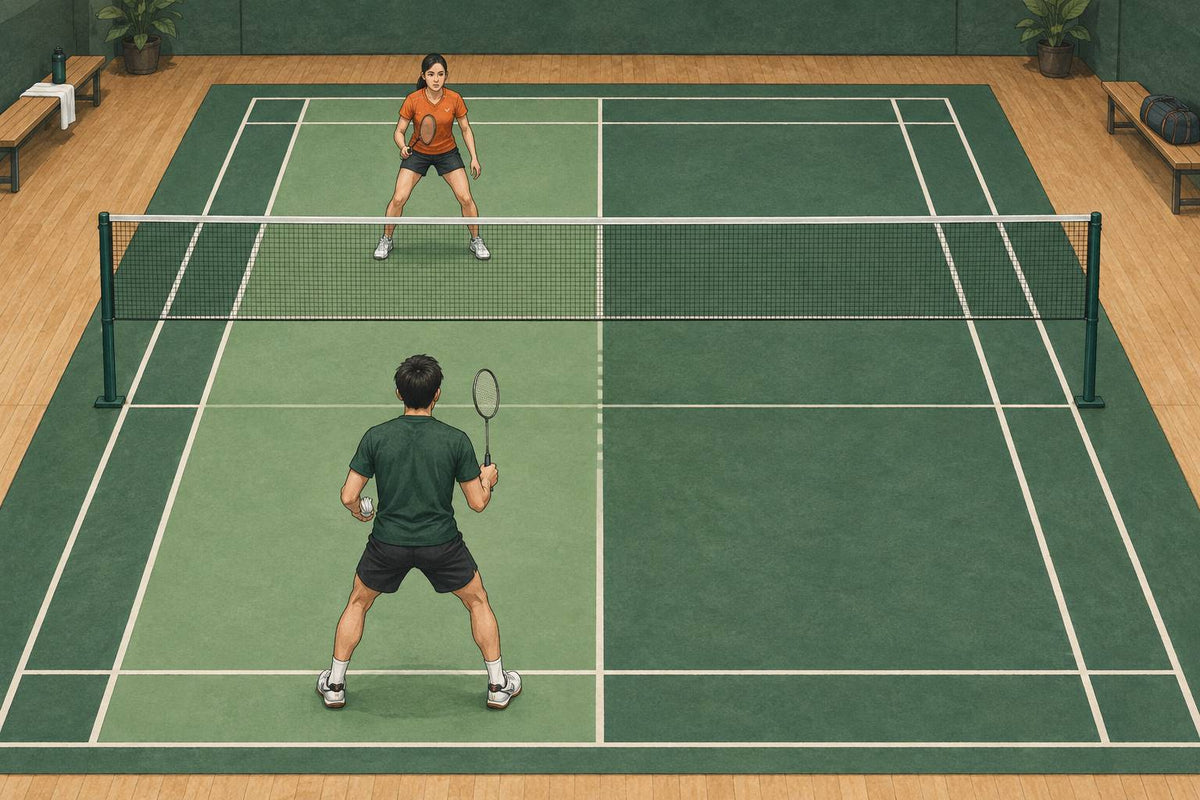
A BWF starter lesson supplies a practical partner setup: players about three metres apart, one partner throwing the shuttle, 12 shots before changing roles, and the same four-rung progression. See the Shuttle Time starter lessons. The spacing and 12-shot role change describe that lesson, not a universal dose for every player.
| Run-now item | Choice for this lesson |
|---|---|
| Partners | About three metres apart, with one feeder and one receiver |
| Feed | Reachable thrown shuttle into the net-shot area |
| Role change | 12 shots, then swap, when following the source lesson |
| Order | Shot only → lunge → chasse plus lunge → split step, chasse, lunge |
Place spare shuttles outside the movement path and make every throw easy enough to identify. The feeder should not change height, distance, side, and timing together. Our shuttle-feeding guide covers feeder position and consistency in more detail.

How do you run each rung of the progression?
Run the BWF rungs in order and keep every earlier element when the next one is added. The source supplies the build; the move-up and regression guidance below is Badminton House coaching advice. Progress only when the newest movement remains visible without turning the net shot into a rushed or accidental contact.
Rung 1 — shot without leg movement. Begin in a comfortable position close enough to reach the throw without a step. Play backhand net shots, then forehand, then alternate. The useful question is whether the player can see the shuttle, present the racket, make the gentle contact, and reset without using movement to rescue the feed.
Hold this rung when the contact is recognizable but inconsistent. Regress by making the throw slower, closer, or easier to read. Move on when the feeder can repeat the setup and the receiver no longer has to chase a poorly placed shuttle.
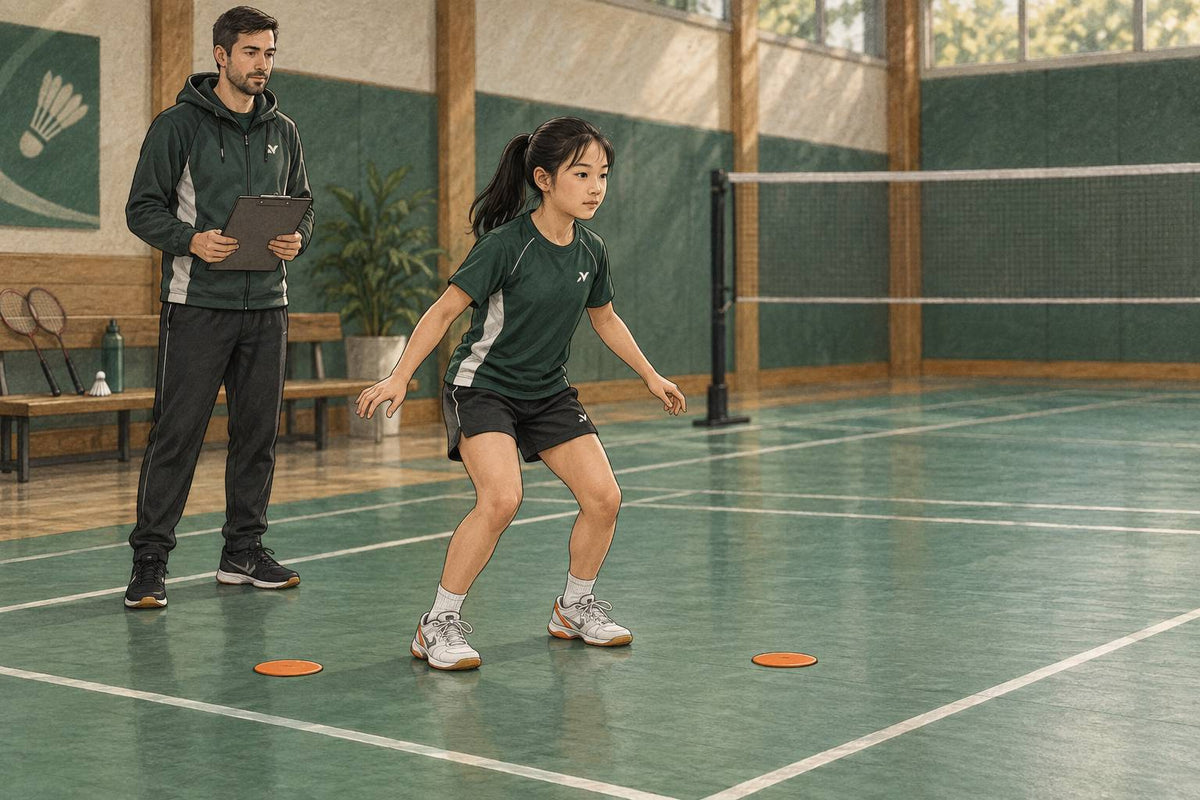
Rung 2 — add the lunge. Move the receiver far enough away that one lunge reaches the feed. The player arrives, plays the same broad net-shot action, recovers from the lunge, and returns to the starting area before the next throw. The lunge is the only new movement demand.
Hold when the player reaches the shuttle but cannot settle after contact. Shorten the distance or slow the throw if the lunge makes the shot rushed. Move up when arrival, contact, and first recovery remain connected instead of becoming three separate emergencies.
Rung 3 — add chasse plus lunge. Increase the starting distance so the receiver must chasse before the final lunge. Keep the feed location steady while the player learns the order. The chasse creates travel; the lunge organizes the final reach and contact. Pause enough between throws for a clear return to start.
Hold when the chasse is useful but the lunge becomes unstable. Reduce the lateral distance before increasing pace. Regress to the lunge rung if the player stops between the movements, crosses into a different pattern unintentionally, or loses the net-shot task completely.
Rung 4 — add split step plus chasse plus lunge. The receiver begins ready, uses a small split step as the movement trigger, travels with the chasse, completes the lunge, and plays the shot. The feed remains predictable because the added problem is the sequence, not surprise.
Hold when the sequence appears but needs a slower feed or longer reset. Regress to chasse plus lunge when the split step becomes an unrelated jump, makes the player late, or causes the chasse to disappear. Use our badminton split-step timing guide when the trigger itself needs a separate lesson.
Do not add an invented pass score: the BWF materials provide a sequence and sample 12-shot role change. They do not establish “seven clean shots out of ten,” a two-week schedule, or a universal frequency.
When should you move up, hold, or regress?
Move up when the added movement is visible and the shot remains intentional; hold when one link is emerging but inconsistent; regress when the newest demand hides the cause of failure. These decisions are observable Badminton House coaching rules, not universal BWF standards or a judgement about the player's long-term ability.
| Decision | What you can see | Next action |
|---|---|---|
| Move up | Current movement order is recognizable; contact stays intentional; receiver can reset | Add the next named movement only |
| Hold | The link appears on some feeds but disappears with small variation | Keep the rung and simplify the feed |
| Regress | You cannot tell whether contact, lunge, chasse, or split step failed first | Remove the newest variable and restore the earlier rung |
Check the movement order. On rung two, the lunge should be obvious. On rung three, the chasse should lead into it. On rung four, the split step should precede the travel instead of appearing after the player already knows where the shuttle is.
Check the contact. It need not look identical to a stationary repetition, but the receiver should still be playing the intended net shot. If movement creates a panicked poke, a large swing, or a feed contacted only by luck, stay or regress.
Check the reset. The player should finish, regain control, and be ready for the next comparable feed without wandering through several unplanned steps. Reset quality lets the feeder see whether the same movement is becoming repeatable.
Check the feeder. When throws vary in height, distance, and timing, the receiver is solving a different task every repetition. Make the feed more consistent before deciding the movement has failed. A regression can be a feeder adjustment as much as a receiver adjustment.
Do not wait for perfection. Move up when the current link is clear enough to survive one added demand, and return when the new rung makes the cause invisible. This keeps progression reversible and prevents the four-step label from becoming a race to the last row.
How do you graduate from predictable feeding to net play?
Rung four completes the predictable build; it does not create match play. Badminton House’s transition plan is first a cooperative net rally, then a varied feed that changes location or timing. The player must begin reading and choosing while trying to preserve the movement sequence.
Predictable feeding has a useful purpose: it lets the player attend to one new link. It also has a limit. A study of 12 youth elite players found biomechanical differences among handfeed, multifeed, and match-play forward-lunge trials and cautioned that predictable routines do not reproduce the same visual-search demands. Read the 2022 study on predictable badminton feeding.
The small sample does not prove predictable practice is useless. It supports a bounded conclusion: do not call the fourth rung match simulation, and do not leave the player there indefinitely. Use the controlled sequence to make movement available, then expose it to information that is not announced in advance.
First, use a cooperative net rally. Both players begin near the forecourt and keep the exchange playable. The receiver now watches another player's racket and shuttle flight rather than a fixed thrown feed. Keep the goal on arriving and producing a recognizable contact, not winning the rally immediately.
Second, vary one feed feature. Change location or timing, not every feature together. Start with modest variation and let the receiver choose the movement. If the sequence disappears, return to the cooperative rally or a simpler rung, restore the link, and try variation again.
Once the task becomes open, distance will affect the approach. Our one-step and two-step net-approach guide explains that selection without turning this progression article into another footwork lesson. The drill-transfer guide gives a broader framework for leaving predictable practice.
The complete path is simple: stabilize contact, add lunge, connect chasse, add split step, then leave the known feed. The handoff to reading and choice is not an optional extra; it is what keeps a four-step drill from becoming an isolated routine.

Leave a comment
This site is protected by hCaptcha and the hCaptcha Privacy Policy and Terms of Service apply.