
Last updated: June 2026 · Written by the team at Badminton House
Quick Answer: Shadow Badminton Footwork
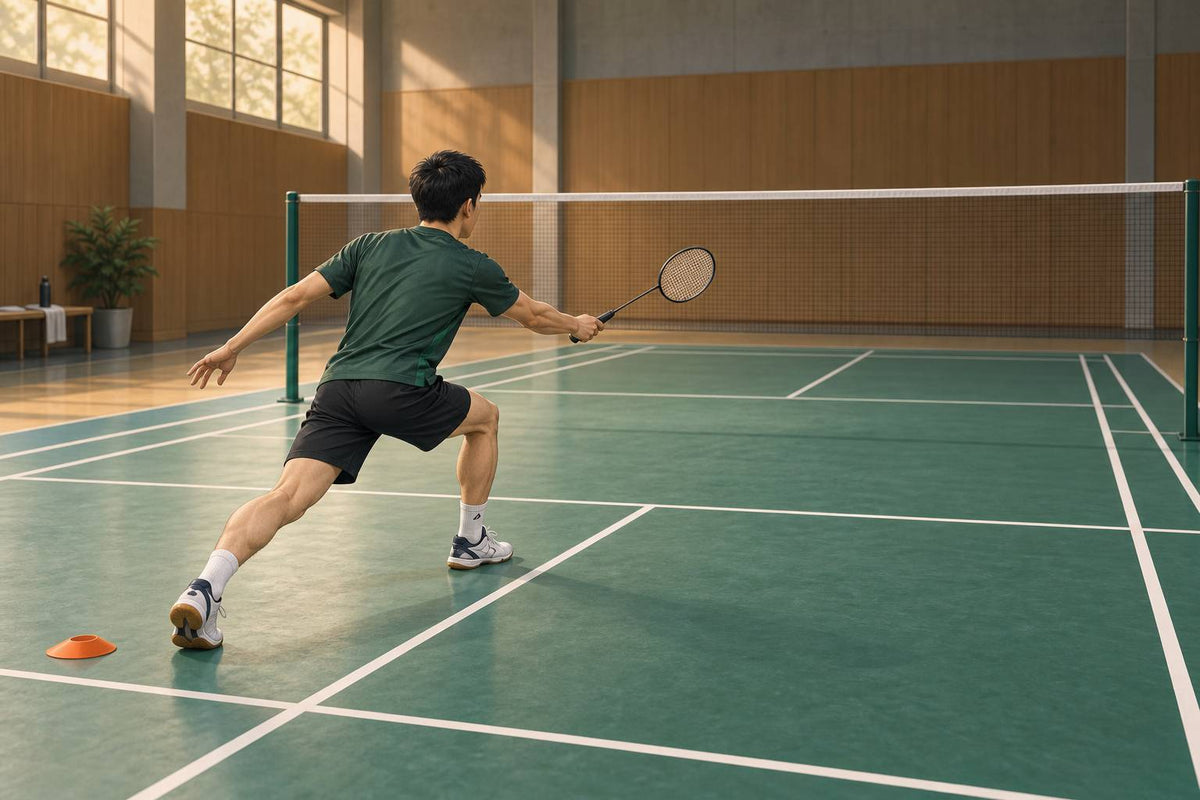
Start with a six-corner shadow badminton footwork routine: split step from base, move to one corner, lunge or jump, recover to base, then repeat with controlled intensity.
Default
Six corners: best all-around choice for most players because it trains the two net corners, two midcourt sides, and two rear corners while reinforcing split step, balance, and recovery to base.
Small space
Use a half-court or smaller open area when you are training in a Canadian gym, basement, or multipurpose room; shorten the distance but keep the same split-step and recovery rhythm.
Reaction
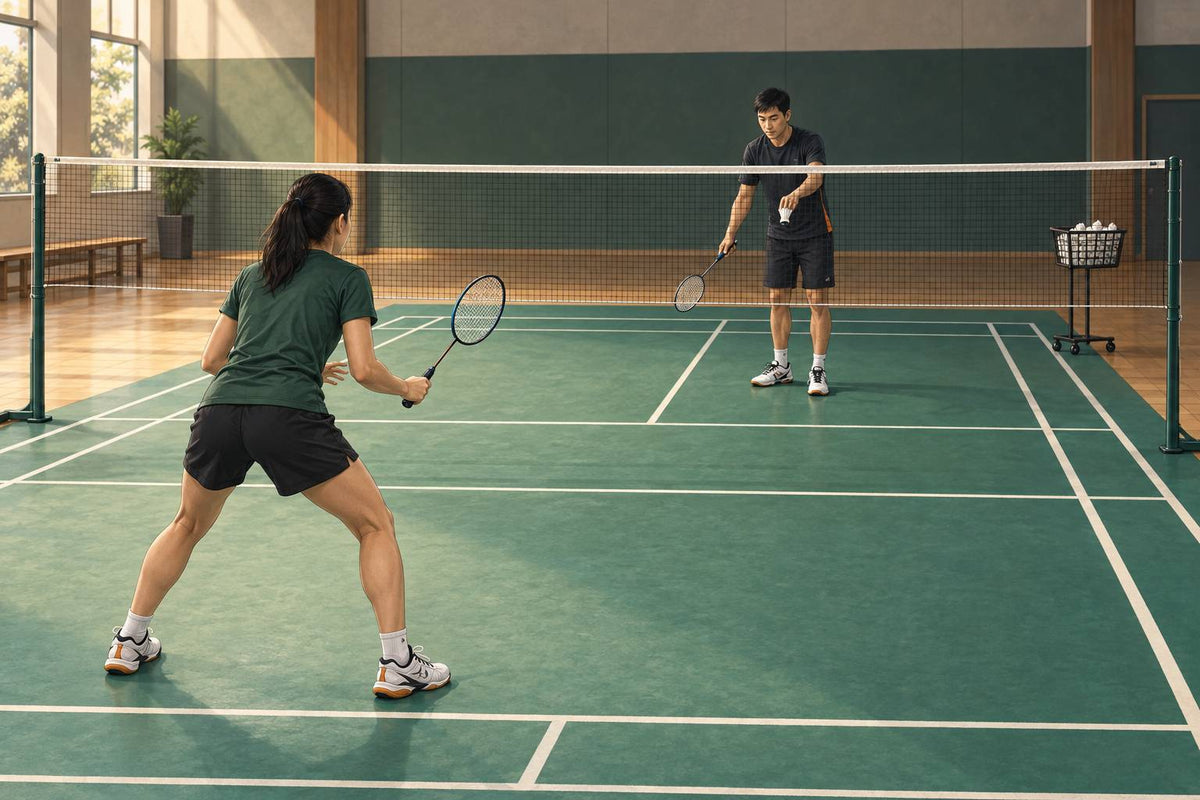
Have a partner call or point to random corners when your basic pattern is clean; this adds game-like uncertainty without needing a shuttle.
You can know the right shot and still arrive late. For many club players, the problem is not effort — it is footwork that only gets practised when a shuttle is already flying. Shadow badminton footwork fixes that by removing the shuttle, so you can isolate the movement pattern first: split step, move to an imaginary shot, lunge or jump, recover to base, and repeat.
The goal is not to jog around an empty court. Good shadow work should feel close to rally speed, with clean balance, a low base, and consistent recovery after every corner. A simple six-corner routine covers the two net corners, two midcourt sides, and two rear corners — enough to train the same movement map you need in singles, doubles defence, and long Canadian club-night rallies.
This guide shows how to structure shadow badminton footwork so it actually transfers to play: what it trains, how to run the six-corner pattern, the split-step and lunge cues that matter, how to set tempo and rest, and how to practise safely in a gym or open space when you do not have a court booked.
Train the movement, protect the landing. Repeated split-steps and lunges need proper non-slip indoor court shoes; browse our CAD-priced badminton footwear collection and check current availability before your next footwork block.
In This Guide
What Shadow Badminton Footwork Trains
Shadow badminton footwork is footwork practice without a shuttle. Instead of chasing a real shot, you move to imaginary shots around the court so you can isolate the movement first: how you start, how you step, how you stay balanced, and how consistently you recover.
That isolation is the point. When there is no shuttle to save, you can stop guessing and pay attention to the parts of movement that usually get hidden during rallies: clean steps, a stable landing, a balanced body position, and a quick return to your base. If you are still learning the basic movement patterns, start with our broader badminton footwork basics guide first, then use shadow work to repeat those patterns with more intent.
Think of shadow work as movement practice, not empty running. The goal is to make every imaginary shot look like a real rally movement: alert start, efficient travel, controlled balance, and recovery for the next ball.
Because shadow drills require almost no equipment, they are one of the easiest ways for Canadian players to train outside normal court time. You only need enough safe space to move, and a racket is optional. You can do it alone by choosing your own directions, or with a partner who calls or points to directions so the drill becomes more reactive.
Done properly, shadow badminton trains more than your legs. It improves reaction time, footwork coordination, agility, and overall court movement because you are repeatedly solving the same problem badminton asks in every rally: leave base quickly, arrive under control, and be ready for the next shot.
The most useful mindset is simple: move as if the shuttle is real. Keep your head up, stay balanced, and make the recovery just as important as the first step out. That is how no-shuttle training starts to transfer into cleaner movement in games.
The Six-Corner Shadow Routine
The easiest way to structure shadow badminton footwork is to map the court into six targets: the two net corners, the two midcourt sides, and the two rear corners. From your base, every rep sends you to one of those targets, then brings you back to base before the next movement starts.
Set your base slightly behind the centre of the court or open space. That small adjustment matters: if you stand too far forward, the rear corners become rushed; if you stand too far back, the net corners turn into long reaches instead of controlled movements.
| Zone | Target in the routine | What you are simulating |
|---|---|---|
| Front left | Left net corner | A net shot, lift, or loose shuttle near the tape. |
| Front right | Right net corner | The same net movement on the opposite side. |
| Side left | Left midcourt side | A drive, push, or side-defence movement. |
| Side right | Right midcourt side | A quick defensive or flat-rally recovery to the other side. |
| Rear left | Left back corner | A clear, drop, smash, or round-the-head preparation depending on your pattern. |
| Rear right | Right back corner | The rear-court movement on the opposite side. |
Core repetition
- Start from base, slightly behind centre.
- Make a split step before you move.
- Explode to one corner with purposeful footwork.
- Finish the corner with a lunge or jump, depending on the target.
- Recover quickly back to base.
- Repeat to the next corner.
That split step is the difference between real shadow badminton footwork and simply running around a court pattern. It is the small loading movement that lets you push off quickly instead of starting from a dead standstill. If the timing piece feels unclear, read our full guide to badminton split step timing before adding more speed.
For the first few rounds, move through the six corners in a fixed order so the map becomes automatic. Once the pattern feels clean, mix the order or have a partner point to corners so the drill starts to feel more like a rally instead of choreography.
Technique Cues: Split Step, Lunge, Recover
Shadow badminton footwork only works if each movement has the same rhythm you would use in a rally: prepare, load, move, reach, and recover. If you skip those details, the drill turns into court jogging. The goal is not just to visit six imaginary corners; it is to rehearse the exact body positions that let you move fast without losing balance.
Movement checkpoint: every direction change should begin with a split step, finish with a controlled lunge or jump, and end with a push back to base before the next corner.
1. Split step: load before you move
The split step is the small drop or hop that happens just before you move. Think of it as loading your legs like a spring: your feet land, your knees and hips are ready, and the bounce from the landing helps you push quickly toward the next corner.
In a real rally, the split step is anticipatory. You start it as the opponent is hitting, before you know the exact shot. In shadow work, copy that timing by splitting before every imaginary feed, not after you have already decided where to run.
- Stay athletic: feet a little wider than shoulder width, knees soft, chest balanced over your base.
- Drop quickly: avoid a tall jump. A quick drop gives you a faster push-off than floating upward.
- Use the bounce: land and push in one rhythm instead of landing, pausing, and then moving.
- Land ready for the direction: when possible, let the foot farthest from the target land slightly first so it can help drive you across.
A useful self-check: if your split step makes you feel heavier or slower, it is probably too high, too late, or too wide. The split should make the first step easier, not add an extra movement.
2. Lunge: reach the corner without collapsing
For front and side-court corners, the final step should be a stable lunge toward the target. Stay low, keep your head up as if tracking the shuttle, and place the last step where you can both reach the shot and push back to centre. A lunge that reaches the corner but leaves you stuck is not a good badminton lunge.
Use these cues as you shadow each corner:
- Final step toward the target: the last lunge step should travel in the direction of the imaginary shuttle, not across your body.
- Knee aligned over the foot: keep the knee tracking in the same direction as the foot so the leg stays stable.
- Stay low and balanced: a low centre of gravity helps you reach without tipping forward.
- Head up: do not stare at the floor. Train the posture you need in a rally.
- Push back from the lunge leg: the lunge is not the finish; the recovery starts immediately from that loaded front leg.
| Cue | What it should feel like | Common mistake |
|---|---|---|
| Split first | A quick load before every corner, followed by an immediate push-off. | Starting from flat feet or walking into the corner. |
| Stable lunge | A wide, low final step with the knee aligned over the foot. | Letting the knee drift or extend far past the toes. |
| Correct lead leg | For standard front-corner lunges, the racket-side leg leads so the body stays connected and balanced. | Lunging with the non-racket leg and collapsing through the core. |
| Recover immediately | Push back to base as part of the same movement, not as an afterthought. | Reaching well, then standing up or admiring the imaginary shot. |
3. Recovery: return ready, not upright
After the lunge or rear-court movement, recover to your base with quick steps and an athletic posture. The base should leave you ready to cover the next front, side, or rear corner. If you return tall with straight legs, you will need to sink again before moving, which wastes time.
Keep the recovery compact: push off the floor, bring the feet back under you, and arrive in a position where another split step feels natural. Good shadow badminton footwork has no dead time between the corner and the next preparation.
Self-check for Canadian gym sessions
- Can you hear heavy heel slaps on every lunge? Soften the landing and control the final step.
- Does your head dip toward the floor? Keep your eyes up as if reading the shuttle.
- Do you pause after reaching the corner? Start the push back to centre immediately.
- Do your knees cave inward or drift far forward? Slow down and rebuild the lunge shape before adding speed.
- Are you skipping the split step when tired? End the set or reduce the pace; do not practise slow habits.
If you are newer to court movement, pair these cues with the broader movement patterns in Badminton Footwork Basics. Shadow work becomes much more useful when the split step, lunge, and recovery are treated as one connected skill instead of three separate actions.
Sets, Tempo, and Rest Structure
Shadow badminton footwork works best when it is treated like a real training set, not casual movement between rallies. Start from base, split-step, move with intent, recover cleanly, then go again. The goal is controlled speed: close enough to rally pace that you are pushing hard off the floor, but not so rushed that your split-step, lunge, or recovery falls apart.
A good shadow set often runs longer than most rallies. That is the point: you are teaching your legs to keep producing sharp starts, stable lunges, and fast recoveries even after the easy speed has faded.
Training checkpoint. Proper shadow work should feel like badminton, not jogging. If the drill is honest, many players will be breathing heavily after 1–2 minutes while still trying to keep clean technique.
| Training focus | How to structure the set | What to watch |
|---|---|---|
| Speed | Use short, sharp bursts. A speed variation can be about 10–20 reps per set, up to 10 sets total. | Explosive first step, no drifting through base, and full recovery before the next rep. |
| Stamina | Cycle all six corners repeatedly: front-left, front-right, side-left, side-right, rear-left, rear-right, then repeat. | Keep the split-step alive even when tired. Straight legs and skipped recovery steps are signs the set is too long or too fast. |
| Reaction | Have a partner randomly call or point to corners so you cannot pre-plan the route. | Head up, balanced landing, and no guessing before the signal. The split-step should prepare you to move either way. |
Rest enough to keep the movement useful
Rest should protect quality. If your lunge starts landing heavily, your base recovery gets lazy, or you stop split-stepping before each move, the drill has stopped training the movement you want. Take enough recovery to make the next set sharp again, especially during speed and reaction work.
For stamina-focused sessions, link shadow work with broader conditioning instead of treating it as random extra cardio. If you are building a weekly plan around longer rallies, see our badminton stamina and fitness guide for how court movement fits into endurance training.
A simple session template
- Warm-up shadow: move at controlled pace first so the split-step, lunge, and recovery pattern feel clean.
- Main work: choose one focus for the day: speed, stamina, or reaction. Do not try to max out all three in one block.
- Quality check: stop a set when you can no longer push off the floor properly or return to base under control.
- Finish easy: slow the final movements down and reinforce smooth foot placement rather than ending with sloppy reps.
Because repeated split-steps and lunges put real load through your feet, ankles, and knees, do this work in proper non-slip indoor court shoes. Canadian players can browse our badminton footwear collection; stock can change, and orders over $200 ship free within Canada.
How to Use Shadow Work in a Gym or Open Space
You do not need a full badminton court to practise shadow badminton footwork. A proper court is ideal because the lines give you clear targets, but the drill can also work in a school gym, condo fitness room, basement open space, or any safe indoor area with enough room to split-step, move, lunge, and recover.
The key is not the exact size of the space. The key is preserving the badminton movement pattern: start from base, split-step, move on the correct angle, finish the imaginary shot shape, then recover back to base before the next movement.
Small-Space Rule
Shrink the court, not the technique. Keep the split-step, low body position, clean lunge shape, and recovery to base even when the corners are closer together.
Scale the Court Lines to the Space You Have
If you are on a badminton court, use the real six corners: two net corners, two midcourt side-defence positions, and two rear corners. If you are off court, simplify those same lines into a smaller map. Your “front corners” may only be one or two lunges away, your “rear corners” may be a short chasse and turn, and your “side” positions may be reduced to a compact defensive step.
This is especially useful in Canadian winter training, when court time can be limited and players may be using a school gym, community centre, or open indoor floor between club sessions.
| Space | How to Adapt the Drill | What to Keep |
|---|---|---|
| Full court | Use the real six-corner pattern from base: front left, front right, side left, side right, rear left, rear right. | Full distance, full recovery, and realistic court angles. |
| Half court | Train one side at a time: front corner, side defence, rear corner, then switch sides. | The same base-to-corner-to-base rhythm, without crossing into another player’s area. |
| Small open space | Compress the corners closer to your base and make the angles simpler, especially for beginners learning the pattern. | Split-step first, stay balanced, and recover fully before the next imaginary shot. |
| Narrow lane | Emphasize front-and-rear movement first, then add small side-defence steps only if the space stays safe. | Clean stopping, controlled lunges, and no drifting out of your training area. |
Use Smaller Angles Without Turning It Into Jogging
When the space gets smaller, the drill should become more precise, not more casual. Keep your base position slightly behind centre, hold your head up as if tracking the shuttle, and move with the fewest useful steps you can manage while still recovering under control.
- Front-court shadow: make a compact split-step, move diagonally forward, finish with a stable lunge shape, then push back to base.
- Side-defence shadow: keep the move short and sharp, as if covering a flat drive or body smash, then reset to base instead of drifting sideways.
- Rear-court shadow: practise the turn and recovery path even if you cannot travel the full rear-court distance.
- Beginner scaling: simplify the lines first so the angles make sense, then gradually increase the distance as your balance and recovery improve.
Do Not Mix Up Shadow Work With Other Solo Drills
Shadow work is its own training method. It isolates badminton movement without a shuttle, so you can master the footwork before layering in real shots. That is different from wall rally practice, where the goal is to hit repeated shots against a wall, and different again from ladder or cone training, where the focus is usually foot speed, coordination, or pre-set agility patterns.
All three can help your game, but they solve different problems:
- Shadow badminton footwork: best for rehearsing badminton-specific movement paths, split-step timing, lunges, turns, and recovery to base without chasing a shuttle.
- Wall rally practice: best when you want a solo hitting session that gives you repeated contact and rhythm. For that method, use the separate badminton wall rally drills guide.
- Agility ladder and cone drills: best when you want a structured foot-speed or coordination session away from the court. For that method, use the separate badminton agility ladder and cone drills guide.
A good training week can include more than one solo method, but keep the purpose clear. If today’s goal is badminton movement quality, shadow work should look like badminton: split-step, move to a meaningful court target, recover to base, and repeat with intention.
Shoes and Safety for Repeated Split-Steps and Lunges
Shadow badminton footwork looks simple because there is no shuttle, but your legs still absorb repeated split-steps, push-offs, braking steps, lunges, and recoveries. That makes footwear a safety item, not just a comfort upgrade.
The biggest shoe-related risk is the lunging foot sliding out as you reach the front court or side defence corner. Proper non-slip indoor badminton shoes help keep that foot planted; slipping on the lunge is a major cause of ankle and knee injuries.
Training footwork at home or in a gym? Check the Badminton House footwear collection for indoor court shoes priced in CAD. Badminton House ships free within Canada on orders over $200.
What to check before you start shadow footwork
- Grip on the floor: On a clean indoor surface, your shoe should let you push hard without sliding. If you feel your front foot drift during lunges, stop the drill and fix the surface or footwear before continuing.
- Indoor-only outsole: Use non-marking indoor court shoes for gym floors and badminton courts. If you are unsure what counts, see our non-marking badminton shoes guide.
- Lateral support: Shadow drills are full of side pushes and recoveries. A shoe that feels fine for straight-line running may not feel stable when you split-step, push sideways, and brake into a lunge.
- Fit during braking: Your foot should not slide forward inside the shoe when you lunge. If your toes jam the front on every front-court rep, the fit or lacing needs attention.
- Floor condition: Dusty gym floors reduce traction. Wipe the outsole, choose a cleaner area, or lower the tempo until the grip is safe.
Safety cues for repeated split-steps and lunges
Good shoes help, but they do not replace clean mechanics. Keep the split-step light and elastic, then land the lunge with the knee tracking over the foot so you can push back to base instead of collapsing forward.
- Do not land heavily on the heel. Heavy heel landings and letting the knee travel far past the toes can strain the knee and throw off balance.
- Use the correct lunging leg. For standard forehand-side front-court lunges, players commonly use the racket-side leg so the body stays stable and the racket reaches forward naturally.
- Stay low, but not stiff. Straight legs make shadow work slow and increase impact. Keep the legs loaded so each split-step becomes a spring into the next corner.
- Stop when form breaks. If your recovery step gets sloppy, your knee caves inward, or your front foot starts sliding, end the set and rest.
| Warning sign | What to do |
|---|---|
| Lunging foot slips forward or sideways | Stop the set, clean the outsole or floor, and switch to proper non-slip indoor court shoes before increasing intensity. |
| Knee collapses inward on the lunge | Slow the drill down and focus on knee-over-foot alignment before returning to rally-speed sets. |
| You are breathing hard after 1–2 minutes | That can be normal for proper high-intensity shadow work. Use controlled rest so the next set stays sharp instead of sloppy. |
| Ankle or knee discomfort builds during the session | End the drill and reduce load next time. For more prevention context, read our badminton ankle sprain guide and knee pain badminton guide. |
Why this matters even when there is no shuttle
Because shadow badminton removes the shuttle, many players push the tempo harder than they would in a casual rally. That is useful for building speed and stamina, but it also means every split-step and lunge is repeated many times in a short window. A 2024 biomechanics study found that split-step technique significantly affects lower-limb mechanics in badminton lunges, with potential benefits for performance and injury-risk reduction.
If you are still using running shoes for indoor badminton movement, make footwear your first safety upgrade before adding more sets. For a deeper comparison, read Badminton Shoes vs Running Shoes. If a specific model in your size is not currently available, check Canadian badminton specialty retailers or your local club’s pro shop rather than training high-volume lunges in shoes that slide.
Which Shadow Footwork Format Should You Choose?
Choose the shadow badminton footwork format based on what you want the session to train. The same basic movement loop still applies: start from base, split-step, move to the imaginary shot, lunge or jump, then recover to base before the next movement.
| Choose this format | Best for | How to use it | Avoid this mistake |
|---|---|---|---|
| Six-corner repeat | Stamina and sustained movement quality. | Cycle through the two net corners, two midcourt sides, and two rear corners, then repeat using the tempo and rest structure from the Sets, Tempo, and Rest Structure section. | Do not let it turn into jogging. Proper shadow work should stay close to rally speed and include a split-step before each move. |
| Partner-called corners | Reaction training and more game-like randomness. | Have a partner point or call the next corner so you cannot pre-plan the full pattern. | Do not wait flat-footed. The split-step is anticipatory, so you should be loaded and ready to move rather than starting from a standstill. |
| Solo random corners | Training alone in a gym, open space, or spare court area. | Pick corners yourself, but keep the movement honest: head up, recover to base, then commit to the next direction. | Do not drift around casually. Focus on the fewest useful steps, fast recovery, and a base position slightly behind centre. |
| Technique cleanup | Fixing split-step timing, lunge balance, and recovery habits before adding a shuttle. | Slow the drill enough to feel the loading action of the split-step and the push back from the lunge, then build speed without losing shape. | Do not lunge with the wrong leg, collapse through the knee, or land heavily on the heel. |
| Warm-up shadow work | Preparing for a main training session without dedicating the full workout to footwork. | Use shadow footwork before your main session to rehearse clean movement patterns and wake up the legs. | Do not skip the split-step just because it is a warm-up. That is the movement trigger the drill is trying to build. |
| Small-space version | Canadian players training off-court when a full court is not available. | Scale the court lines down and keep the angles clear, especially for beginners learning where the six movement directions are. | Do not shorten the drill by standing tall or skipping recovery. Even in a smaller area, every move should return you to a usable base. |
For high-repetition shadow sessions, use proper non-slip indoor badminton shoes so the lunging foot does not slide. Badminton House lists footwear in CAD in the badminton shoes collection; availability changes, so confirm live stock before choosing a model. Orders over $200 ship free within Canada.
Get Canadian badminton gear advice + restock alerts
Join the Badminton House list for buying checklists, restock alerts, and practical gear advice for Canadian players.
By subscribing, you agree to receive Badminton House emails and can unsubscribe anytime.
Shadow badminton footwork looks simple, but the details matter: split-step timing, clean lunges, quick recovery, and shoes that grip properly on indoor courts. We play badminton ourselves, so if you are unsure how to structure your drills or what court footwear makes sense for your training space, contact us and we will help you think it through.
Training footwork regularly? Start with proper indoor court support.
Browse badminton footwear in CAD and check current availability before your next shadow footwork block.
Shop Badminton FootwearFree shipping within Canada on $200+ · 14-day returns · Canadian badminton specialty shop


Leave a comment
This site is protected by hCaptcha and the hCaptcha Privacy Policy and Terms of Service apply.