
Last updated: July 2026 · Written by the team at Badminton House
Quick Answer: Badminton Match Video Analysis
Use a 15-minute review to turn one recorded match into one written pattern and one practice focus, instead of trying to build a complicated stats project.
15 min
Best choice: scan a short segment for score context, then check the first three shots, unforced errors, recovery, and one repeated pattern before choosing your next practice focus.
5 min
Use this when you are between games or short on time: review only serve, return, and third shot to see who is taking the attack first.
Coach
Share the clip with a coach or experienced player when the same mistake keeps showing up, but always follow your Canadian club or community centre’s filming rules and get player consent first.
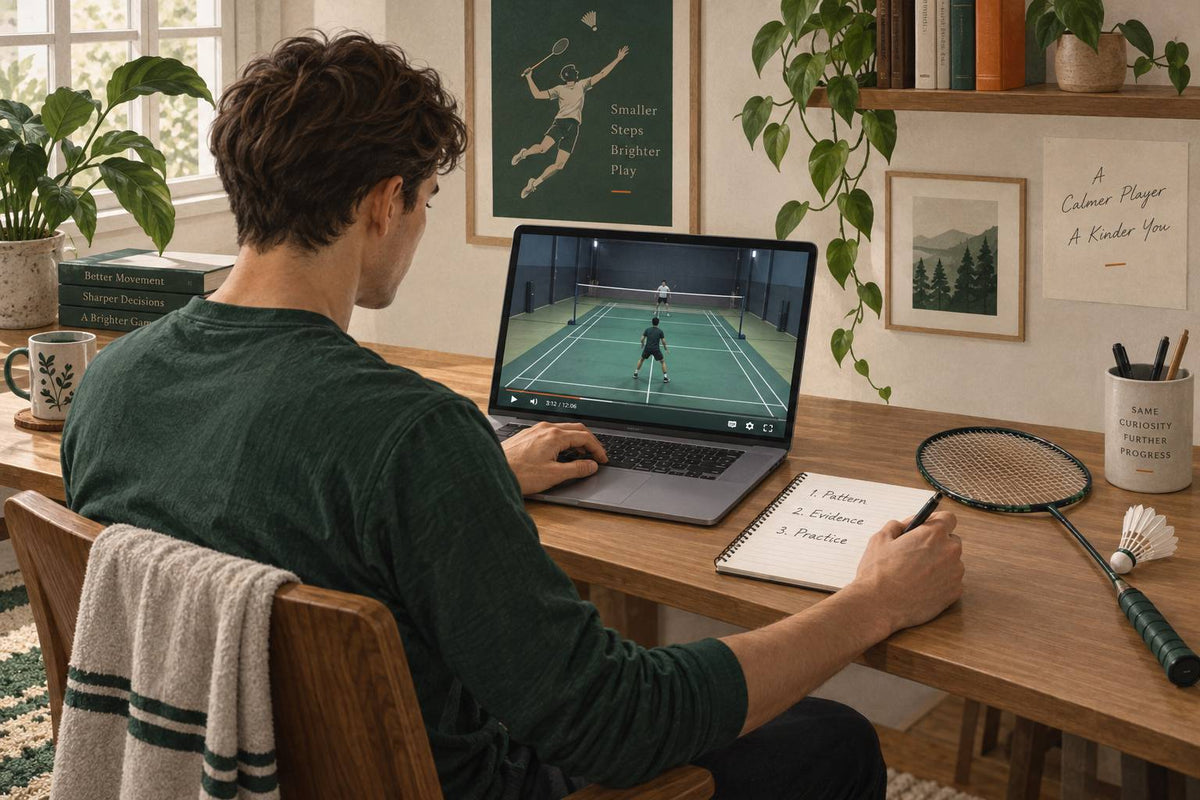
Before you film your next club match, make the setup boring: a phone on a stable, unobstructed tripod, placed where it can capture the whole court without blocking players, bags, walkways, or neighbouring courts. Ask the players on court, follow your venue’s photo/video rules, and avoid recording people who did not agree to be in the clip. Good badminton match video analysis starts there (safe footage, clear context, and no drama at the community centre).
The mistake is trying to review everything. You pause every rally, chase every technical flaw, and end up with a page of notes that never turns into practice. This guide keeps the review to 15 minutes: score context first, then the first three shots, unforced errors, recovery, positioning, and one repeated pattern.
Your goal is not a complicated statistics project. Your goal is one written takeaway you can actually use next session (for example, “my return of serve is too loose under pressure” or “I hit and watch instead of recovering to base”). That is enough to make your next practice sharper.
Want a second set of eyes? If your video review points to racket setup, strings, or a practice-plan question, send us a note through Badminton House contact and we’ll help you think through the next step without overcomplicating it.
In This Guide
- Set Up Badminton Match Video Analysis Safely
- Minute 0–3: Watch Once for Score Context
- Minute 3–7: Review the First Three Shots
- Minute 7–10: Sort Unforced Errors by Context
- Minute 10–13: Check Recovery and Positioning
- Minute 13–15: Find One Pattern and One Practice Focus
- Decision Helper: Which Video Problem Should You Choose First?
Set Up Badminton Match Video Analysis Safely

You do not need a coaching-camera setup to start useful badminton match video analysis. A smartphone on a stable tripod is enough if the footage is steady, the full court is visible, and you can clearly see your movement before and after each shot.
Place the phone where it will not block walkways, benches, court entrances, or another court’s run-off space. For most club players, the best practical angle is behind the baseline or high enough at the back corner to capture both sides of the net, the sidelines, and your recovery steps between shots.
Simple recording checklist
- Use a stable, unobstructed tripod or phone mount so the camera does not shake or fall.
- Frame the whole court, not just the player hitting the shuttle.
- Check that your feet, recovery path, and base position stay in frame.
- Record one game or one short match segment first; a 15-minute review is easier when the clip is not overwhelming.
- Keep the setup away from loose shuttles, bags, water bottles, and court traffic.
Before you press record, handle the etiquette properly. Follow your facility’s photo and video policy, ask the players on your court for consent, and avoid capturing people on nearby courts or in the background if they have not agreed to be filmed. Many Canadian clubs, school gyms, recreation centres, and community facilities set their own recording rules, so treat this as good club etiquette rather than legal advice.
If the venue allows recording, keep it low-key: set up quickly, confirm the frame before the warm-up ends, and then forget about the phone until the match is done. The goal is not to create perfect footage. It is to capture enough of the rally, footwork, and court position to make the next 15 minutes of review useful.
Minute 0–3: Watch Once for Score Context
Start with a short match segment or a quick scan of the score changes. A full match will not fit into this three-minute block. Do not pause every rally, count every shot, or build a spreadsheet yet. For the first three minutes, your job is simply to understand when the match changed: early lead, mid-game run, tight finish, or a stretch where one player stopped scoring.
This matters because the same mistake means different things at different scores. A loose lift at 4–4 may be a small technical miss. The same loose lift at 19–19 may tell you more about nerves, shot selection, or whether you trusted your usual pattern under pressure. If you need a quick refresher on rally scoring, intervals, and deuce situations, use our badminton rules and scoring guide before reviewing the clip.
Your 3-Minute Score Context Pass
- Watch a selected short segment without pausing. Use the score and rally flow to identify a stretch worth reviewing.
- Mark only score swings. Note any run of points, missed chance to close a gap, or late-game moment where your decisions changed.
- Ignore technique details for now. Save serve returns, unforced errors, recovery, and patterns for the later parts of the 15-minute review.
- Write one context line. Keep it short enough that you can use it before your next Canadian club night, league match, or practice session.
A good context line sounds like this: “I was fine until 12–12, then lost four points by rushing the rally.” Or: “At 18–16 up, I stopped serving with purpose and gave away the attack.” That single sentence gives the rest of your review a target. You are no longer asking, “Was I bad?” You are asking, “What changed at the score that mattered?”
Keep the note plain and honest. If you won, look for the stretch where you created separation. If you lost, look for the stretch where the opponent took control. Once you have that score context, the next part of your badminton match video analysis can focus on the first three shots instead of drifting into random comments about every rally.
Minute 3–7: Review the First Three Shots

Now rewind to the start of a few rallies and study only the serve, the return, and the third shot. Do not judge the whole point yet. In badminton match video analysis, these first three contacts are often where the rally’s attack-defence shape is decided: who gets to hit down, who has to lift, and who is already late.
This is especially useful for club players because many casual and amateur rallies end inside those first three hits. If you can clean up your serve pattern, return choice, and first follow-up shot, you can improve a match without changing every stroke in your game.
Use a simple three-shot note
Pick five to eight rallies from the match. For each one, write one short line using this format:
Serve → return → third shot → who gained the advantage?
Example: low serve → pushed flat to backhand hip → late lift → receiver attacked.
Then ask the key review question: “How do I want the next 3 shots to ideally work out?” That keeps the analysis practical. You are not just saying “bad serve” or “good return”; you are checking whether your first shot set up the next two.
| Shot | What to watch on video | Useful note |
|---|---|---|
| Serve | Was it tight, too high, predictable, or aimed to a clear target? | Mark the serve type and whether it created pressure or gave it away. |
| Return | Did the receiver lift, push, net, drive, or attack the serve? | Returns rarely need to be outright winners; they need to be played with purpose and prepare the next shot. |
| Third shot | Did the server’s side attack, stay neutral, or immediately defend? | This is where you see whether the serve plan actually worked. |
Singles: compare your serve choices
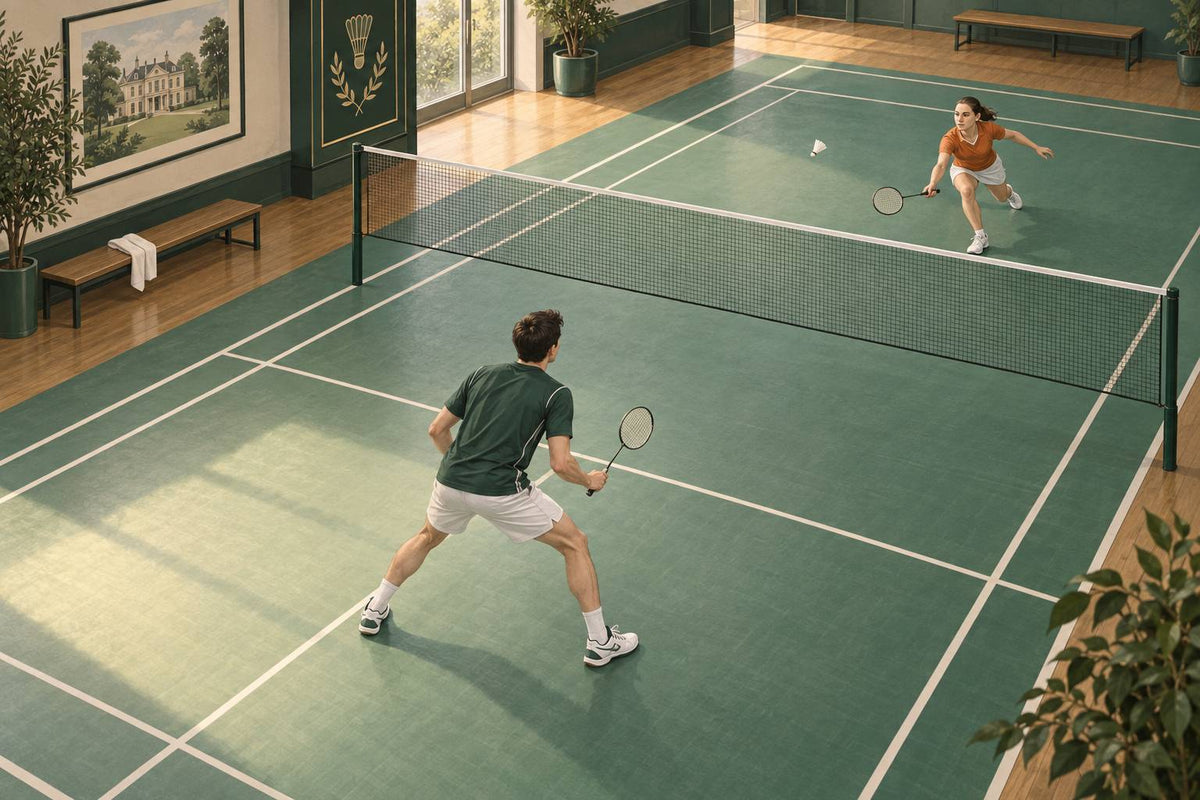
Singles serving is not the same problem as doubles serving. In singles, high serves and low serves are both useful most of the time, while flick serves are better saved for a specific reason (for example, when an opponent is rushing your low serve or has shown a weakness moving back).
On the video, compare what happens after different serves. Does your high serve give you time to get set? Does your low serve draw a loose lift, or does it let your opponent take the shuttle early? If you serve low, pay attention to whether the receiver lifts, plays the net or pushes past you, and whether you are ready for the next shot.
If your serve mechanics are the issue, keep this review narrow and pair it later with our badminton serve guide. For this 15-minute review, your goal is simply to notice which serve gives you the best first-rally position.
Doubles: check who wins the net pressure first
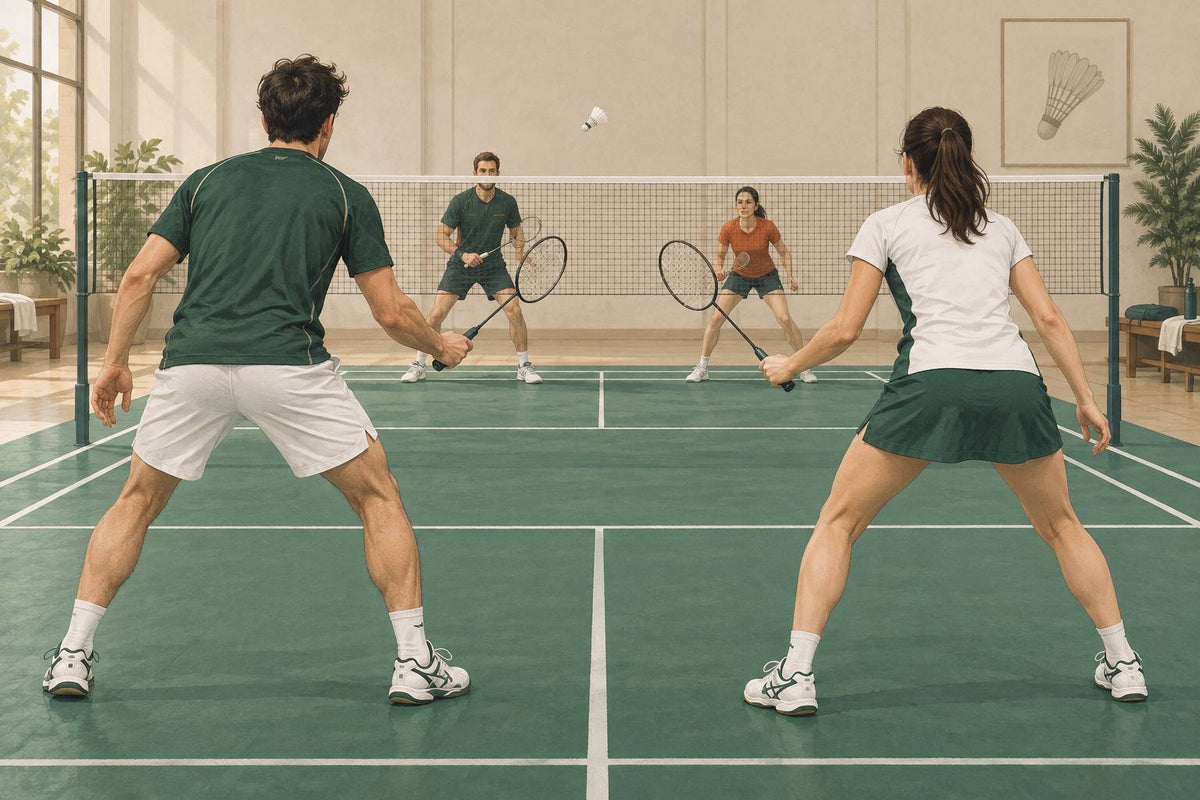
In doubles, the first three shots are even more direct. The serve, return, and first shot after the return can shift the advantage immediately. A loose low serve gets attacked. A soft return may let the serving pair step forward. A late third shot can force your side into defence before the rally has really started.
Watch for these three doubles patterns:
- Your serve is too high: the receiver attacks down or drives before your partner can help.
- Your return is too passive: the serving pair gets the first downward shot.
- Your third shot is rushed: you serve well, but the follow-up is lifted or pushed loose because you were not ready.
For a deeper look at receiving patterns, use this alongside our badminton doubles return of serve guide. Many Canadian club nights are doubles-heavy, so this is one of the fastest areas to review if you play drop-in, league, or ladder matches.
The four-minute takeaway
By the end of minute 7, write one sentence, not a full report. Good examples are:
- “My low serve is fine, but I am not ready for the push return.”
- “In singles, my high serve gives me better shape than my rushed low serve.”
- “In doubles, our return is too safe and lets the serving pair attack first.”
That one sentence becomes a strong candidate for your final practice focus. If the first three shots keep deciding rallies against you, fix this before chasing more complicated tactics.
Minute 7–10: Sort Unforced Errors by Context
Now resist the temptation to count every mistake. For a 15-minute badminton match video analysis, the useful question is not “How many errors did I make?” It is “Which errors are repeating in situations I can actually train?”
This matters because match outcomes are strongly linked to the balance between winners and unforced errors. An analysis of all 57 men’s singles matches at the 2016 Olympics found that winning players made significantly more winner points, while losing players made significantly more unforced errors. The same analysis associated more than 10 winner points and fewer than 5 unforced errors with a high chance of winning in that sample; those thresholds are not a universal target for club players.
Three-minute task
Mark only the unforced errors that show a pattern: critical-stage errors, repeated return-of-serve misses, and mistakes caused by low margin or late racket preparation.
Use three labels, not a full spreadsheet
Create a short note beside each important error. Keep the label simple enough that you can write it while scrubbing through the video:
| Label | What to mark | Practice meaning |
|---|---|---|
| Critical | An unforced error at an important stage of the match, especially when the rally did not require a risky shot. | Train safer targets and better shot selection under score pressure. |
| Return | A repeated missed return of serve, weak return, or rushed return that gives away the rally too early. | Build a safe return first, then add sharper options once the basic return is reliable. |
| Prep | A late contact, framed shot, net error, or sideline miss where your racket was down or your preparation looked rushed. | Improve racket readiness so you are not lifting the racket from too low after the shuttle is already arriving. |
Separate “bad choice” from “bad execution”
When you see an error, pause for one second and decide which problem it was:
- Bad choice: you aimed for a perfect line, a tight net tape shot, or a low-percentage attack when a safer shot would have kept the rally alive.
- Bad execution: the idea was fine, but your racket preparation, contact timing, or body position made the shot unreliable.
- Opponent pressure: the opponent created the mistake by forcing you late, wide, or off balance. Do not count every pressured miss as the same type of unforced error.
The key consistency cue is margin. Instead of trying to paint every line or shave every shot over the tape, aim just inside the court and just above the net. That small buffer reduces unforced errors without asking you to play passive badminton.
Pay special attention to return-of-serve errors
A repeated return-of-serve miss is one of the easiest patterns to fix because it happens from a predictable starting point. If your video shows two or more similar return problems, write the exact pattern rather than a vague note like “bad returns.”
Better note: “Backhand return into net when rushed” is useful. “Too many mistakes” is not.
For doubles players, this connects naturally to the first-three-shots review because serve, return, and the first shot after the return often decide who attacks first. If return patterns keep showing up in your notes, compare your video against the ideas in our badminton doubles return of serve guide.
Look for racket preparation before judging the swing
Many errors look like “bad technique” at full speed, but the video may show a simpler cause: the racket starts too low or too late. If your racket is down while the shuttle is already coming, you spend the next moment lifting the racket instead of preparing the shot. That can make you contact the shuttle later and under more pressure.
On your notes, write “prep” when the miss appears connected to late readiness. Then your practice focus becomes clearer: start with a better ready position, earlier racket lift, and more relaxed preparation before trying to change the whole stroke.
End this block with one error pattern
At the end of minute 10, choose one pattern only. For most Canadian club players reviewing after a league night or drop-in session, one clear fix is more valuable than a long list you never train.
- If the pattern is critical-stage errors: your practice focus is safer targets with more margin over the net and inside the lines.
- If the pattern is return-of-serve misses: your practice focus is a reliable safe return before adding riskier replies.
- If the pattern is late preparation: your practice focus is earlier racket readiness before the shuttle crosses into your hitting zone.
That single pattern feeds directly into the next review block, where you check whether your recovery and court position are creating the errors in the first place.
Minute 10–13: Check Recovery and Positioning

Now watch the same rallies with your eyes mostly on your feet, not the shuttle. The mistake you are looking for is the spectator habit: you hit, admire the shot, and stay planted where you made contact. On video, it usually looks like a pause after impact, then a late scramble when the opponent replies.
After every shot, your default should be to recover toward a useful base position: usually the centre of the area you are responsible for, or the “T” area in singles. You are not trying to stand perfectly in the geometric centre every time. You are trying to be balanced, ready, and close enough to cover the most likely next shot.
What to mark in your notes
- Rooted after contact: Did you hit and watch instead of pushing back toward base?
- Late split step: Were you still moving or standing tall when your opponent struck the shuttle?
- Overreaching: Did you lunge with your upper body instead of moving your feet into position?
- Wrong base: Were you recovering to the same spot even when your opponent kept using one predictable strength?
- Balance after the shot: Could you change direction immediately, or did the shot leave you falling forward, sideways, or backward?
A simple way to review this section is to pause the video just after you hit. Ask: “If my opponent plays the most likely reply, am I already moving toward the right base?” If the answer is no, write down the shot that caused the problem. For example: “forehand rear-court clear — stayed in back corner,” or “net shot — leaned in and could not recover.”
Do not make the base-position idea too rigid. If your opponent keeps playing a predictable shot, you can shade your base toward that threat. For example, if they repeatedly use a cross-court drop, your recovery can move slightly forward and toward that cross-court side. The more predictable the pattern, the more you can adjust your base. The key is that the adjustment is intentional, not just drifting because you are tired.
| What you see on video | Likely issue | Practice cue |
|---|---|---|
| You hit from a corner and remain there | Spectator habit | “Hit, push, recover” before watching the result |
| You reach far with the racket arm and lose balance | Overreaching instead of moving the feet | Move first, then strike from a stable base |
| You recover to the middle but still get beaten by the same shot | Base is too neutral for a predictable opponent | Shade the base toward their favourite reply |
| You are still drifting when the opponent contacts the shuttle | Recovery timing is late | Recover earlier and split as they hit |
For singles players, this check connects directly to court coverage: after you play a shot, recover toward a central base that lets you cover the whole court. For doubles players, the idea is similar, but your “base” depends on the formation and rotation with your partner. Either way, the video should show a clear recovery action after contact, not a frozen finish.
If you are reviewing footage from a Canadian club night or community-centre drop-in, this is one of the easiest improvements to spot because the camera does not need a perfect angle. Even a safe phone recording from behind the court will usually show whether you are recovering, pausing, or overreaching.
Need the movement pieces behind this review? Use our badminton footwork basics guide for the core movements, then connect it with receive footwork and recovery so your first step after the serve or return is not late.
Minute 13–15: Find One Pattern and One Practice Focus
The last two minutes are where your badminton match video analysis becomes useful. Do not leave with ten corrections. Leave with one repeated pattern and one practice focus you can actually train next time.
Look for the point type that kept coming back: maybe your low serve got lifted often enough to start planning the next shot, your high serve gave you better time to set your base, or your opponent kept choosing the same reply under pressure. If an opponent becomes predictable, you can shade your base toward the expected area instead of standing neutrally every time.
Copyable 15-Minute Match Review Note
Score context:
I lost/won most points when the score was __________.

First-three-shot issue:
Serve, return, or third shot problem = __________.
Best question for next time: how do I want the next 3 shots to work out?

Unforced-error theme:
Most avoidable errors came from __________.
My safer margin is __________.

Recovery note:
After my shot, I was late because __________.
My base/recovery cue is __________.

Repeated pattern:
Opponent often chose __________ when __________.
My adjustment is __________.

Serving test:
Low serve outcome = __________.
High serve outcome = __________.
Next match, I will compare __________.

One practice focus:
For the next session, I will train __________ for 15–25 minutes.
Choose one focus, not five
A good focus is specific enough to run as a drill. “Improve singles” is too broad. “Low serve, expect lift, recover early for the third shot” is trainable. So is “reduce backhand net errors at 18-all by aiming with more margin” or “recover to base immediately after clears instead of watching the shuttle.”
For singles serving, make the next match a simple test: compare what happens after your low serves against what happens after your high serves. You are not trying to prove one serve is always better; you are checking which serve creates the rally shape you want against that opponent.
Turn the note into a session. Use this takeaway with our badminton practice session plan. If your focus needs lots of repetitions, check live availability for practice shuttlecocks; if your note points to racket control, timing, or power issues, check live availability in our badminton rackets collection.
For Canadian club players, this lightweight note is usually enough after a league night or drop-in match. Film safely, respect your venue’s recording rules, get consent from the players involved, then use the video to choose one better habit for the next time you step on court.
Decision Helper: Which Video Problem Should You Choose First?
After one 15-minute badminton match video analysis, pick the single row that explains the most lost points. If you are not sure, start with the first three shots because the serve, return, and third shot usually decide who is attacking and who is defending, and many casual or amateur rallies end inside those first three hits.
| Choose this focus | Your video shows | Why it matters | Your next practice focus |
|---|---|---|---|
| First three shots | You lose the advantage right after the serve, return, or third shot. | These shots set up the rally. In doubles, the serve, return, and first shot after the return are especially important for shifting advantage. | Write one simple plan: serve or return with purpose, then ask, “How do I want the next 3 shots to ideally work out?” |
| Unforced errors | You miss before the opponent has truly pressured you, especially on returns, clears, lifts, or routine net shots. | An analysis of all 57 men’s singles matches at the 2016 Olympics found that losing players made significantly more unforced errors. In that study, games with more than 10 winner points and fewer than 5 unforced errors had a high probability of being won. | Add margin: aim just inside the lines and just above the net. Keep your racket prepared so you are not lifting it late under pressure. |
| Recovery and base | You hit, watch the shuttle, and stay rooted where you finished the shot. You may also overreach and lose balance. | After each shot, you should recover toward a central base position so you can cover the court. Coaches commonly describe the same idea as returning quickly toward the “T” position to maintain control. | Practice hit-and-recover habits: after every shot, move back toward your base before watching where the next shuttle lands. |
| Repeated point pattern | The same serve response, lift, drop, or cross-court choice keeps appearing in lost rallies. | If an opponent becomes predictable, you can adjust your base toward the expected shot. Serving tactics also reward testing whether low serves or high serves create better responses. | Test one pattern on purpose: change the serve, return, or base position and compare what response you get. |
Once you pick the row, write one practice focus and stop there. If that focus needs a high-repetition feeding session, durable practice shuttles are the practical follow-up; check live availability in the shuttlecocks collection before your next club session.
Get 10% off your first order
Join the Badminton House list and we’ll email you a 10% welcome code — plus subscriber-only restock alerts, giveaways, and honest gear advice from players.
By subscribing, you agree to receive Badminton House emails and can unsubscribe anytime.
Use your 15-minute review to leave the gym with one clear practice focus, not a notebook full of vague corrections. We play badminton ourselves, so if your video keeps showing the same issue (late recovery, loose serve return, too many rushed clears, or a racket setup that does not match your training goal), contact Badminton House and we can help you think through the next step.
Turn your match notes into better practice reps.
If your analysis points to more serve-return, consistency, or rally-pattern work, check live availability on practice shuttlecocks from a Canadian badminton specialty shop.
Shop Shuttlecocks10% off first order · Free Canadian shipping on $200+ · Canadian badminton specialty shop

Leave a comment
This site is protected by hCaptcha and the hCaptcha Privacy Policy and Terms of Service apply.