
Last checked: August 2026 · Written by the player-led team at Badminton House
Quick answer
No badminton-specific, evidence-based replacement calendar was found for shoe insoles. Inspect the removable liner instead: replace it when it is worn through, torn, permanently creased, curled, delaminated, or no longer lies flat and fits securely inside an otherwise sound shoe.
Replace the insole: the removable layer is damaged or misshapen, and a compatible new liner restores a flat, secure fit.
Replace or assess the shoe: traction, the outsole bond, midsole platform, upper or heel hold has failed. A new insole cannot repair those components.
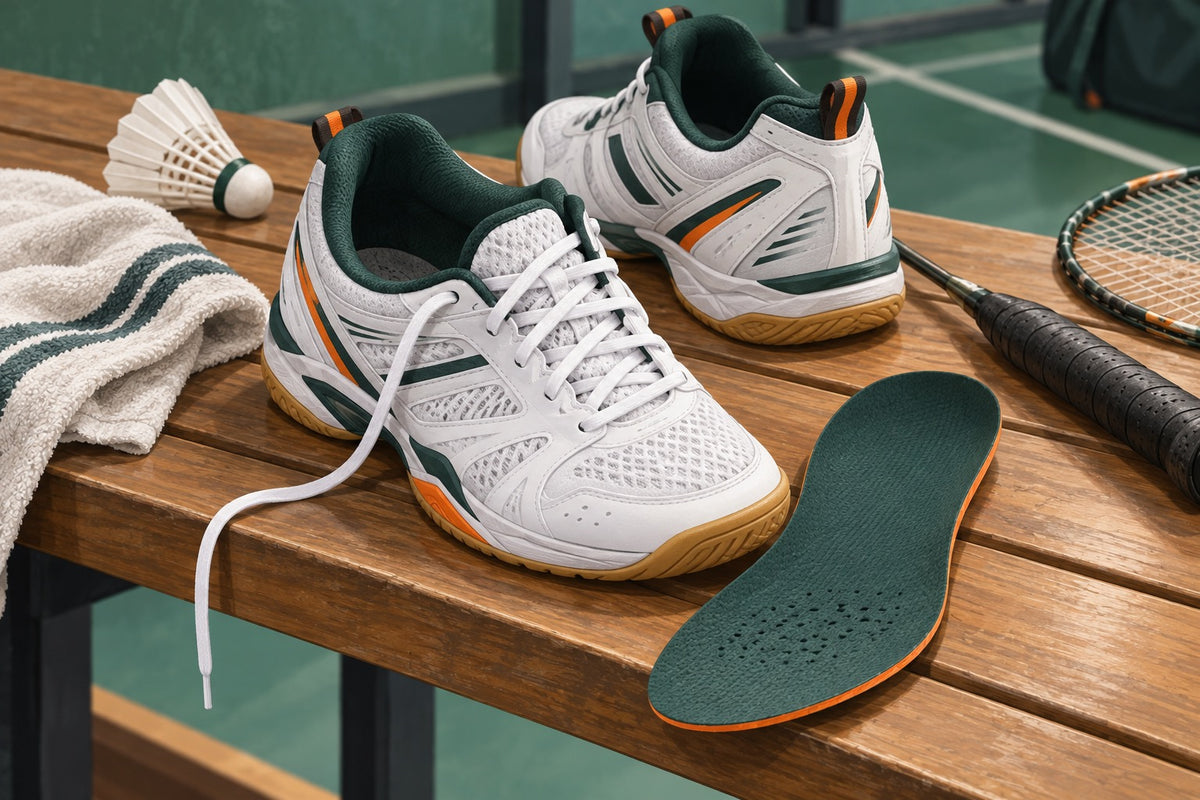
The removable insole is only one layer of a badminton shoe. It sits above the midsole, inside the upper and away from the outsole that contacts the court. Changing that layer can change contact under the foot, internal volume and heel position. It cannot rebuild compressed midsole material, restore worn tread or tighten a stretched upper.
Use this guide as a condition audit rather than an upgrade pitch. If your stock liner is intact, flat and comfortable, there may be nothing to fix. If you are deciding whether a different insert would solve a specific fit problem, compare that purpose with our guide to replacing the stock badminton shoe insole.
Why there is no reliable replacement calendar
No located badminton study establishes a number of months, sessions, court hours or kilometres at which a stock insole stops working. Players differ in body size, movement, session volume, socks, shoe fit, moisture exposure and the material used in the liner. Products sold under the same broad “insole” label also have different shapes and constructions.
A small primary study helps show why mileage alone is a weak rule. Researchers mechanically degraded three types of shock-absorbing insoles by an amount intended to represent 100–130 km of running, then tested them in military boots with nine participants. The simulated wear did not reduce their measured ability to attenuate peak plantar pressures. Two of the three types reduced heel and forefoot peaks compared with the no-insole condition.
That simulated-wear study was not about badminton, stock court-shoe liners, comfort, injury prevention or an eventual failure point. It does not prove that insoles last indefinitely. It shows that one distance number cannot be treated as a universal performance threshold.
Clinical orthosis guidance is also product-specific. The Dudley Group NHS guidance says prescribed orthoses should be reviewed when they are no longer functional or symptoms return rather than replaced solely because of age. Those devices are not the same as a factory liner, but the decision principle is useful: inspect the item that is actually in your shoe instead of copying a generic date.
A visible footprint is not a countdown
Darkened fabric or the outline of your toes shows where contact occurred. It does not, by itself, measure cushioning, support or remaining service life. Look for material failure, loss of flatness and a changed in-shoe fit.
A five-minute badminton insole condition audit
Audit both shoes together after they are dry. First confirm that the liner is intended to be removable. Lift gently from the heel. Do not tear out a layer that is firmly bonded to the shoe.
- Inspect the top surface: look for wear-through, holes, lifted fabric, split foam or an edge separating into layers.
- Inspect the underside: check for tears, missing material, permanent folds or debris embedded deeply enough to create a pressure point.
- Check shape: place the liner on a flat surface. A heel or edge that stays curled, a crease that will not release, or a section that buckles when pressed back into the shoe is a fit failure.
- Compare sides: different contact marks are normal, but a large difference in thickness or shape deserves a closer look at both the liner and the shoe beneath it.
- Reinstall it: the heel should sit fully back, the edges should lie flat and the toe should not ride up or bunch.
- Test the complete shoe: with your normal sock and lacing, check toe room, heel hold and pressure across the top and sides of the foot.
| Finding | Decision | What it does not prove |
|---|---|---|
| Surface marks only; liner remains intact and flat | Clean as directed, reinstall and keep using it if fit remains good | Marks do not measure remaining cushioning |
| Wear-through, delamination, tear or permanent crease | Replace the removable liner if the rest of the shoe passes inspection | Damage does not identify the cause of pain |
| New liner curls, bunches or crowds the foot | Refit or choose a compatible shape and thickness | A thicker liner is not automatically better |
| Shoe still slips, leans, separates or lacks reliable traction | Inspect or replace the whole shoe | An insole cannot repair another shoe component |
Flattening is a prompt to inspect, not a validated badminton performance score. If the liner looks lower but still lies flat and the shoe remains secure and comfortable, there is no research-backed thickness percentage that forces replacement. If the changed shape creates movement, crowding or an uneven contact point, the fit result gives you a practical reason to act.

What different insole types can—and cannot—change
“Insole” can describe several different products. Judge the physical change each one makes inside the actual shoe, not the strength of a support, cushioning or performance label.
| Type | What it may change | Boundary |
|---|---|---|
| Stock removable liner | The contact surface, local shape and usable volume supplied with that model | Its role is model-specific; do not assume every stock liner is disposable or inadequate |
| Like-for-like replacement liner | Restores a flat contact layer when the original is physically damaged | Different thickness or shape can still alter toe room and heel position |
| Aftermarket comfort or contoured insert | Underfoot feel, contact shape, heel cup and internal volume | It cannot make a narrow outsole wider or guarantee injury prevention |
| Prescribed orthosis | A clinician-selected change for an assessed need | Follow its fitting, wearing-in and review instructions; it is not a generic gear upgrade |
Manufacturers sometimes document a specific fit role for a named insole. For example, the official Yonex 2025 badminton catalogue describes its Synchro-Fit Insole as reducing the gap between foot and shoe and adding support around the heel. The current Power Cushion 88 Dial specification lists that insole alongside a synthetic-resin midsole and rubber outsole.
Treat the fit description as a manufacturer claim for that design, not proof that every player needs it or that any replacement with a raised heel area will produce the same result. It also illustrates the component boundary: the insole, midsole and outsole are separate parts with different jobs. Our badminton shoe midsole guide explains why changing the removable top layer does not rebuild the cushioning platform beneath it.
How to fit a compatible replacement
A replacement must fit the shoe as well as the foot. Use the old liner as a template only when the new product is designed to be trimmed and the old one still shows the correct outline.
- Confirm removal: gently lift the stock liner. If strong adhesive holds it in place, stop rather than damaging the shoe.
- Compare thickness and shape: check heel width, arch contour and forefoot depth before cutting. A visibly thicker replacement will consume more shoe volume.
- Align from the heel: place the original liner on the replacement with both heels fully aligned, then trace the outline.
- Trim gradually: remove a small amount at a time. Material can be cut again, but it cannot be added back.
- Install one intended layer: replace the removable stock liner rather than stacking another full-length insert over it, unless the product instructions or your clinician specifically direct otherwise.
- Check by hand: the heel must sit back, the sides must not curl and the toe must not bunch. There should be no debris beneath it.
- Recheck the complete fit: wear your normal badminton socks, lace normally and confirm toe room, heel hold and comfortable pressure over the top of the foot.
The Dorset County Hospital trimming guide, updated in July 2025, uses the original liner as a heel-aligned template and warns against forcing out a strongly glued layer. It was written for supplied insoles, so follow the instructions for your own product first. Its physical fitting principles are useful because a badminton liner also needs to sit flat in one specific shoe.
Use a staged court-fit check
- Indoors: walk, rise onto the forefoot and make several controlled side steps.
- At low speed: complete a short warm-up with split steps, shuffles and shallow lunges.
- At ordinary intensity: use the setup for a short normal block before committing to a long match or tournament day.
- Stop the trial: remove the replacement if it creates sliding, bunching, numbness, rubbing, new pain or obvious pressure.
This progression is a practical fit check, not a validated injury-prevention protocol. Change one variable at a time so that a new sock, lacing pattern and insole do not obscure which change caused the result. If heel hold is the only problem after the liner fits flat, review the patterns in our badminton shoe lacing guide before adding more thickness.
Replace the insole or the whole badminton shoe?
Replace only the removable liner when its condition or fit is the isolated problem and the shoe around it remains sound. Move to a whole-shoe decision when another component no longer performs its basic physical job.
- Outsole: retire or professionally assess a shoe with peeling rubber, a separating bond or traction that remains unreliable on a clean, dry court.
- Midsole platform: an insole cannot correct a shoe that has developed a persistent lean, uneven platform or structural separation beneath the foot.
- Upper and heel structure: a liner cannot close a torn upper or restore heel hold when the structure no longer secures the foot under normal lacing.
- Overall fit: do not use a thick insert to occupy excess room in a fundamentally oversized shoe or force an insert into a shoe that is already too shallow.
Some midsole change is not visible, and surface creases alone do not certify failure. Use the whole pattern: physical condition, secure fit and what happens during ordinary court movement. The broader badminton shoe replacement checklist covers traction, upper damage and structural wear in more detail.
Do not ask a removable layer to repair the shoe
A fresh insole may change comfort and internal fit. It does not restore outsole rubber, midsole foam, bonded seams or upper structure. If the replacement feels better but the shoe still slips, leans or separates, the structural problem remains.
When fit testing should stop
An insole audit cannot diagnose foot, ankle, knee or lower-leg symptoms. Stop using a new setup if it causes worsening pain, numbness, blistering, broken skin or persistent pressure marks. Arrange assessment when symptoms continue despite returning to a previously comfortable setup, limit normal walking or badminton, or keep recurring without a clear fit cause.
If you use a prescribed orthosis, follow the provider’s wearing-in and review instructions instead of substituting a consumer replacement. Current North Bristol NHS orthosis guidance notes that longevity varies between individuals and advises review when the device becomes uncomfortable, symptoms recur or skin breaks down. Those clinical stop signals are more important than finishing a court session.
If you have reduced sensation, check your skin daily and ask your clinician how to monitor the fit safely. Bring the badminton shoes, both liners and the socks you normally wear so the complete setup can be assessed.
Replace by condition, not by the calendar.
Keep an intact liner that lies flat and fits well. Replace an isolated damaged layer with a compatible one. Replace or assess the shoe when the structure around it has failed.

Leave a comment
This site is protected by hCaptcha and the hCaptcha Privacy Policy and Terms of Service apply.