
Last updated: July 2026 · Written by the team at Badminton House
Quick Answer: Badminton vs Pickleball
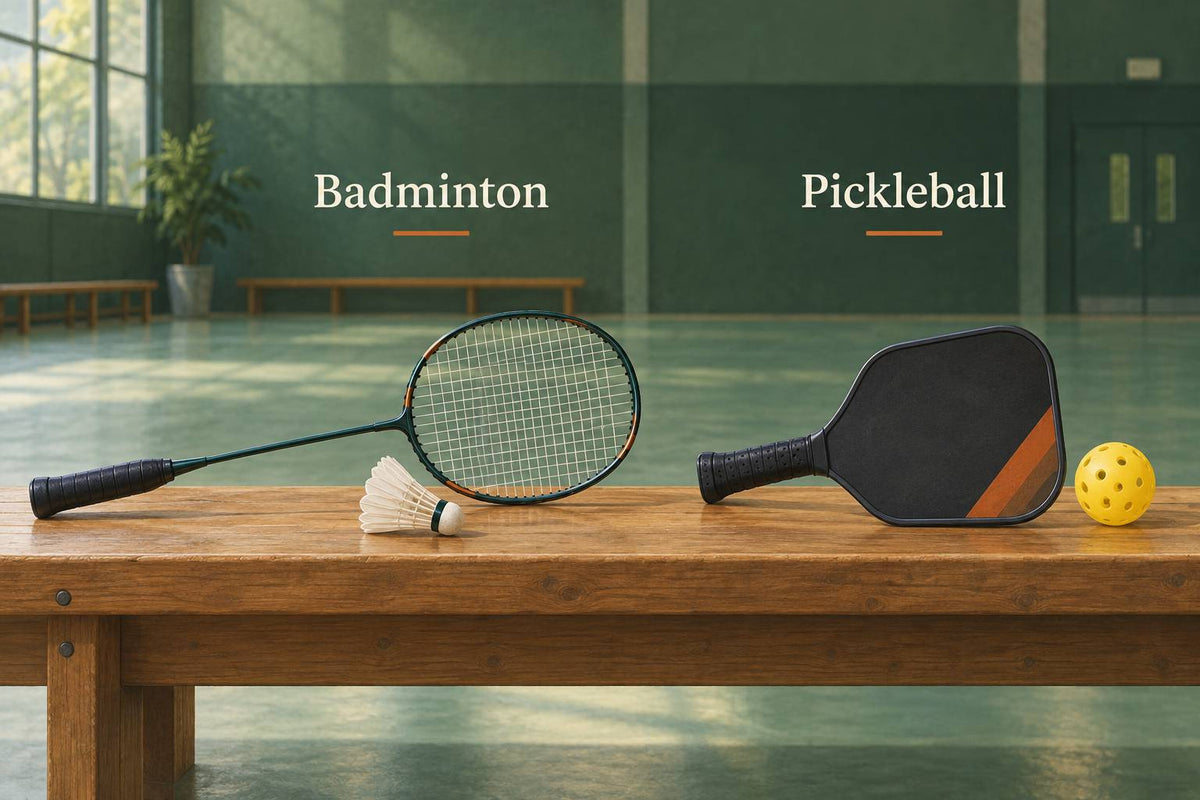
If you already play pickleball, try badminton next: the doubles court footprint is the same, but the higher net, no-bounce shuttle, and faster rally rhythm make it feel like a very different game.
Badminton
Best crossover choice: pick badminton if you like quick hands, overhead attacking, explosive forward-back movement, and rallies where the shuttle never bounces.
Pickleball
Choose pickleball if you prefer a lower net, paddle-and-ball contact, kitchen strategy, and the double-bounce structure before rallies open up.
Play both
A lot carries over: hand-eye coordination, lateral footwork, wrist speed, net awareness, and shot placement all help when moving between the two sports.
Pickleball is booming in Canada: the 2026 national survey estimated approximately 1.80 million Canadians are currently playing. If you are one of them and wondering how badminton vs pickleball actually compares, here is the short version: the two sports can share gym space and attract the same social, fitness-minded players, but they ask your body and timing to solve very different problems.
Crossing over to badminton? Start with stable indoor court footwear built for quick stops, lunges, and recovery steps. Browse badminton shoes in Canada from Badminton House, which ships across Canada.
In This Guide
- Is a Badminton Court the Same Size as a Pickleball Court?
- How Do the Net and the Kitchen Rules Differ?
- Gear: Racket and Shuttlecock vs Paddle and Ball
- Why Does Badminton Feel Faster Than Pickleball?
- How Do Serving, Scoring, and Rally Rhythm Compare?
- What Pickleball Skills Carry Over to Badminton?
- Which Should You Choose: Badminton or Pickleball?
Is a Badminton Court the Same Size as a Pickleball Court?

The easiest crossover point in badminton vs pickleball is the court footprint. A standard pickleball court and a doubles badminton court both measure 44 feet long by 20 feet wide. If you are used to seeing pickleball lines in a Canadian school gym, community centre, or multi-sport facility, the overall rectangle will feel familiar when you step onto a doubles badminton court.
The difference is how that rectangle is used. Pickleball uses the full 20-foot width for both singles and doubles. Badminton doubles also uses the full 20-foot width, but badminton singles narrows to the inner sidelines at about 17 feet wide. That narrower singles lane changes the feel of the game: you cover less side-to-side width than doubles, but you still defend the full 44-foot length, so front-back movement becomes a major part of the challenge.
| Format | Court length | Court width | What changes in play |
|---|---|---|---|
| Pickleball singles | 44 ft | 20 ft | Full-width court for one player. |
| Pickleball doubles | 44 ft | 20 ft | Same full-width court, shared by two players. |
| Badminton singles | 44 ft | About 17 ft | Narrower sidelines, but the full length still matters. |
| Badminton doubles | 44 ft | 20 ft | Same footprint as pickleball, with badminton-specific service and tramline rules. |
For Canadian facilities, that shared 44-by-20-foot footprint matters. Pickleball Canada’s 2026 survey reported a shortage of facilities as one of the two most reported challenges, cited by 15% of respondents. When gym time is tight, sports that can share a similar floor area are easier to schedule than sports that require a completely different room size.
New to badminton lines? Start with the court markings before you worry about advanced tactics. Our badminton singles vs doubles guide explains which sidelines and back lines count in each format.
How Do the Net and the Kitchen Rules Differ?

The biggest tactical difference at the net is simple: pickleball protects the space beside the net; badminton does not. A badminton net stands 5 feet (1.524 m) high at the centre, while a pickleball net sits at 34 inches (86 cm) in the middle — and pickleball adds a non-volley zone that badminton has no equivalent for.
| Rule area | Pickleball | Badminton |
|---|---|---|
| Net height | 36 inches at the ends and 34 inches in the middle | 5 feet in the centre and 5 feet 1 inch at the ends |
| Net restriction | A 7-foot non-volley zone, or kitchen, sits on each side of the net. A volley cannot involve touching that area or its line; momentum from the volley also counts. Players may enter to play a bounced ball. | There is no equivalent kitchen. Players can attack from anywhere, including right at the net. |
That one rule difference changes the entire feel of front-court play. In pickleball, the kitchen limits how aggressively you can volley near the net, so players often build points with soft shots, resets, and careful positioning around the non-volley line. In badminton, if the shuttle is high enough near the tape, it can be attacked immediately. There is no safe kitchen zone to keep your opponent from stepping in and finishing the rally.
Crossover tip: if you are a pickleball player trying badminton, do not pause at the front court expecting kitchen-style protection. Learn to move in, take the shuttle early, and recover fast. Our badminton net shot guide is a good next step.
The higher badminton net also changes shot shape. A pickleball ball is worked over a lower net with bounce-based exchanges built into the sport. A badminton shuttle has to clear a 5-foot centre net, then can be played downward if the opponent lifts it. That is why front-court control matters so much: a tight net shot can force a lift, and a loose net shot can be punished on the spot.
Gear: Racket and Shuttlecock vs Paddle and Ball

The biggest equipment difference in badminton vs pickleball is that badminton is built around a very light, strung racket and a shuttlecock, while pickleball is built around a solid-faced paddle and a perforated plastic ball. That changes almost everything: swing timing, contact feel, defensive reactions, and what happens after the object crosses the net.
Badminton rackets are usually made from lightweight graphite or carbon fibre and sit roughly in the 70–100 g range. That light frame lets you accelerate quickly for drives, blocks, net kills, and overhead smashes. A pickleball paddle feels more like a compact striking surface: the face is solid, the ball rebounds off it, and rallies often include bounces from the court.
| Gear piece | Badminton | Pickleball |
|---|---|---|
| Striking tool | Lightweight graphite or carbon-fibre racket with strings; roughly 70–100 g. | Solid-faced paddle. |
| Object in play | Shuttlecock, also called a birdie. | Perforated plastic ball. |
| Flight behaviour | The shuttlecock decelerates rapidly, floats, then drops. | The ball travels and bounces off the floor during normal rally patterns. |
| After it lands | A shuttlecock does not bounce off the floor, so the rally is over once it lands. | The ball can be played after a bounce, depending on the rally situation. |
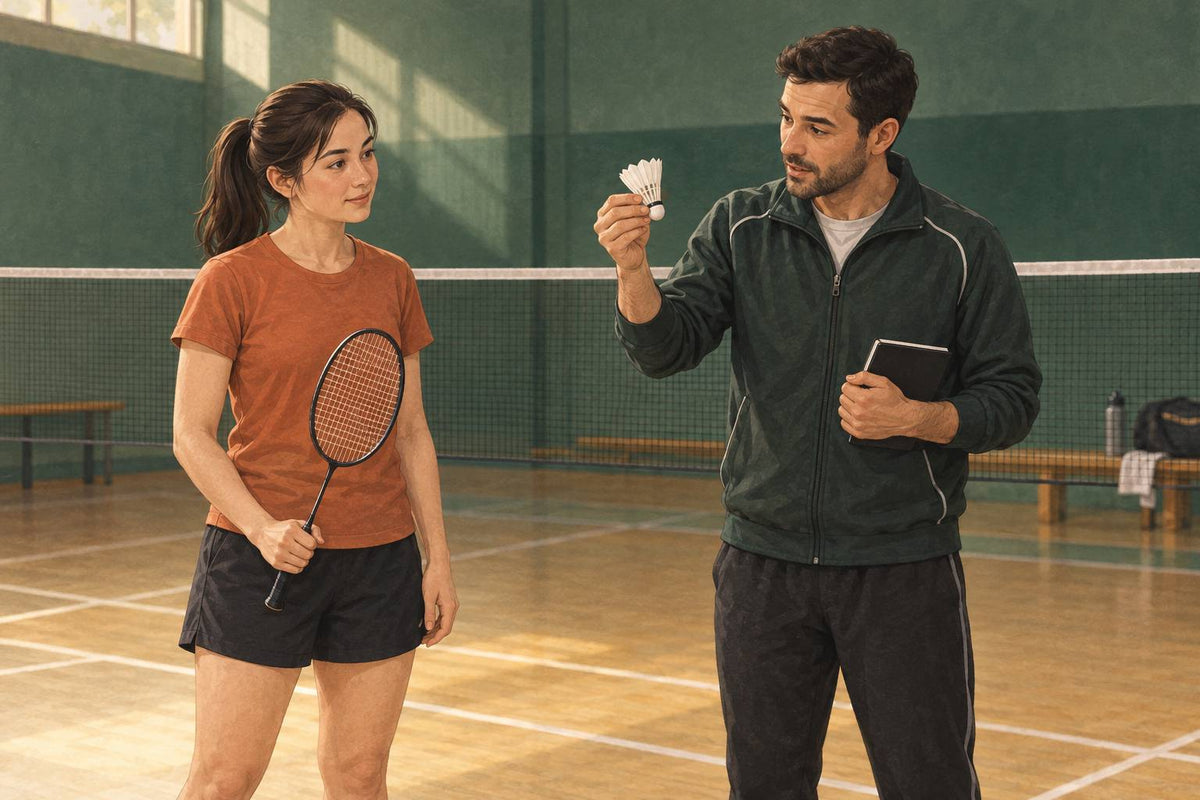
For pickleball players trying badminton, the shuttlecock is usually the surprise. You cannot wait for a bounce, and you cannot assume the same ball-style trajectory. A clear may look like it is sailing long, then slow down and fall inside the back line. A drop shot may hang for a moment, then fall sharply. That float-and-drop movement rewards early preparation and quick footwork.
Switching from pickleball to badminton? Start with the essentials: browse badminton rackets and shuttlecocks, and check the live collection pages for current availability before choosing a specific model.
Why Does Badminton Feel Faster Than Pickleball?
Guinness lists controlled badminton record attempts of 565 km/h for Satwiksairaj Rankireddy and 438 km/h for Tan Pearly, both on 14 April 2023. Those immediate post-impact speeds are not typical club shots; preparation, distance and the shuttle’s rapid slowing shape the rally you actually play.
That does not mean every club rally is moving at record speed. What beginners feel is the combination of shuttle speed, shuttle drop, and constant court coverage. A pickleball slows after the bounce and often gives you a more predictable read. A shuttlecock can float, stall, and sink at awkward angles, so a shot that looks reachable can suddenly die in front of you or drift behind your hitting shoulder.
"Badminton feels fast because the shuttle changes speed and angle while your feet are already being asked to move again."
For pickleball players crossing over, the biggest adjustment is movement. Badminton asks you to cover the full court with repeated:
- Forward movement to net shots and tight drops.
- Backward movement for clears, lifts, and deep attacking shots.
- Lateral movement for drives, blocks, and defensive recoveries.
- Reaching and lunging when the shuttle falls sooner than expected.
Coming from pickleball? Spend time on badminton footwork before trying to hit everything harder. Start with these six beginner badminton footwork moves, then build your pace gradually.
Footwear matters here too. Badminton shoes are built for quick stops, lunges, and side-to-side changes on indoor courts. If you are moving from pickleball into regular badminton sessions, look for a non-marking court shoe with lateral support rather than relying on running shoes. One current Badminton House option is the Babolat Shadow Tour Men’s Badminton Shoes – Orange, a non-marking pair built for that kind of lateral movement.
How Do Serving, Scoring, and Rally Rhythm Compare?
Under the current BWF format, badminton is best of three games to 21, win by two, with a cap at 30. Traditional pickleball commonly uses side-out scoring to 11, win by two; event formats, including rally scoring, can differ.
The serve rules differ. Under BWF’s standard rule, the whole shuttle must be below 1.15 m at impact, with its base struck first and flight initially upward. Pickleball distinguishes volley and drop serves. Its two-bounce rule requires the serve and the return of serve each to bounce before being returned; after those bounces, volleys are allowed subject to the kitchen rules.
See the 2026 official pickleball rules for volley versus drop serves and non-volley-zone details.
| Rule area | Badminton | Pickleball |
|---|---|---|
| Game target | Typically 21 points | Generally 11 points |
| Win condition | Win by two, capped at 30 | Win by at least two points |
| Match format | Usually best two-of-three | Game format varies by setting |
| Serve | Whole shuttle below 1.15 m under the standard BWF rule | Volley serve has upward-motion, waist and paddle-position requirements; drop serve has separate rules |
| After the serve | Full-speed rally can begin immediately | Double-bounce rule delays volleys until the required bounces happen |
| Scoring rhythm | Rally scoring keeps every exchange scoreboard-relevant | Traditional pickleball uses side-out scoring |
For pickleball players trying badminton, the biggest adjustment is mental: do not wait for the rally to “settle” after the serve. Because the shuttle does not bounce and the rally can accelerate immediately, the serve-and-return phase feels more urgent.
If you want the full badminton scoring breakdown, including how 21-point games, deuce situations, and doubles serving work, read our badminton rules and scoring guide.
What Pickleball Skills Carry Over to Badminton?
If you play pickleball in Canada and you’re curious about badminton, you’re not starting from zero. Pickleball players already bring useful tools: hand-eye coordination, lateral movement, wrist speed, net awareness, and the habit of placing shots instead of just swinging harder.
That crossover matters because Canada’s pickleball surge is pulling more court-sport athletes indoors. Pickleball Canada’s 2026 survey estimates that approximately 1.80 million Canadians are currently playing pickleball, up from 1.54 million in 2025. Gen Z participation rose 85%, and the top motivations were enjoyment and fun at 85% and health and fitness at 48%.
Participation figures come from Pickleball Canada’s May 2026 survey report.
Your crossover advantage
- Hand-eye timing: helps with fast exchanges, especially around the front court.
- Lateral footwork: transfers well, but badminton adds more explosive forward-and-back movement.
- Wrist speed: useful for drives, blocks, net shots, and late changes of direction.
- Net awareness: pickleball dinking can translate into better patience near the tape.
- Shot placement: badminton rewards the same idea: move your opponent before you go for the winner.
The biggest adjustment is that the shuttlecock does not bounce and it slows down sharply in flight. You’ll still recognize the value of soft hands and court positioning, but badminton asks you to recover faster after every shot. That’s why pickleball players often progress faster than complete beginners, while still needing a few sessions to get used to the shuttle’s float-and-drop rhythm.
Babolat Shadow Tour Men's Badminton Shoes – Orange
For pickleball players crossing into badminton, proper indoor court footwear is a practical first upgrade because badminton movement is explosive side-to-side and forward-back. You can browse all badminton footwear or check this current shoe option.
Shop Babolat Shadow TourShips across Canada
Once your footing feels secure, the next steps are learning badminton grip changes, serve height, and recovery patterns. If you’re brand new to the sport, start with our adult beginner badminton guide and our badminton footwork basics before worrying about advanced racket specs.
Which Should You Choose: Badminton or Pickleball?
| Choose | Best fit if you want... | Why it fits |
|---|---|---|
| Badminton | A faster, more airborne racket-sport feel | Badminton uses a lightweight racket and shuttlecock, has no kitchen, and allows full-speed rallies immediately after the serve. The shuttle floats, sinks, and does not bounce, so timing matters right away. |
| Pickleball | A paddle-and-ball game with a defined non-volley zone | Pickleball uses a solid-faced paddle and perforated plastic ball, a 7-ft kitchen on each side of the net, and a double-bounce rule before volleys can take over. |
| Badminton | More forward-back court movement | Badminton can be physically demanding because players constantly move forward and backward, reach for the birdie, and cover the court through continuous rallies. |
| Pickleball | A lower net and games to 11 | The pickleball net is 36 inches high at the ends and 34 inches in the middle, and games are generally played to 11, win by two. |
| Badminton | A higher net and longer scoring format | The badminton net is 5 feet high in the centre and 5 feet, 1 inch at the ends. Under the current BWF format, games go to 21, win by two, capped at 30, in a best-of-three match. |
| Either | Shared gym space and easy crossover curiosity | A standard pickleball court and a doubles badminton court share the same 44 ft by 20 ft footprint. Pickleball players also bring useful crossover skills to badminton: hand-eye coordination, lateral movement, wrist speed, net awareness, and shot placement. |
Practical pick: if you already play pickleball and want a new indoor challenge, try badminton first on a doubles court. The familiar court footprint helps, but the higher net, shuttle flight, and immediate rally pace will make it feel like a new sport.
For gear, start with court footwear before chasing a high-end racket. The Babolat Shadow Tour Men’s Badminton Shoes – Orange are one badminton-specific option in the Badminton House footwear lineup; you can also browse badminton footwear for available sizes.
If you choose badminton, the next useful step is learning the rally-scoring format in our badminton rules and scoring guide.
Get new badminton guides by email
Join the Badminton House list for occasional emails with new guides, technique tips and news from our club in Moncton.
By subscribing, you agree to receive Badminton House emails and can unsubscribe anytime.
If pickleball brought you here, welcome — badminton rewards many of the same instincts, but the shuttle, net height, and movement patterns make it a very different game once rallies speed up. We play badminton ourselves, so if you are unsure where to start with shoes, rackets, shuttles, or club-night gear, contact us and we will help you choose based on your level, budget, and court time.
Crossing over from pickleball to badminton?
Start with court-ready badminton footwear for the lunges, recovery steps, and quick direction changes that make the sport feel so sharp.
Shop Badminton FootwearCAD pricing · Canadian badminton specialty shop · Player-run gear advice

Leave a comment
This site is protected by hCaptcha and the hCaptcha Privacy Policy and Terms of Service apply.