
Last updated: July 2026 · Written by the team at Badminton House
Quick Answer: Badminton Drive Shot
Use the badminton drive shot when the shuttle is too low to smash: stay low, take it in front, and send it flat through the middle or an opponent’s no-power zone.
Default
Best choice: in fast doubles mid-court exchanges, keep your racket up, use a compact forearm-and-wrist action, and drive flat at the centre seam to force hesitation or a weak lift.
Block
If the drive duel gets too fast near the net, soften your hand and let the shuttle rebound over instead of adding a big arm swing.
Gear
For drive-heavy doubles, a 4U head-light or even-balance racket is usually easier to move quickly than a head-heavy smash frame; browse badminton rackets in CAD, with free Canadian shipping.
If your doubles rallies keep turning into panicked mid-court exchanges, the problem usually is not strength — it is timing, racket position, and shot shape. The badminton drive shot is a fast, flat shot that travels low over the net, most often from mid-court to mid-court, and it becomes especially important when the shuttle is too low to smash but still high enough to pressure your opponent.
This guide breaks down how to stay low, use both forehand and backhand drives, aim into better targets, and win the drive duel without over-swinging.
Want a quicker racket for drive exchanges? Start with our badminton rackets collection, then look for a setup that feels fast through short swings, blocks, and front-court reactions.
In This Guide
What Is a Badminton Drive Shot?

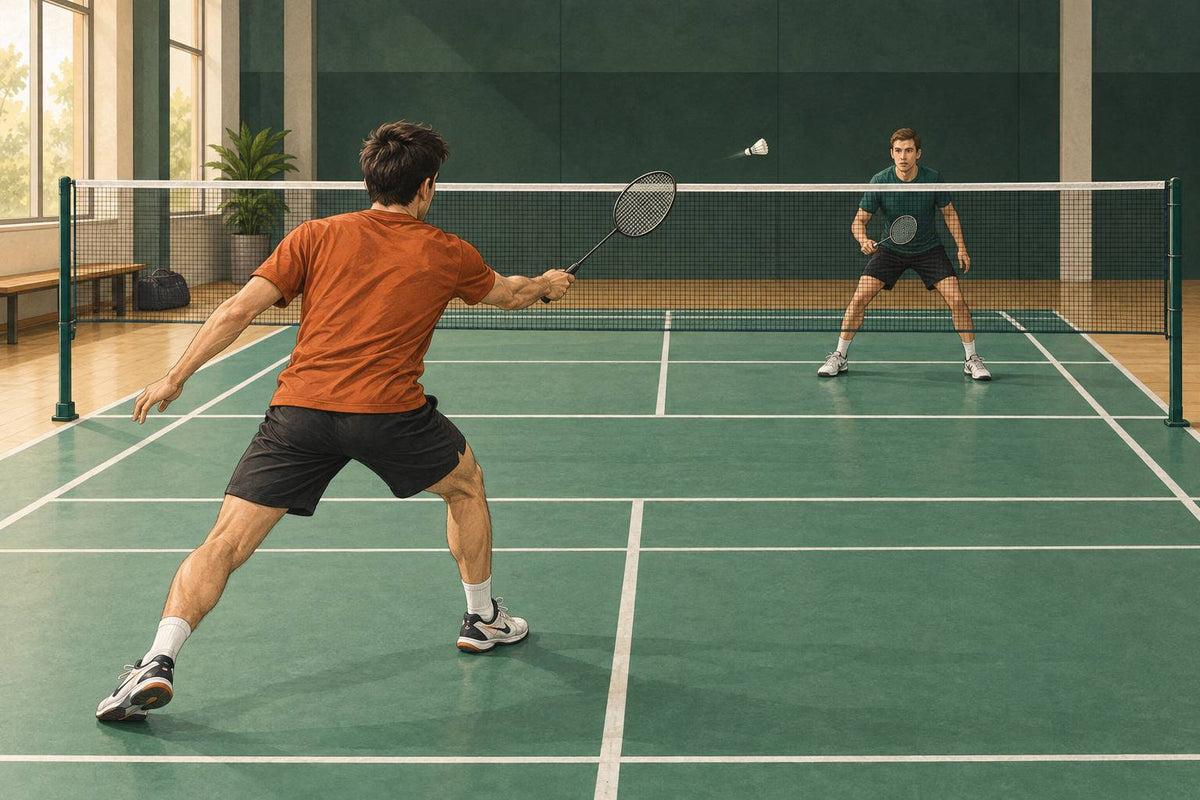
A badminton drive shot is a fast, flat shot that travels close to the net on a mostly horizontal path. It is usually played from mid-court to mid-court, not from the deep back court like a clear or from high above the shuttle like a smash.
Think of the drive as your answer when the shuttle is too low to smash, but still high enough that you can attack it forward. Instead of hitting downward, you send the shuttle flat through the court, trying to reduce your opponent’s reaction time and force a weak upward reply.
Simple definition: a badminton drive is a quick, flat attacking or counter-attacking shot hit in front of the body that skims just above the net (1.55 m high at the posts), usually in fast mid-court exchanges.
Drives can be played on both the forehand and backhand side. In doubles, they are especially important because both pairs are trying to keep the shuttle low, stay on the attack, and avoid giving the other side an easy lift or smash opportunity. Flat mid-court drives and blocks are often the exchanges that decide doubles rallies.
In singles, the drive is still useful, but it is rarer and riskier. Because there is more open court to cover, a flat drive that does not pressure the opponent can come back into space quickly. Singles players usually use drives more selectively: to counter a smash, attack a loose mid-court shuttle, or change the pace of the rally.
| Shot | Typical path | When it fits |
|---|---|---|
| Drive | Fast and flat, close to net height | When the shuttle is too low to smash but you can still attack forward |
| Smash | Steep and downward | When the shuttle is high enough to hit down |
| Lift | High and defensive | When you need time to recover or escape pressure |
| Block | Soft, short, and controlled | When you want to take pace off a fast exchange and make the shuttle drop near the net |
If you are building a doubles game in a Canadian club, drop-in, or league setting, learn the drive early. It connects directly with doubles positioning and rotation, smash defence, and the ability to turn a neutral rally into an attacking one without needing a full overhead swing.
What Is the Right Ready Position for Drives?
A good badminton drive shot starts before you swing. Because drives are fast, flat mid-court exchanges, you do not have time for a tall stance, a big backswing, or a late contact point. Your ready position should make the racket feel close to the shuttle already.
Drive-ready cue: stay low, racket up, elbows loose, and meet the shuttle in front of your body. If the shuttle gets beside you or behind you, your drive usually turns into a weak push or a lift.
Start in a semi-squat, not an upright stance
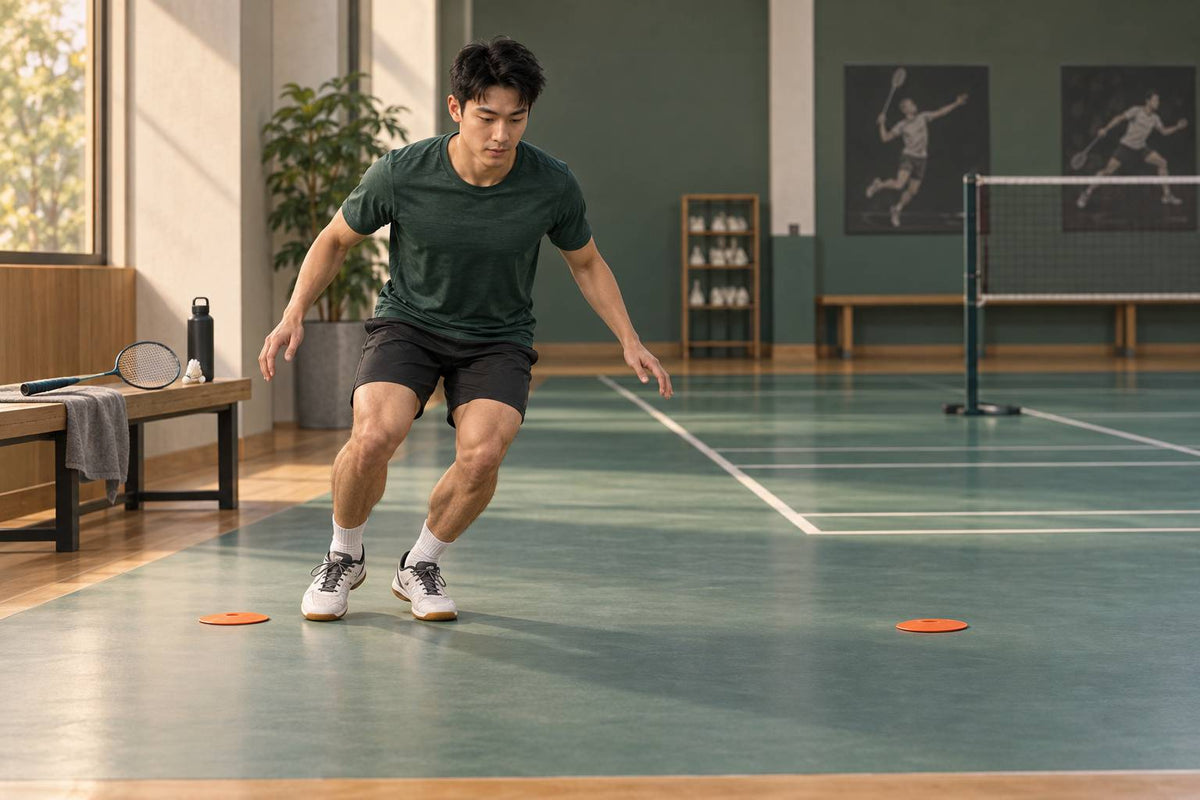
For flat drives, think of a compact semi-squat: knees bent, hips slightly lowered, chest balanced over the feet, and weight ready to move forward or sideways. You are not sitting deep like a gym squat. You are lowering your centre of gravity enough that your first movement is quick and stable.
This low base matters in doubles because drive rallies often happen around the mid-court. The shuttle is travelling fast and low, so a tall posture makes you reach down late. A lower stance lets your racket stay in the hitting lane and helps you recover after each contact.
Use a small split step before the shuttle arrives
A split step is the small timing hop or bounce that prepares your legs to push in any direction. For drive defence and mid-court exchanges, it should be quick and quiet: land as your opponent hits, then push toward the shuttle.
If the shuttle is slightly in front, you may need a short lunge. If it is near your body, you may only need a small adjustment step. Either way, the goal is the same: arrive early enough that the racket face can push forward through the shuttle instead of chopping down at it.
If your split step, lunge, or recovery feels slow, review the basics in our badminton footwork guide. Efficient footwork is what lets you reach mid-court drives early and still get back into position for the next shot.
Keep the racket up and in front
Your racket should start up, in front of your body, and around chest to shoulder height depending on the incoming shuttle. Avoid letting the racket drop beside your hip between shots. From a low racket position, you need extra time to lift the frame before you can drive — and in a drive duel, that delay is often enough to lose the exchange. If you still feel late with the racket already up, our badminton reflex training guide scores your hand speed and pinpoints the fault behind slow flat exchanges.
- Elbow slightly away from the body: not locked out, not tucked tight against your ribs.
- Racket head higher than the hand: ready to intercept the shuttle early.
- Grip firm but relaxed: a grip that is too tight restricts wrist movement and reduces the quick racket speed needed for drives.
- Short preparation: the swing should be compact because the shuttle is coming fast.
Take the shuttle early, in front of your body
Early contact is the biggest difference between a sharp drive and a rushed rescue shot. Aim to meet the shuttle in front of your hitting shoulder, using a compact forearm and wrist action with a slightly forward racket face. That forward contact helps keep the shot flat and quick over the net.
When you contact late, the shuttle is often beside your body. From there, it is harder to keep the drive low, harder to aim at the opponent’s no-power zone, and harder to recover for the next reply. In doubles, late contact also gives the other side more time to step in and counter-drive.
| Ready-position habit | Why it helps your drive |
|---|---|
| Semi-squat base | Keeps you stable and low enough to intercept flat mid-court shots. |
| Split step as the opponent hits | Prepares your legs to push forward or sideways without a slow first step. |
| Racket up in front | Shortens the swing and helps you meet the shuttle before it drops or passes your body. |
| Relaxed grip | Allows the wrist and forearm to create quick racket acceleration. |
| Contact in front | Makes it easier to drive flat, aim accurately, and recover for the next exchange. |
A simple check: after every drive, ask whether your racket finished close enough to reset immediately. If your arm swings across your body and stays there, the next shuttle will feel too fast. Compact ready position, early contact, and quick recovery are what let you stay in the rally long enough to force the weak upward reply.
How Do You Hit Forehand and Backhand Drives?
A good badminton drive shot is not a full swing. It is a compact, forward punch through the shuttle, taken in front of your body, with the racket face moving slightly forward to keep the shuttle flat. The biggest mistake is chopping down on the shuttle: that either sends it into the net or turns a fast drive into a loose upward reply.

Think of the drive as a short sidearm action. Start from a split step, move toward the shuttle, keep the grip relaxed, and use forearm and wrist rotation at the end of the swing. Your body momentum adds speed, but the racket path stays short so you can recover for the next shot.
Drive technique cue: meet the shuttle early, in front of your hip or shoulder line, then push the racket face forward. If your arm finishes big, you are probably too late or swinging too much.
Forehand drive: short sidearm action
On the forehand side, use a relaxed forehand grip. If you are unsure where your fingers should sit, review the badminton grip basics before trying to hit harder. A tight grip restricts the wrist and makes the drive slower, even if you feel like you are using more effort.
- Prepare early: racket up, elbow slightly away from the body, strings facing the incoming shuttle.
- Take it in front: contact should happen before the shuttle passes your body. Late contact usually creates a weak lift or a sideways slap.
- Rotate, do not scoop: use forearm and wrist rotation forward, then let the racket continue only as much as needed to send the shuttle flat.
- Use body momentum: a small lunge or forward step helps add pace without making the swing long.
The forehand drive can finish slightly across the body, but keep it compact. In doubles, a huge follow-through is dangerous because the next shuttle often comes back immediately at your body, racket shoulder, or backhand side.
Backhand drive: firm direction, restrained finish
The backhand drive is often the safer option in fast doubles exchanges because it keeps the racket in front of your body. Use a relaxed backhand grip, keep the thumb support active, and push the shuttle with a short forward rotation rather than taking a big backswing.
The key difference is the finish. A backhand drive should briefly follow the line of the shot, then stop and reset. Do not let the racket wrap around your body. A big backhand follow-through may feel powerful, but it leaves your racket late for the next block, drive, or body shot.
| Drive type | Main action | Common mistake |
|---|---|---|
| Forehand drive | Relaxed forehand grip, short sidearm motion, wrist and forearm rotation forward. | Swinging too long or chopping down instead of pushing through the shuttle. |
| Backhand drive | Relaxed backhand grip, compact forward push, brief finish along the shot line. | Using a big follow-through and failing to reset for the next shuttle. |
A simple checkpoint: can you reset instantly?
After every drive, your racket should return to a neutral ready position quickly. If you cannot recover before a partner feeds the next shuttle, reduce the swing size. Drives win because they are early, flat, and repeatable — not because one shot is hit with maximum effort.
Racket manoeuvrability also matters for drive-heavy play, but technique comes first: relaxed grip, contact in front, forward rotation, compact finish, and fast reset.
Where Should You Aim Flat Drives in Doubles?

A good badminton drive shot is not just “hit it hard and flat.” In doubles, the best drive is usually the one that makes the other side contact late, cramped, or unsure whose shuttle it is. Because drives travel low and fast through the mid-court, small changes in placement can decide whether you win the exchange or feed an easy counter-drive.
Start with this simple rule: straight drives are your default pressure shot; cross-court drives are your gap-finder. A straight drive travels the shorter path, so it gives the opponent less reaction time. A cross-court drive travels farther, but it can punish a pair that has shifted too far to one side or left a clear lane through the middle.
Doubles context matters. Drive placement works best when you understand who is covering the front, middle, and rear court. For the full rotation picture, read our badminton doubles positioning guide.
1. Straight drives: the safest way to take time away
When the shuttle is in front of your body and you can meet it early, drive straight down the line more often than not. The shuttle gets to the opponent quickly, stays flat, and reduces the chance that you open a huge cross-court angle for the other side.
2. Aim at the no-power zone
The most uncomfortable target is often not the sideline. It is the opponent’s no-power zone: the area where they cannot make a clean, full swing and have to jab, block, or lift. In drive exchanges, this usually means driving at the body rather than giving them a free extension to the forehand or backhand side.
A body drive does not need to be reckless. Keep the racket face slightly forward, contact in front, and send the shuttle flat into a cramped receiving position. The goal is not to hit through the opponent; it is to make their next shot weak enough that your partner can step in.
3. Hit the centre seam between two opponents
When both opponents are side-by-side, the centre seam is one of the highest-value drive targets. A flat drive through the middle can create hesitation: both players see the shuttle, but neither player is completely sure who should take it. Even if they reach it, the reply is often awkward or upward.
This is a great target when the rally is already fast. Instead of trying to paint a sideline, drive through the gap between the two rackets. In Canadian club doubles, where many rallies are decided by one rushed mid-court touch, this middle drive can be a simple way to turn a neutral exchange into an attacking chance.
| Target | Why it works | Best time to use it |
|---|---|---|
| Straight down the line | Shortest path, faster arrival, less reaction time. | Your default drive when you are balanced and taking the shuttle early. |
| Opponent’s body | Cramped contact can force a block, mishit, or upward reply. | When the opponent is square, late, or standing too upright. |
| Centre seam | Creates uncertainty between two players and can produce a weak lift. | When opponents are side-by-side in defence or both reaching into the middle. |
| Cross-court gap | Exploits a pair that has shifted too far or left a clear lane open. | Use selectively when you can see the gap and still keep the shuttle flat. |
4. Use cross-court drives as a change, not a habit
Cross-court drives can be excellent when the gap is real. If the front player has overcommitted, or the rear defender is leaning the wrong way, a quick diagonal drive can pull the pair apart. But if you play cross-court by habit, you often give the opponents more distance to read the shuttle and a wider angle to counter.
How Do You Break or Win a Drive Duel?
A drive duel starts as a flat mid-court exchange, then usually gets faster, lower, and tighter to the net cord. If both players keep punching the shuttle back flat, the rally often ends in one of two ways: someone hits the net, or someone changes the shot first.
That change is often the block. Instead of adding more arm speed, you soften the hand, hold the racket face steady near the net, and let the shuttle rebound just over. In many situations, you do not need to swing at all — the incoming pace already gives the shuttle enough energy to cross the net.
"The best block in a drive duel is not a slower drive — it is a soft touch that makes the opponent move forward."
How to play the block
- Stay low after your drive. Do not admire the shot. Keep the racket up and expect the shuttle to come back at your body or racket hip.
- Meet the shuttle in front. The block is much harder if the shuttle has already passed your front shoulder.
- Soften the fingers. Keep control of the handle, but avoid squeezing so hard that the racket face becomes bouncy and uncontrolled.
- Use the opponent’s pace. If the drive is fast, a small touch is usually enough. Adding a big arm motion can pop the shuttle up or send it long.
- Recover immediately. After a block, be ready to move forward for a net kill, lift under pressure, or cover the next flat reply.
When to block instead of keep driving
| Situation | Best choice | Why it works |
|---|---|---|
| You are late and the shuttle is already close to your body | Block | A compact touch is safer than trying to force another flat drive from a cramped position. |
| Your opponent is leaning back and waiting for pace | Block | Taking pace off the shuttle can pull them forward and break their timing. |
| You contact the shuttle early, in front, above net height | Drive or push | You can still keep the shuttle flat and pressure the opponent’s no-power zone or centre seam. |
| The exchange is getting lower and closer to the tape | Block or change direction | Continuing the duel can force errors, but changing first can win the tactical battle before the rally becomes a coin flip. |
The key mistake: blocking with a swing
Many players lose the drive duel because they treat the block like a mini-clear or a slower drive. The racket travels too far, the face opens, and the shuttle floats upward. In doubles, that gives the front player time to pounce.
Think of the block as a front-court skill, not a power shot. Your job is to present the racket face, absorb the shuttle, and make it land tight enough that the opponent cannot keep attacking flat. For more detail on soft touch, net height, and front-court control, read our badminton net shot technique guide.
Drive-duel cue: if you are early, drive with a compact punch; if you are late or your opponent is sitting on pace, block softly and make them move forward.
Practice and Gear for Faster Drives
The badminton drive shot is one of the easiest shots to practise without a formal training session: you need repetition, early contact, a compact swing, and a partner who can keep the shuttle flat through the mid-court.
Start every drive drill from the same base: semi-squat posture, racket up, grip relaxed, contact in front of the body. If the shuttle starts climbing, slow down and rebuild the shape of the shot before trying to hit harder.
Simple drive drills that actually transfer to doubles
| Drill | How to do it | What it teaches |
|---|---|---|
| Straight drive rally | Stand mid-court across from a partner and trade flat drives down the same line. Keep the racket in front after every shot. | Compact recovery, clean timing, and keeping the shuttle low instead of lifting. |
| Forehand-backhand switch | Alternate drives to each side of the body so the hitter must change between forehand and backhand grips without taking a big swing. | Grip changes, fast hands, and the ability to stay balanced during a drive exchange. |
| Middle-seam target | In doubles, aim flat drives between two opponents when they are side-by-side rather than always hitting at one player. | Better tactical placement: the centre seam can create hesitation and force a weak upward reply. |
| Drive-to-block change | Trade flat drives, then have one player soften the racket face and block the shuttle back over the net instead of adding more arm power. | How to break a drive duel when the rally is getting too fast or too tight to the tape. |
For repetitive drive practice, durable nylon shuttles are a practical choice because the goal is volume: lots of flat contacts, lots of resets, and lots of control over the racket face. Feather shuttles are excellent for match feel, but nylon shuttles make sense when you are drilling the same fast exchange again and again. Browse badminton shuttlecocks and choose based on how you train, not just what you use in matches.
Racket balance: why drive players often like head-light frames
For fast drive-heavy rallies, head-light rackets usually feel easier to manoeuvre because there is less weight concentrated in the racket head. That helps when you need short swings, quick grip changes, and a fast reset after a backhand drive or block.
Head-heavy rackets trade the other way: they typically add power on clears and smashes, but they can feel slower in flat exchanges. That does not make them wrong — a rear-court power player may still prefer one — but if your doubles game is built around interceptions, drives, and blocks, racket speed matters.
| Racket balance | Drive-shot feel | Trade-off |
|---|---|---|
| Head-light | Quicker through fast mid-court exchanges; helpful for drives, blocks, net control, and rapid racket recovery. | Less head weight can make it harder to generate the same smash power as a head-heavy frame. |
| Even balance | A middle-ground option if you want decent racket speed without moving fully away from rear-court power. | May not feel as sharp as a head-light frame in pure drive duels or as powerful as a head-heavy frame for smashes. |
| Head-heavy | More power-oriented, especially for clears and smashes. | Can feel slower when you are defending, counter-driving, or changing quickly from forehand to backhand. |
If you are choosing a racket mainly for doubles speed, a 4U head-light racket with a stiff or medium shaft is a common profile to consider because drive exchanges often use short swings and blocks. For a deeper explanation of the trade-offs, read our head-heavy vs head-light racket balance guide, then compare current options in our badminton rackets collection.
Shop Badminton Rackets — Find a Faster Drive Setup
Free shipping across Canada · 14-day returns
Which Drive Option Should You Choose?
Use the badminton drive shot when the shuttle is too low to smash but high enough to meet early in front of your body. In doubles, the decision is usually not “drive or lift?” — it is “which flat option gives my opponent the least time and the worst contact point?”
| Choose this | When it fits | Why it works |
|---|---|---|
| Straight flat drive | You are balanced in the mid-court and can take the shuttle early. | Straight drives travel on the quickest line and give the opponent less reaction time. |
| Centre-seam drive | Both opponents are side-by-side or unsure who should cover the middle. | Aiming between two players can create hesitation, a weak lift, or an awkward upward reply for your partner to attack. |
| Cross-court drive | You see a clear positioning gap and can keep the shuttle low over the net. | Cross-court drives can exploit space, but the longer path gives opponents more time if the shot sits up. |
| Soft block | The exchange is getting too fast, or the shuttle is close enough to the net that extra arm power is unnecessary. | At the net, simply touching the shuttle back over can break the drive duel and stop you from feeding another flat counter. |
| Defensive drive | You are under smash pressure but can meet the shuttle in front instead of lifting automatically. | A quick, flat reply can neutralize the attack and help you recover court position. |
| Avoid the drive | You are late, reaching behind your body, or playing singles without a clear gap. | Drives are a staple of fast doubles exchanges, but they are riskier and less common in singles because a loose flat shot can be punished. |
For gear, keep the decision simple here: if you are comparing racket feel, browse badminton rackets and use the head-heavy vs head-light balance guide before buying.
Note for Canadian players. Badminton House lists Yonex Mavis 350 Nylon Shuttlecocks, a durable nylon option built for repetitive drive drilling; prices are in CAD, and Canadian orders qualify for free shipping.
Get 10% off your first order
Join the Badminton House list and we’ll email you a 10% welcome code — plus subscriber-only restock alerts, giveaways, and honest gear advice from players.
By subscribing, you agree to receive Badminton House emails and can unsubscribe anytime.
Flat drives improve fastest when you stay low, keep the swing compact, and meet the shuttle early in front of your body. At Badminton House, we play badminton ourselves, so if you want help choosing a drive-friendly racket balance, string setup, or practice plan for your club nights, contact us for advice.
Build a faster doubles setup
Browse our badminton racket collection and check current availability for frames that fit your speed, control, and drive-heavy rallies.
Shop Badminton RacketsCanadian badminton specialty shop · CAD pricing · Free Canadian shipping

Leave a comment
This site is protected by hCaptcha and the hCaptcha Privacy Policy and Terms of Service apply.