Last updated: June 2026 · Written by the team at Badminton House
Quick Answer: Junior Badminton Racket
Choose the shortest, lightest racket your child can swing properly; height and clean technique matter more than the age printed on a size chart.
Ages 8–13
Best default: look for a light junior or transition racket that is easy to control, with a smaller grip such as G6, G5, or junior-specific G7 where available. If restringing, keep junior tension in the 17–22 lbs range unless a coach recommends otherwise.
Ages 5–7
Start shorter so the racket does not drag, twist, or force a full-arm chopping swing. A quick parent test: with the child standing and holding the racket at their side, the frame should not touch the floor.
Teens
Most teens can start comparing adult frames, but avoid jumping straight to heavy adult rackets. For competitive juniors moving up, 4U or 5U is usually the safer starting point than a 3U frame.
Buying a junior badminton racket can feel surprisingly confusing: age charts say one thing, your child’s height says another, and a full-size adult racket can look “close enough” until they try to swing it in a fast rally.
For kids, the right racket is the one they can move properly. A racket that is too long or too heavy can slow down racket speed, encourage full-arm chopping swings, and make badminton feel harder than it should. The goal is simple: give young players a frame that helps them learn clean wrist and forearm rotation, make contact comfortably, and enjoy school, club, or family play.
This guide walks through junior sizing by age, height, weight class, grip size, and string tension so Canadian parents can choose with more confidence — whether your child is just starting at school or moving toward competitive junior training.
Need help sizing before you buy? Tell us your child’s age, height, experience level, and current racket if they have one — we’ll help you choose the right direction through our Contact Us page. Canadian orders over $200 ship free when the right gear is available to bundle.
In This Guide
- Age 5–7: Start Short Enough to Swing Properly
- Age 8–10: Prioritize Control, Light Weight, and Confidence
- Age 10–13: The Transition Zone from Junior to Full Size
- Teens Moving to Adult Frames: 4U, 5U, and F-Class Options
- Grip Size for Kids: Why G6, G5, and G7 Matter
- Strings, School Season, and When to Upgrade
- Which Junior Badminton Racket Should You Choose?
Age 5–7: Start Short Enough to Swing Properly
For a first junior badminton racket, the biggest mistake is buying too long too early. A younger child does not need an adult-length frame to learn badminton; they need a racket short enough that they can swing without dragging the head, chopping from the shoulder, or fighting the racket through the air.
A practical length ladder puts most 4–6 year olds around a 21-inch junior racket and most 7–8 year olds around a 23-inch junior racket. Age is only the starting point, though. If your child is tall for their age, they may be ready to size up sooner; if they are smaller or still developing coordination, sizing down can make the game much easier and more fun.
| Child age | Typical junior racket length | How to adjust |
|---|---|---|
| Age 4–6 | 21 inches | Best starting point for many younger kids who are just learning to make clean contact. |
| Age 7–8 | 23 inches | Often a better fit once the child is taller, stronger, and can clear the racket head without it feeling clumsy. |
Need help choosing the right junior size? Badminton House does not currently have in-stock junior rackets listed, but we can still help you size your child correctly before you buy. Contact us for sizing help.
The quick parent test
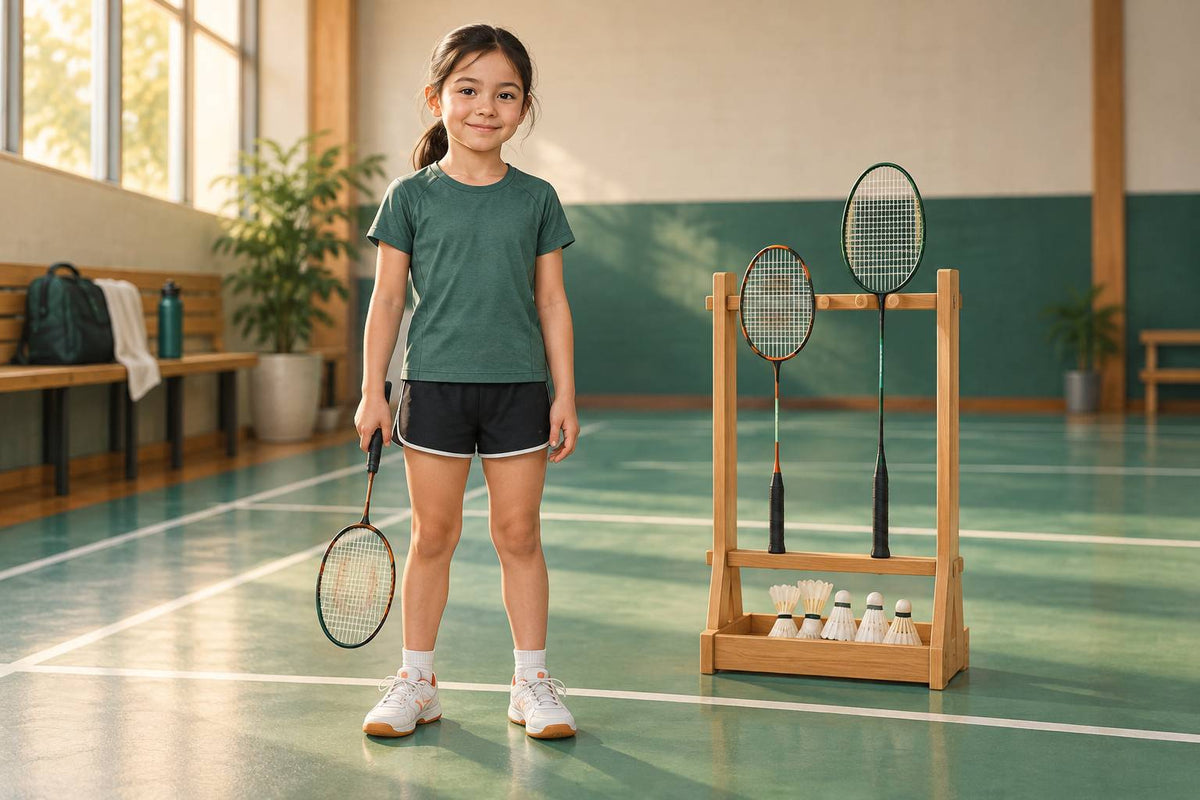
Have your child stand naturally with their arm relaxed at their side while holding the racket. The racket frame should not touch the floor. If it does, the racket is likely too long for comfortable learning right now.
This test matters because a too-long frame changes the way kids move. Instead of learning a compact swing, soft grip, and early contact point, they may start lifting the whole arm, dropping the racket head, or turning every shot into a big push. That can make rallies frustrating, especially in school gyms where younger players are already dealing with heavy shuttles, high ceilings, and limited court confidence.
- If the frame touches the floor: choose a shorter junior length.
- If the frame clears the floor easily: the length is more likely workable.
- If the child can swing smoothly without the head dropping: that is a better sign than age alone.
Why shorter is usually better at this age
At ages 5–7, the goal is not maximum smash power. The goal is helping the child make repeated, clean contact and enjoy the rally. A shorter junior frame is easier to control, easier to accelerate, and less likely to pull the swing off balance.
If your child is between two sizes, lean toward the one they can swing well today rather than the one they might grow into later. Badminton technique develops faster when the racket feels manageable from the first session.
Age 8–10: Prioritize Control, Light Weight, and Confidence
Ages 8–10 are the awkward middle of junior racket sizing. One common length chart places ages 7–8 at a 23-inch racket and ages 9–10 at a 25-inch racket, which means a child in this bracket may be ready for either size depending on height, strength, and how cleanly they can swing.
The goal is not to buy the longest racket they can physically hold. A too-big racket makes it harder for a child to generate racket speed, and when the racket feels slow, badminton quickly becomes less fun. For this age group, a junior badminton racket should help them make contact in front of the body, recover quickly after each shot, and rally with confidence.
| Age range | Typical junior length | How to decide |
|---|---|---|
| 7–8 | 23 inches | Better for smaller 8-year-olds, newer players, or kids who struggle to get the racket moving quickly. |
| 9–10 | 25 inches | A good next step for taller or stronger kids who can still swing comfortably without dragging the racket through the shot. |
Use height and swing quality, not just birthday age
Age charts are a starting point, not a rule. Taller kids can size up earlier, while smaller kids are often better off staying with the shorter option until their swing is fast and relaxed. If your child stands with their arm at their side while holding the racket, the frame should not touch the floor. That quick check helps catch rackets that are simply too long for the player right now.
On court, watch the swing. If the racket pulls the child’s arm down, causes late contact, or makes them take a big full-arm chopping motion, it is likely too much racket. A lighter, easier-to-control frame encourages better wrist and forearm rotation, which is the technique base they need before chasing power.
Parent shortcut: when choosing between 23 inches and 25 inches, pick the racket your child can swing fastest while still hitting cleanly. For the broader racket-selection framework, see our badminton racket buying guide.
What “control before power” looks like
- Shorter rallies improve: the child can get the racket up in time and make cleaner contact.
- Clears feel easier: they are not fighting the length of the frame just to send the shuttle back.
- Net shots become less rushed: a manageable racket helps small hands make softer, more controlled movements.
- Practice stays fun: kids are more likely to keep playing when the racket helps them succeed instead of slowing them down.
If you are buying for school badminton or weekly club sessions in Canada, think of the 8–10 age range as a confidence-building stage. The right junior badminton racket is the one that lets your child learn timing, footwork, and relaxed strokes first. Power can come later, when the player is strong enough and skilled enough to use a longer or more demanding frame properly.
Need help choosing a size before you order? Contact Badminton House with your child’s age, height, and playing experience. For Canadian orders, free shipping applies on orders over $200, so many families bundle racket needs with strings, shoes, shuttles, or other badminton essentials when it makes sense.
Age 10–13: The Transition Zone from Junior to Full Size
Ages 10 to 13 are where junior badminton racket sizing gets tricky. Many kids around 10–11 are still best served by a 26-inch frame, while many players 12+ can move into the full-size 27-inch category. But the important rule is still the same: height and swing quality matter more than age.
If a 10-year-old is tall, coordinated, and swinging a 26-inch racket cleanly, moving up may make sense. If a 12-year-old is smaller, still learning timing, or struggling to get the racket through the shuttle quickly, staying with a junior-length frame a little longer is the better badminton decision.
Shopping note for Canadian parents. Junior racket availability can change quickly, so check our badminton rackets collection for current and future junior options, or ask us for sizing help before you buy.
What the transition usually looks like
| Player stage | Common racket length | What to watch |
|---|---|---|
| Around age 10–11 | Often 26 inches | Good for kids who still need easier racket speed and cleaner contact without the frame feeling too long. |
| Around age 12+ | Often full-size 27-inch category | Best when the player can prepare early, recover the racket quickly, and clear the shuttle without forcing the shoulder. |
| Smaller or newer 12–13-year-olds | Junior or shorter full-size frame | Stay conservative if the child is chopping with the whole arm or arriving late to the shuttle. |
| Tall, trained 12–13-year-olds | Full-size 665–675 mm range | A 4U or 5U frame is usually easier to manage than a heavier adult racket. |
One simple home check: have your child stand naturally with their arm at their side while holding the racket. If the frame touches the floor, it is likely too long for their current height and control level.
Why a junior-specific performance frame can make sense
This age group is where parents often wonder whether to buy a “real” adult racket or one more junior racket. A good junior-specific performance frame can be the smarter bridge because it gives the player better proportions, a smaller handle, and easier racket speed while still feeling like proper badminton equipment.
The Yonex Nanoflare Junior is a useful example of this category. It is built for competitive junior athletes looking for lightness, maneuverability, and speed. Its listed specs include a 665 mm length, 4U average weight of 83 g, G7 grip, and recommended stringing range of 17–22 lb. That combination tells you a lot about what to look for in a transitional junior badminton racket: light enough to move quickly, short enough to control, and small enough in the grip for developing hands.
The 665 mm length is especially important. It sits close to the lower end of typical full-size racket lengths, but it keeps the setup more manageable for juniors than jumping straight into a longer or heavier adult frame. The G7 grip also matters because many adult rackets come with larger handles that can make relaxed grip changes harder for kids.
Signs your child is ready to move up
- The racket no longer looks oversized. They can hold it comfortably without the head dropping or dragging through preparation.
- They can swing with wrist and forearm rotation. If every shot is a stiff full-arm chop, the racket may be too heavy, too long, or both.
- They recover quickly after shots. A good fit lets them prepare for the next shuttle instead of finishing every swing off-balance.
- They can clear without over-swinging. The goal is efficient technique, not forcing the shoulder to make up for a poor fit.
- The grip feels controllable. If they cannot change between forehand and backhand grips smoothly, look at smaller grip sizes before blaming technique.
String tension: do not over-string the transition racket
For this age range, lower tension is usually the safer starting point. The Nanoflare Junior’s 17–22 lb stringing advice is a good example of how junior rackets are meant to be set up. Lower tension gives more trampoline effect, helps with depth, and reduces shock compared with high adult-style tensions.
If your child is moving from school gym badminton into club training, a proper restring can make the racket feel more predictable than factory strings. For more detail, see our badminton string tension guide or check our stringing service for junior-friendly setup help.
Bottom line for ages 10–13
Choose the shortest and lightest racket that still lets your child play full badminton strokes. If they are between sizes, prioritize clean swing mechanics over “growing into” an adult frame. A well-fitted junior badminton racket will build better technique than an adult racket they have to fight.
If you are bundling gear for school season, club training, or tournament prep, Badminton House offers free Canadian shipping on orders over $200. For sizing questions before ordering, you can also contact us and tell us your child’s age, height, current racket length, and playing level.
Teens Moving to Adult Frames: 4U, 5U, and F-Class Options
Once a junior player is tall enough, strong enough, and swinging with good timing, an adult-length or transitional racket can make sense. Typical full-size badminton rackets run about 665–675 mm long, and the BWF maximum racket length is 680 mm. That means many older juniors are not moving into a “giant” racket — they are moving into the normal length used by competitive players.
Age still matters, but height and swing quality matter more. Kids over ten are often ready for adult-size rackets if they can swing freely without dragging the frame, chopping with the full arm, or losing recovery speed after each shot. If the racket feels like it controls the player instead of the player controlling the racket, stay lighter or shorter for now.
Parent check: for a teen moving up, look for clean preparation, relaxed wrist/forearm rotation, and the ability to recover quickly after clears, drives, and defensive blocks. A heavier adult frame should not force a slow, full-arm chopping swing.
Understanding 4U and 5U for juniors
Badminton racket weight codes can feel backwards at first: the higher the U number, the lighter the racket. A 5U racket is very light at 75–79 g, while a 4U racket is 80–84 g. For many competitive juniors stepping up from starter rackets, 4U or 5U is the practical sweet spot because it keeps the racket quick enough for proper technique while adding the stability of a full-size frame.
| Weight label | Typical weight | How it fits older juniors |
|---|---|---|
| 5U | 75–79 g | Best when the teen needs fast handling, easy defence, and a racket that does not slow down wrist and forearm rotation. |
| 4U | 80–84 g | Often the safest adult-frame step for competitive juniors who already swing confidently and want more stability than an ultra-light starter racket. |
| 3F / F-class | Model-specific | Transitional ultra-light categories used on some power-oriented junior-to-adult frames. Check the exact model specs instead of assuming it matches a U rating. |
For a deeper breakdown of adult racket weight labels, see our 3U vs 4U vs 5U badminton racket guide. If the teen is choosing between speed, control, and power, our racket selection guide is also a useful next step.
Where Astrox 22 LT-style frames fit
Astrox 22 LT-style frames are a good example of the transitional category: they are not normal heavy adult rackets, but they are also not beginner toys. The Yonex Astrox 22 LT spec class includes a 3F average weight of 63 g, medium flex, G5 grip, and 19–26 lb stringing advice. It is also listed as 10 mm longer than a standard length reference, with a graphite/tungsten frame construction.
That ultra-light weight can help a developing player access power without fighting the racket, but it should still be matched to technique. Astrox 22 F-style transitional power frames are better treated as experienced-junior options — roughly 13+ once technique is established — rather than beginner shortcuts. A new teen player who is still learning grip changes, overhead timing, and relaxed forearm rotation is usually better served by a forgiving 4U or 5U setup first.
Rule of thumb: if the teen is already training regularly and can clear, drive, and defend without muscling the shuttle, a 4U, 5U, or carefully chosen F-class frame can be considered. If technique still breaks down under pressure, prioritize easy handling over headline power.
Do not ignore string tension when moving up
A teen moving into an adult-length racket does not automatically need adult-level string tension. Junior players are commonly better served at lower tensions because the string bed gives more trampoline effect, makes depth easier, and reduces shock on the arm. If you are unsure, ask for advice before stringing high; high tension can make the racket feel crisp, but it also demands cleaner timing.
Badminton House can help Canadian families think through racket length, weight, grip size, and string setup before buying or restringing. For help with a specific teen player, use our contact page, check current options in the badminton rackets collection, or review our stringing service before the next school or club season.
Grip Size for Kids: Why G6, G5, and G7 Matter
Grip size is one of the easiest junior racket details to overlook, but it has a big effect on how naturally a child can hold, squeeze, relax, and rotate the racket. In badminton grip codes, the number generally works in reverse: G1 is the thickest and G6 is the thinnest. Children usually need thinner handles such as G6 or G5, while G3 and G4 are more typical adult sizes.
Some junior-specific rackets go even smaller. For example, junior frames may use a G7 grip to suit smaller hands learning fundamentals. That matters because a handle that is too thick can make a young player squeeze too hard, slow down grip changes, and rely on a stiff full-arm swing instead of relaxed finger, wrist, and forearm action.
| Grip code | Typical fit | Parent buying note |
|---|---|---|
| G7 | Small junior hands on junior-specific frames | Useful when the child is still developing a relaxed, correct grip. |
| G6 | Children and smaller-handed juniors | Often the safer junior choice because it leaves room to add an overgrip later. |
| G5 | Older children, teens, and smaller adult hands | A common transition size when a junior is moving toward full-length rackets. |
| G4 / G3 | Average adult hands | Usually too large for younger players unless the child has unusually large hands. |
Safe buying rule: when in doubt, choose the smaller grip. You can build a thin handle up with overgrips, but you cannot make an oversized handle smaller. For a deeper breakdown, see our G4 vs G5 vs G6 badminton grip size guide.
Grip codes are also not perfectly standardized across every brand. Most modern badminton brands broadly follow the Yonex-style convention, but the exact handle feel can vary slightly by manufacturer, factory grip thickness, and whether the racket arrives with a replacement grip or an added overgrip. For Canadian parents buying online, that is another reason to avoid sizing up too aggressively.
- If the child struggles to change from forehand to backhand grip: the handle may be too thick, or the grip may be too bulky after extra wrap.
- If the racket twists in the hand on off-centre hits: add a thin overgrip before assuming the racket is wrong.
- If the child is between sizes: start with G6 or G5 rather than G4, then adjust thickness gradually with overgrip.
A junior badminton racket should make the grip feel natural, not forced. The right handle size lets kids hold the racket lightly, move the fingers, and learn clean technique before they worry about adult-level power.
Strings, School Season, and When to Upgrade
For a junior badminton racket, string tension should support clean technique first. A lower tension gives the shuttle more trampoline effect, which helps young players get depth without muscling every clear. It also reduces shock through the hand, wrist, elbow, and shoulder.
A practical starting point for many juniors is 19–22 lbs, especially once they are playing school team, club lessons, or regular drop-in. Some junior-specific rackets list a wider recommended range such as 17–22 lbs; think of that as the frame’s safe junior-spec range, while 19–22 lbs is the common coaching-friendly starting zone for players with developing technique.
Need help choosing a junior tension? If your child’s racket feels dead, harsh, or hard to clear with, our badminton stringing service can help set it up at a more junior-friendly tension.
Why not string a kid’s racket at 25+ lbs?
High tension can feel crisp for advanced players with strong timing, but it is usually the wrong shortcut for juniors. At 25 lbs and above, the string bed gives less help, the sweet spot feels smaller, and young players may start forcing the shuttle with a stiff arm instead of learning relaxed forearm rotation and timing.
That can slow development. A junior who cannot hit a full-court clear with relaxed technique is usually better served by a lighter racket, appropriate grip size, and moderate tension — not by copying an elite player’s setup.
| Tension range | Best use for juniors | Parent takeaway |
|---|---|---|
| 17–22 lbs | Common junior-spec range on some junior frames | Stay inside the racket’s printed recommendation. |
| 19–22 lbs | Practical starting zone for many school and club juniors | Good balance of power, comfort, and control while technique develops. |
| 25+ lbs | Elite technique and strong timing | Usually too demanding for developing juniors and can make learning harder. |
Factory strings are not always the final setup
Many rackets arrive pre-strung, but factory strings are often a generic starting point. If the racket is the right length and weight but still feels hard for your child to use, a proper restring can make a noticeable difference without buying a new frame.
Before restringing, check the manufacturer’s printed tension range on the racket or packaging. For juniors, the goal is not to maximize tension — it is to make the racket easy to swing, forgiving on off-centre hits, and comfortable enough that the player wants to keep practising.
Canadian school-season timing: shop before the rush
In Ontario, high-school badminton runs through April, with OFSAA badminton in early May. That means many families start looking for rackets, eyewear, shoes, and restringing help in late winter or early spring — often right when teams are being selected and practice volume increases.
If your child is trying out for a school team, do not wait until the week before a tournament to fix a broken string or replace a racket that is too long, too heavy, or too thick in the grip. Give them a few practices to adjust before matches matter.
For school and team purchasing context, see our Badminton Equipment Guide for Schools and Teams in Canada.
Parent safety note for school badminton
OFSAA badminton rules require protective eyewear meeting ASTM F803 or equivalent for players on court. Check the current-year OFSAA badminton regulations before the season starts, because school sport rules can be updated.
When should a junior upgrade?
Upgrade when the current racket is clearly limiting the player — not just because they are older. Common signs include the frame being too short for their height and level, the grip feeling cramped even after a proper regrip, repeated string breakage from regular play, or the player needing a more stable full-size frame for faster club or school matches.
- Restring first if the racket fits well but feels dull, loose, or hard to clear with.
- Regrip first if the handle is slippery, too built up, or forcing the child to squeeze.
- Upgrade the frame if the racket is the wrong length, too heavy to swing properly, or no longer matches the speed of play.
For Canadian families buying before school season, it can make sense to plan the whole kit at once: racket setup, indoor court shoes, eyewear, and shuttles. Badminton House offers free Canadian shipping on orders over $200, which can help when you are preparing for a full school or club season.
Which Junior Badminton Racket Should You Choose?
Use length first, then weight and grip size. Age charts are only a starting point: taller kids can size up, while smaller kids should size down. As one quick fit check, have your child stand with their arm at their side holding the racket; the frame should not touch the floor.
| Choose this | Typical fit | Why it works | Watch for |
|---|---|---|---|
| 21" junior racket | Roughly ages 4–6 | Short enough for early swings, so kids are not fighting the racket before they learn timing. | Do not size up too quickly if the child is small for their age. |
| 23" junior racket | Roughly ages 7–8 | A practical step up for school-age players who need more reach but still need easy racket speed. | If the swing turns into a full-arm chop, the racket may still be too long or too heavy. |
| 25" junior racket | Roughly ages 9–10 | Good for kids who are learning clears, serves, and basic rallies but are not ready for a full adult-length frame. | Prioritize control and confidence over maximum power. |
| 26" transition racket | Roughly ages 10–11 | Bridges the gap before full size, especially for players who have outgrown shorter junior frames. | Height matters more than age; smaller 10–11 year olds may still be better in a shorter junior length. |
| Full-size 27" frame | Often players 12+ | Typical full-size rackets are 665–675 mm long, while BWF rules cap racket length at 680 mm. | For most competitive juniors stepping up, 4U or 5U is a safer starting point than a heavier adult frame. |
| Head-light 4U junior frame | Developing club or school players around the 9–12 range | The Yonex Nanoflare Junior class is built for competitive junior athletes seeking lightness, maneuverability, and speed, with published examples using 4U weight, G7 grip, and 17–22 lb stringing advice. | Best when the player values fast handling more than extra head-heavy power. |
| F-class / ultra-light power frame | Experienced teens, roughly 13+ | Astrox 22-style frames are very light and head-heavy, giving easier access to power once technique is established. | Not the first choice for beginners; poor technique plus a power-oriented setup can slow development. |
For stringing a junior badminton racket, keep tension conservative: many developing juniors are better around 19–22 lbs because the extra trampoline effect helps depth and reduces shock on the arm. If your child already has a frame, our badminton stringing service is the most relevant Badminton House option here.
For the handle decision, jump back to the grip-size section: kids usually need smaller G6, G5, or junior-specific G7 grips rather than adult-oriented G3/G4 handles.
Get Canadian badminton gear advice + restock alerts
Join the Badminton House list for buying checklists, restock alerts, and practical gear advice for Canadian players.
By subscribing, you agree to receive Badminton House emails and can unsubscribe anytime.
The best junior badminton racket is the one your child can swing cleanly, recover with, and enjoy using for a full practice — not simply the longest or most powerful frame available. We play badminton ourselves, so if you are stuck between two lengths, grip sizes, or string tensions, contact us for advice and we will help you choose a sensible path for your player.
10% off first order · Free Canadian shipping on $200+ · 14-day returns · Canadian badminton specialty shop


Leave a comment
This site is protected by hCaptcha and the hCaptcha Privacy Policy and Terms of Service apply.