
Last updated: July 2026 · Written by the team at Badminton House
Quick Answer: How to Improve Your Badminton Smash
Improve your smash by fixing technique first: relaxed forehand grip, better body rotation, high contact in front, and pronation through impact will do more than simply swinging harder.
Default
Best choice: build the smash from the ground up (sideways stance, racket foot back, non-racket arm pointing, high contact just in front, then forearm pronation and shoulder internal rotation through impact).
Accuracy
If your smash is powerful but easy to defend, stop chasing speed only. Aim away from the defender's racket and at awkward targets.
Gear
Once your timing is consistent, racket balance and string tension can help. Higher tension rewards clean sweet-spot contact but makes the sweet spot smaller.
If your badminton smash feels loud but not dangerous, you are probably not missing “strength” as much as sequence. A harder swing can still produce a flat, floaty, easy-to-defend shot if your grip is tight, your contact point is late, or your body weight never transfers into the shuttle.
Learning how to improve badminton smash power starts with cleaner mechanics: a relaxed forehand grip, a sideways preparation, good spacing behind the shuttle, and a fast forearm rotation through impact. Even world-record smashes come from clean mechanics. More on that below.
This guide is for Canadian club, league, and tournament players who want a more reliable smash before buying a stiffer racket. We build the shot from the floor up, then explain when racket balance and string tension actually help.
Upgrade after the mechanics are working. If your technique is improving and you want a racket that fits your swing, browse our badminton rackets. Canadian orders over $200 ship free.
In This Guide
- What Actually Creates Smash Power?
- Use a Relaxed Forehand Grip, Not a Panhandle Grip
- Build the Smash From the Ground Up
- Fix Your Contact Point and Timing
- Pronation, Impact, and Placement Matter More Than Swinging Harder
- When Do Racket and String Tension Actually Help?
- Which Smash Fix Should You Choose First?
What Actually Creates Smash Power?

If you are searching for how to improve badminton smash, the first thing to drop is the idea that smash power comes mainly from “wrist strength.” A strong wrist can help you control the racket, but the big speed comes from how your body rotates and transfers energy into the shuttle.
Classic biomechanics research on the badminton forehand smash identified shoulder internal rotation and forearm pronation as principal contributing movements. In plain English: the smash is not a straight-arm slap. It is a coordinated rotation where the upper arm turns inward and the forearm rolls through the hit so the racket face accelerates into the shuttle. If that rolling action is the piece you struggle to feel, drill it on its own with our forearm pronation power guide.
Smash power starts before the racket moves fast. Build the rotation first, then let the shoulder and forearm release through contact. If you are also comparing racket balance later, use our badminton racket selection guide before buying.
A later 3D motion-capture study of 18 experienced players found that higher shuttle speed was linked with greater pelvis–thorax separation during retraction and greater shoulder internal rotation at shuttle contact. That “pelvis–thorax separation” phrase sounds technical, but the court cue is simple: your hips and chest should not open at the same time too early. You want a loaded, turned position before the upper body unwinds into the hit.
Power Chain: What to Feel
- Lower body load: get balanced enough that the legs and hips can start the movement instead of forcing everything from the arm.
- Torso rotation: create a turned, stretched position so the chest can unwind into the shot.
- Shoulder internal rotation: let the upper arm rotate powerfully through the hitting phase.
- Forearm pronation: roll the forearm through impact so the racket face squares up and accelerates into the shuttle.
- Relaxed release: avoid muscling the racket from the start; tighten through impact rather than gripping hard the whole swing.
This is also why gear is not the first fix. The Guinness men’s fastest badminton hit is 565 km/h by Satwiksairaj Rankireddy, recorded at the Yonex Tokyo Factory in Soka, Japan on 14 April 2023 using a Yonex Nanoflare 1000 Z. This was a controlled test, not a match measurement or proof that the same retail model improves every player’s smash. The record racket was from Yonex’s Nanoflare speed series, not simply a “heaviest head-heavy racket wins” example.
"The smash is a rotation-and-timing skill first, and a racket-power problem second."
Use a Relaxed Forehand Grip, Not a Panhandle Grip

If your smash feels flat, weak, or hard to aim, check your grip before you blame your racket. A proper forehand grip lets the racket rotate naturally through the shot; a panhandle grip often makes the smash feel easy to start but difficult to accelerate.
Use the simple handshake cue: hold the racket as if you are shaking hands with it. The handle should sit diagonally across your fingers, with a clear “V” shape between the thumb and index finger, and your fingers wrapped loosely around the grip instead of squeezing it in your palm.
Grip check before you smash: if your racket looks like a frying pan facing the ceiling, you are probably in a panhandle grip. Rotate back toward a handshake-style forehand grip so the racket face can move forward through contact.
Why the panhandle grip feels tempting
The panhandle grip comes naturally to many beginners because it feels direct: the strings point at the shuttle, and the hand feels square behind the racket. For short taps or simple net shots, that can feel comfortable. For a smash, it becomes a ceiling.
With a panhandle grip, the racket face tends to point upward instead of forward. That makes it harder to turn the forearm through the shot and square the racket face with speed. In practical terms, you often end up pushing the shuttle instead of whipping through it.
Why a relaxed forehand grip creates better smash mechanics
A relaxed forehand grip gives your arm room to rotate. That matters because forearm pronation and shoulder internal rotation are key movements in a powerful forehand smash. If your hand is locked into a panhandle position, you block that rotation and lose the fast “snap” that turns body power into racket-head speed.
Stay loose during preparation, then tighten your fingers at impact. A tight grip too early makes the wrist and forearm stiff; a loose grip that tightens at the right moment helps transfer energy into the shuttle.
| Grip cue | What you should feel | Smash result |
|---|---|---|
| Relaxed forehand grip | Handshake position, loose fingers, racket able to rotate through the hit | More natural pronation, cleaner contact, better direction control |
| Panhandle grip | Racket held like a frying pan, strings facing upward too early | Reduced power, reduced control, and higher injury risk from forcing the swing |
A quick self-check at club night
- Hold the racket in front of you. If the strings naturally face the ceiling, adjust away from panhandle.
- Find the handshake feel. Let the handle sit in the fingers, not buried tightly in the palm.
- Keep the fingers loose. You should be able to make small grip adjustments without re-grabbing the racket.
- Shadow swing slowly. Feel the forearm rotate so the racket face comes through forward, not upward.
If your grip feels too thick, slippery, or hard to relax, it may be worth reviewing your handle setup as well. Our badminton grip guide explains overgrips, replacement grips, and towel grips for Canadian players who want a more secure feel without squeezing the racket too hard.
Build the Smash From the Ground Up
As covered above, the research points to rotation, not arm strength. This setup makes that rotation possible.
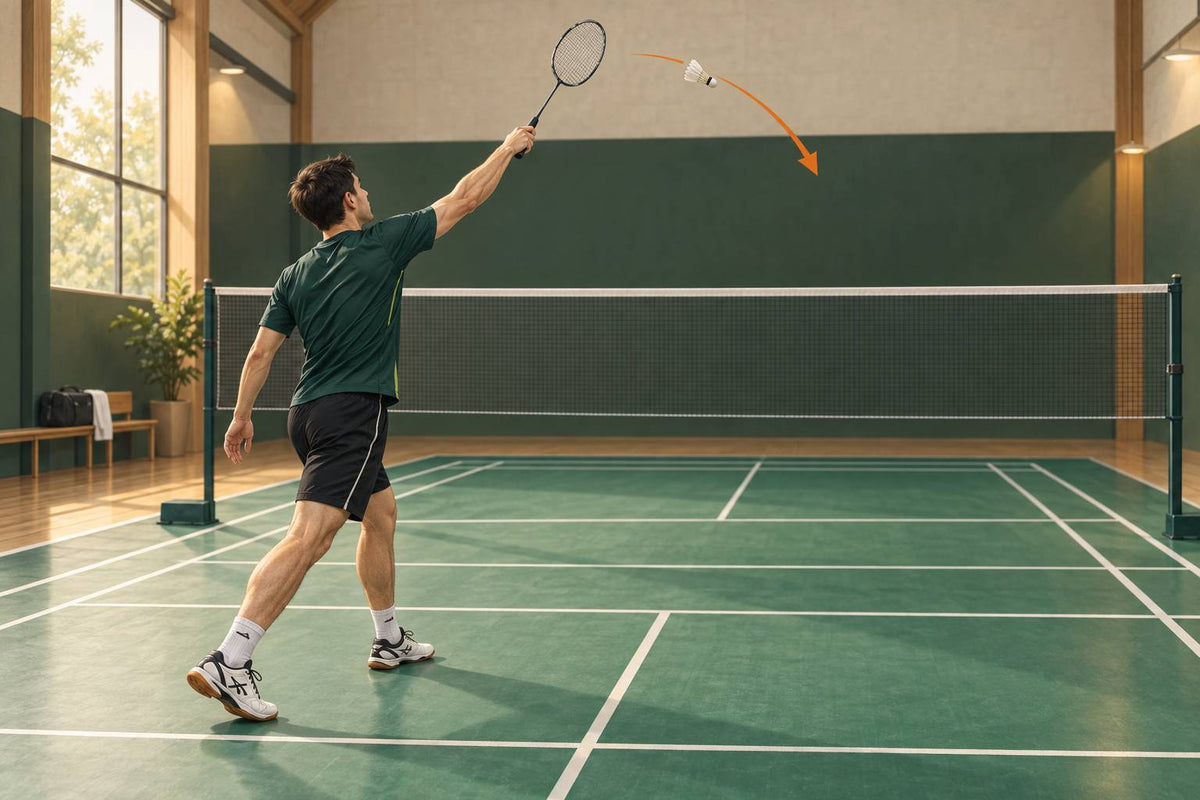
Simple cue: get sideways early, show your chest away from the net, then rotate through the shuttle instead of reaching up with only your arm.
The preparation checklist
Use this sequence when you practise clears, drops, and smashes at club night. The same overhead preparation makes your attack harder to read and gives you time to load the body properly.
| Setup cue | What it should feel like | Common mistake |
|---|---|---|
| Wide sideways stance | Turn side-on so your body can rotate into the shot instead of facing the net too early. | Standing square and trying to hit with only the shoulder and arm. |
| Racket foot back | Your racket-side foot starts behind you, giving you space to load, rotate, and move forward through contact. | Planting too close under the shuttle, then leaning backward to reach it. |
| Relaxed forehand grip | Use the forehand grip covered in the grip section, not a panhandle grip. | Choking the handle or opening the racket face before the swing begins. |
| Bow-and-arrow position | Your racket arm is prepared behind you while the front side of the body stays lifted and balanced. | Dropping the elbow, rushing the swing, or starting with the racket already too far forward. |
| Non-racket arm points up | Point at the shuttle so your spacing, shoulder line, and timing stay organized before contact. | Letting the front arm collapse, which often makes the body open too early. |
Think “load, rotate, strike”
When the shuttle goes up, your first job is to get behind it. Many weak smashes come from arriving late, standing under the shuttle, or letting it fall too low. Once you are behind the shuttle, the wide sideways stance and racket foot back position create the “load.” The bow-and-arrow shape keeps the upper body ready. The non-racket arm helps you track the shuttle and keeps the contact point in front of you.
From there, the feeling is not a straight arm slap. It is a chain: legs stabilize, hips and trunk begin to turn, the shoulder comes through, and the forearm and racket finish the strike. If one part starts too early (especially the arm), the chain breaks and the smash usually loses both angle and power.
"If your body is not loaded, your arm has to do work it was never meant to do alone."
A court drill for Canadian club nights
Before asking a partner to feed full smashes, rehearse the preparation without worrying about speed. On each overhead feed, call out the sequence in your head:
- Sideways: turn early instead of backpedalling square to the net.
- Foot back: keep the racket-side foot behind you so you can rotate forward.
- Bow: prepare the racket arm without tightening the grip.
- Point: use the non-racket arm to track the shuttle.
- Strike in front: make contact high and just in front of the body.
A good test: if you can pause briefly in the bow-and-arrow position and still feel balanced, your setup is probably useful. If you feel twisted, rushed, or falling backward, fix the feet before trying to add racket speed.
Coach-yourself checkpoint
Record one rally from the side of the court. On your best smash attempts, check whether you were sideways before the shuttle dropped, whether your racket foot was back, and whether your non-racket arm stayed up long enough to guide the contact.
Fix Your Contact Point and Timing

A lot of players think their smash is weak because they are not swinging hard enough. Often, the real problem is simpler: they are contacting the shuttle too late, too low, or while still reaching backward for it.
For a clean overhead smash, aim to contact the birdie at its highest reachable point and just in front of your body. That contact position gives your shoulder rotation, forearm pronation, and body weight somewhere useful to go. If the shuttle drifts behind you, your arm has to rescue the shot. If it drops too low, you are no longer smashing down. You are just pushing or clearing from a bad position.
The simple contact cue
- Get behind the shuttle early. Move so the shuttle is slightly in front of you at impact, not directly above or behind your head.
- Reach high, but stay natural. Contact it at your highest comfortable point without over-stretching the elbow or lifting the shoulder excessively.
- Use your non-racket arm. Pointing at the shuttle during preparation helps line up your body and improves timing.
- Hit before it falls. Once the shuttle drops below your ideal strike zone, your smash angle and power both suffer.
The preparation pattern taught in badminton fundamentals is a wide sideways stance with the racket foot back, a relaxed forehand grip, a “bow and arrow” racket position, the non-racket arm pointing at the shuttle, and contact at the highest point just in front of the body. That setup matters because it gives you time and space to rotate into the shot instead of swatting late.
| Timing problem | What it feels like | Correction |
|---|---|---|
| Not far enough behind the shuttle | You feel cramped, the shuttle is above or behind your head, and the smash floats instead of driving down. | Recover earlier after your previous shot and use small adjustment steps so the shuttle finishes in front of you. |
| Letting the shuttle fall too low | You swing hard but the shuttle travels flat, slow, or into the net because the hitting window has already passed. | Start your preparation earlier and make contact at the top of your reach, before the shuttle drops into a defensive hitting zone. |
| Applying power on the wrong part of the swing | The racket feels heavy and late, as if you are forcing the shot downward after the best contact moment. | Build speed into contact rather than muscling the racket after the shuttle has already dropped. |
Where on the strings should you hit the shuttle?
Centre contact is a good starting cue, but there is a useful detail for players who already strike the shuttle cleanly. A Loughborough University study cited by Badminton Insight found that the optimal smash contact point on the string bed is slightly off centre: about 2 cm above centre and 1 cm to the inside. The reason is that players pronate the racket head slightly at impact, so the racket face is not arriving perfectly square in the way a beginner might imagine.
Do not turn that into a complicated target during a rally. Use it as a refinement: if your timing is good but your smash still feels dull, pay attention to whether you are striking too low on the string bed or too far toward the outside edge. A clean, slightly high-inside contact can feel sharper than a forced centre hit because it matches the way the racket head is rotating through impact.
"If the shuttle is behind you or already falling, more effort usually makes the smash worse—not better."
A quick self-check for your next practice
Ask a partner to feed high shuttles to your rear court. Before you smash, freeze your preparation for a moment and check three things: your body is sideways, your racket foot is back, and the shuttle would land slightly in front of you if you let it drop. Then hit normally and notice whether contact happens high and in front.
Once that timing feels repeatable, the next step is making the racket head move correctly through impact (especially the forearm pronation that turns good positioning into a heavier, steeper smash).
Pronation, Impact, and Placement Matter More Than Swinging Harder
Quick reminder: keep the racket relaxed until the last instant, then tighten at impact; gripping tightly too early restricts wristwork and wastes the energy you have built through the body.

For the hitting action, think rotate through the shuttle, not “swing harder.” Classic biomechanics research supports this shoulder-and-forearm focus in the forehand smash: the racket head should accelerate late as the arm unwinds, rather than starting tense and muscling the shot from the hand.
That also explains why a locked, fully stretched arm is not the goal. A study of 19 elite Malaysian players found that faster smashes were characterized by a more internally rotated shoulder, less elevated shoulder, and less extended elbow at contact. In plain language: do not over-extend the elbow, and do not lift or shrug the hitting shoulder excessively upward just to feel taller at impact.
Impact checklist for your next Canadian club session
- Stay loose until the final squeeze at shuttle contact.
- Let the shoulder rotate through the hit instead of forcing a straight-arm slap.
- Keep the elbow active but not locked out at contact.
- Avoid excessive shoulder elevation; reach high through footwork and timing, not by jamming the shoulder upward.
- Contact high and just in front, remembering the off-centre sweet spot from the previous section.
Pick a Target Before You Hit
Once your contact is cleaner, placement becomes the fastest way to make your smash more dangerous. Do not measure every smash by sound or speed alone. A hard smash sent straight to the defender’s racket gives them the exchange they want.
Use these placement targets before adding more power:
- Away from the opponent’s racket: make the defender move the racket first instead of blocking from a comfortable position.
- To either side: aim into open space when the defender is square or late recovering.
- At the right hip of a right-hander: a useful body-smash target when there is no clear sideline opening.
- Down the middle in doubles: a strong option when both defenders are covering their outside lanes.
If you are working on how to improve badminton smash quality, make “relaxed grip, clean rotation, chosen target” your order of priorities. Speed is valuable, but only after the shuttle is struck cleanly and sent somewhere uncomfortable. A well-placed smash often draws a fast, low block, so sharpen the reactions you need to pounce on that reply with our reflex training guide for faster hands.
When Do Racket and String Tension Actually Help?
Gear can help your smash, but it cannot replace the mechanics you just worked through. If your grip is still tight, your contact point is late, or you are muscling the swing instead of using rotation and pronation, a more powerful racket will mostly make the same problem louder.
Once your technique is stable, then racket weight, flex, balance, string type, and tension become useful tools. A heavier racket can support more power because there is more mass behind the shot. A stiff racket can reward a faster swing because it deforms less and gives a more direct response. A head-heavy balance can add momentum through the head of the racket, which is why offensive players often look at smash-focused frames.
Upgrade after the technique checkpoint. If your timing is already consistent, browse current badminton rackets or compare the Yonex Astrox series for head-heavy attacking options.
What to look for in a smash-oriented racket
For most players trying to improve a badminton smash, the useful gear questions are:
- Can you handle the weight? More weight can help power, but only if you can still prepare early, recover quickly, and defend under pressure.
- Is the flex matched to your swing speed? Stiffer rackets tend to suit players who can generate their own racket-head speed. If your swing is still developing, too-stiff may feel demanding rather than powerful.
- Does the balance fit your game? Head-heavy balance can maximize momentum for offensive play, but it is not automatically better for doubles defence, flat exchanges, or players who prefer fast handling.
A good example of the smash-racket idea is the Yonex Astrox 100 ZZ, but check availability before planning around it. Its published specs are extra stiff flex, head-heavy balance, Rotational Generator System, 4U average 83 g / 3U average 88 g, and recommended tension of 20–28 lbs for 4U or 21–29 lbs for 3U. Those specs make it a serious attacking frame, not a shortcut for inconsistent contact.
Higher string tension is not free smash power
String tension is where many players chase power too early. Most club players string between roughly 20 and 26 lbs, and the important point is not “higher is better.” Higher tension can feel more direct and can improve placement for players who consistently hit the sweet spot. The trade-off is that the sweet spot becomes smaller, and strings are more likely to break on mis-hits.
If your smash contacts the top edge, bottom edge, or outside the clean hitting zone, raising tension usually makes the racket less forgiving. You may feel a sharper impact, but the shuttle will not necessarily leave faster. For developing players, a tension that lets you hit cleanly again and again is usually more productive than copying an advanced player’s setup.
| Setup choice | What it can help | Main risk |
|---|---|---|
| Head-heavy racket | More momentum through the racket head for attacking play. | Can feel slower in defence or quick doubles exchanges. |
| Stiff flex | More direct response for players with fast, efficient swings. | May feel unforgiving if your swing speed or timing is not there yet. |
| Higher tension | Sharper feel and better placement when you hit the sweet spot consistently. | Smaller sweet spot and more string breakage on mis-hits. |
| Lower-to-moderate tension | More forgiveness while you build cleaner timing. | May feel less crisp for advanced players who already generate power. |
Practical smash-tension rule
Default
Stay controlled: choose a tension you can hit cleanly in rallies, not only during warm-up feeds.
Go higher
Only when you can repeatedly find the sweet spot and want a crisper, more precise response within the recommended range above.
Go lower
If your smashes often miss the centre of the string bed, your strings break on mishits, or the racket feels harsh on contact.
Get the string job matched to your game
If you are in Greater Moncton, Badminton House offers badminton racket stringing in Moncton with a 2–3 day turnaround, matching string and tension to your game. Smash-oriented options listed for the service include BG80, described as crisp with high repulsion for intermediate to advanced players, and BG80 Power, described as a hard, explosive option for aggressive smashers.
For a deeper tension breakdown, read our badminton string tension guide. If you are still deciding between weight, balance, and flex before restringing, start with how to choose a badminton racket so the frame and string setup work together.
Bottom line: improve the smash with technique first, then use gear to reinforce what your body is already doing well. When you are ready to test an attacking setup, check current racket availability and remember that Badminton House offers free shipping within Canada on orders $200+.
Which Smash Fix Should You Choose First?
If you are wondering how to improve badminton smash power, choose the fix based on the symptom you actually feel on court. Most players should solve grip, positioning, contact, and pronation before changing rackets or string tension.
| If your smash feels like... | Choose this fix first | Why it matters |
|---|---|---|
| The racket face opens upward or the shot floats | Fix the grip: use a relaxed forehand “handshake” grip, not a panhandle grip. | A panhandle grip is common for beginners, but it limits effective smash mechanics and makes it harder to square the racket face through pronation. |
| You feel rushed, cramped, or late to the shuttle | Fix preparation and contact: get behind the shuttle, turn sideways, and meet it high and slightly in front. | Common beginner errors include not getting far enough behind the shuttle and letting it fall too low. See the Contact Point and Timing section. |
| You swing harder but the shuttle does not get much faster | Stop muscling it: build the smash from stance, rotation, relaxed acceleration, and forearm pronation. | Smash speed comes from a connected chain, not just arm strength. See the Ground Up and Pronation sections. |
| Your smash is fast enough, but opponents keep defending it | Choose placement: aim away from the defender’s racket, to the sides, at the right hip of a right-hander, or down the middle in doubles. | Placement is often overlooked. A slightly slower smash in the right lane can be harder to return than a predictable straight smash. |
| You increased string tension and started mis-hitting more | Choose control over ego: use a tension you can hit cleanly before moving higher. | Higher tension can reward precise timing, but it also reduces the sweet spot and punishes mis-hits. See the racket and string tension section. |
| Your technique is solid and you want a more attacking setup | Then consider gear: a head-heavy or stiffer racket can suit offensive players, while even-balance options may feel easier all-court. | Gear helps most after timing, contact, and swing mechanics are consistent. Browse the Yonex Astrox Series or check current racket availability before planning an upgrade. |
Technique first, tuning second. Once you can contact the shuttle cleanly, our Moncton racket stringing service can help match string and tension to your game, including smash-oriented options like BG80 and BG80 Power.
Get 10% off your first order
Join the Badminton House list and we’ll email you a 10% welcome code, plus subscriber-only restock alerts, giveaways, and honest gear advice from players.
By subscribing, you agree to receive Badminton House emails and can unsubscribe anytime.
Keep the focus simple: clean preparation, relaxed grip, high contact slightly in front, and a fast pronation through the shuttle. We play badminton too, so if you want a second opinion on whether your next step is technique work, string tension, or a more smash-oriented racket setup, contact us and tell us how you play.
"Build the smash first; use gear to support it once your contact point, pronation, and timing are repeatable."
— Badminton House player advice
Explore Yonex Astrox SeriesFree shipping on $200+ · 14-day returns · Canadian badminton specialty shop

Leave a comment
This site is protected by hCaptcha and the hCaptcha Privacy Policy and Terms of Service apply.