
Last updated: July 2026 · Written by the team at Badminton House
Quick Answer: Badminton Shoes With Ankle Support
For most Canadian club players, choose a badminton-specific court shoe that locks the heel, supports lateral movement, and resists twisting; if you have already rolled an ankle, add a brace and balance work instead of relying on shoes alone.
Default
Featured pick: Babolat Shadow Tour, with Power Straps structural midfoot support for lateral stability, a Michelin non-marking outsole, and about 295 g weight in size 9.
Max support
If ankle stability is your top priority, look for flagship stability features such as reinforced sidewalls, a firm heel counter, torsion support through the midfoot, and a secure collar; check current Badminton House footwear first, then Canadian specialty retailers or your local club pro shop if you need a model we do not carry.
Brace
If you have a previous ankle sprain, a pharmacy or physio-fitted lace-up brace can be worthwhile, especially when paired with balance and proprioception exercises for repeated lunges, jumps, and direction changes.
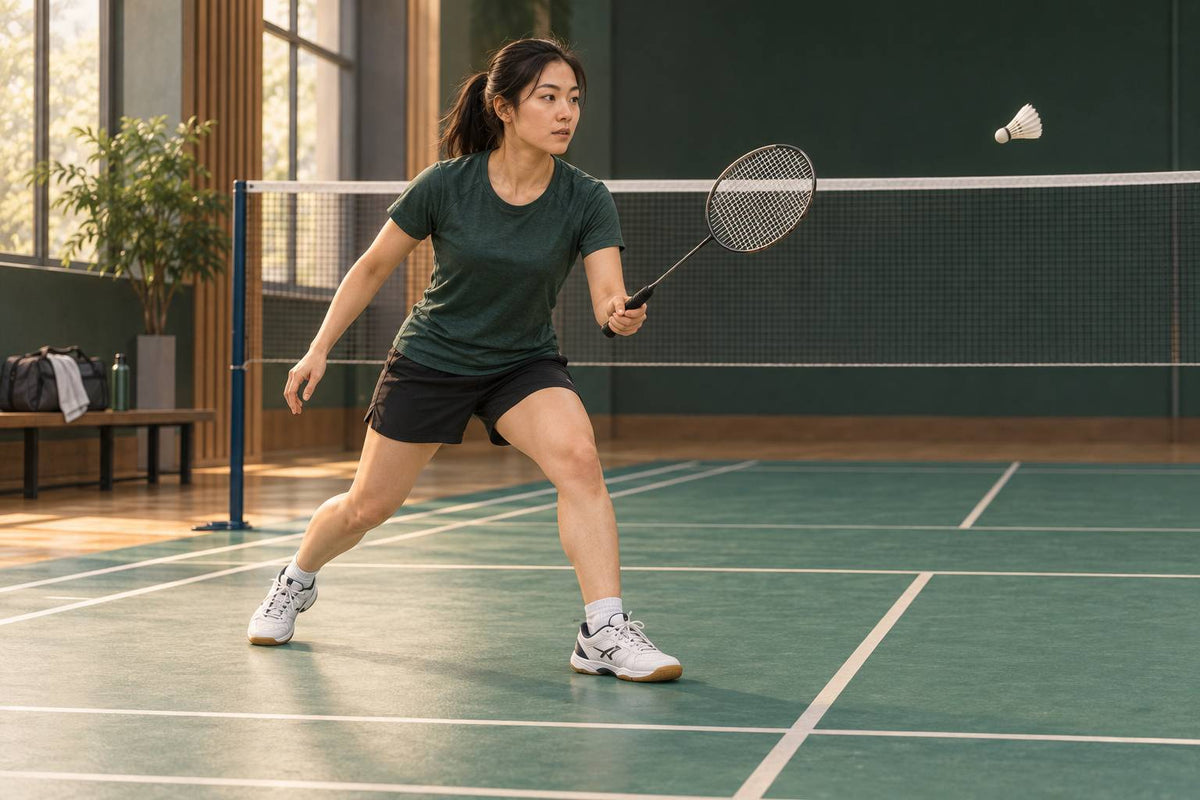
If you are searching for badminton shoes with ankle support, you are probably not just looking for a comfortable shoe — you are trying to stop your foot from sliding, twisting, or collapsing during lunges, split steps, and hard side-to-side recoveries. That concern is real: ankle sprains account for a large share of badminton injuries, and badminton’s repeated changes of direction, jump landings, and forward lunges put the ankle under constant stress.
The key is knowing what “ankle support” actually means in a badminton shoe. For indoor court play, it is less about choosing the tallest shoe and more about lateral stability: a secure heel, reinforced sidewalls, torsional support through the midfoot, reliable non-marking grip, and a fit that keeps your foot locked in place when you push off.
Start with proper indoor court shoes. Browse our badminton footwear collection, which ships within Canada.
In This Guide
- Why Are Ankle Rolls So Common in Badminton?
- What Does Ankle Support in a Badminton Shoe Really Mean?
- Best Stability-First Badminton Shoe Options to Consider
- Best Badminton House Pick: Babolat Shadow Tour
- Stability vs Lightweight Shoes: What You Give Up
- Fit and Heel-Lock Lacing to Reduce Foot Movement
- When Should You Add an Ankle Brace for Badminton?
- Which Ankle-Support Option Should You Choose?
Why Are Ankle Rolls So Common in Badminton?

Ankle rolls are badminton’s most common injury fear for a reason: the sport constantly asks your foot to land, brake, and push off while your body is still rotating or reaching. That is a very different demand from straight-line running, and it is why shoe stability matters so much on court.
Ankle sprains are among the most common injuries in badminton. They are typically described as happening on jump landings during backward or lateral movements or during a forward lunge.
- Backward and lateral jump landings: the case that loads the ankle hardest, and the movement most badminton sprains are described as happening on.
- Forward lunges, where the shoe has to stop the foot from sliding, twisting, or collapsing inward as you reach for a net shot.
- Direction changes: knee and ankle injuries commonly occur during changes in direction, which are built into nearly every rally.
Most ankle sprains are inversion injuries — the classic “rolled ankle,” where the foot turns inward. In badminton, that can happen when the outside edge of the shoe catches the court, when the heel shifts inside the shoe, or when a tired player lands slightly off-balance after a jump or late lunge.
So when players ask for badminton shoes with ankle support, they usually do not mean a high-top shoe like basketball. They mean a badminton shoe that keeps the heel locked, resists twisting, grips predictably on wood or PVC courts, and supports fast side-to-side footwork. For a broader prevention overview beyond footwear, see our Common Badminton Injuries: Canadian Prevention Guide.
What Does Ankle Support in a Badminton Shoe Really Mean?

When players search for badminton shoes with ankle support, they often picture a high-cut shoe. In badminton, the more useful question is: does the shoe stop your foot from sliding, twisting, or tipping during hard side-to-side movement?
In a badminton shoe, ankle support means lateral stability: a firm heel counter, reinforced sidewalls, and a torsion-resistant midfoot, not a high-cut collar. The key difference from running shoes is lateral-support reinforcement: badminton shoes are built for lunges, split steps, jump landings, and rapid direction changes, while running shoes are primarily shaped for forward motion. If you are still comparing court shoes against trainers, start with our guide to badminton shoes vs running shoes.
Ankle-support features to look for
- Reinforced sidewalls: help keep the foot from spilling over the edge of the shoe during defensive pushes and fast recovery steps.
- Firm heel counter: supports the back of the foot so your heel stays centred instead of shifting inside the shoe.
- Midfoot shank or torsion plate: adds torsional rigidity, which helps the shoe resist twisting when you plant and rotate.
- Multiple lacing eyelets: allow a tighter, more customized lockdown through the midfoot and ankle area.
- Padded collar and tongue: improve comfort and help the shoe hold the foot securely without creating sharp pressure points.
- Rounded outsole edges: can help reduce the chance of the sole catching abruptly during lateral movement.
- Non-marking gum rubber outsole: gives the grip needed for indoor badminton courts; on PVC or wood courts, non-marking court soles are the standard choice.
The best stability shoes combine several of these features. A firm heel counter without good midfoot lockdown still lets the foot move around. A grippy outsole without sidewall support can still feel unstable when you push wide for a smash block. A soft, comfortable upper can feel great at first but may not provide enough structure for aggressive doubles movement.
For ankle support, look for a shoe that feels snug, centred, and resistant to twisting. Your heel should stay down, your midfoot should feel locked in, and the shoe should feel stable when you make a small side lunge—not just when you stand still in it.
Best Stability-First Badminton Shoe Options to Consider
If your search for badminton shoes with ankle support really means “I want the shoe to resist rolling, twisting, and sliding inside the upper,” focus on lateral structure first. The models below are worth knowing because they are built around side-to-side stability, torsional support, and landing control — not just arch support, cushioning, or wide-foot fit.
| Shoe line | Stability features to look for | Why it matters for ankle support | Canada buying note |
|---|---|---|---|
| Yonex Eclipsion Z3 | Lateral Shell, Stability Reinforcement, Semi One-Piece Sole, Radial Blade Sole, larger ground contact area, and Power Cushion+. | This is the stability benchmark in the Yonex court-shoe family: the wider contact concept and reinforced side structure are aimed at steadier landings and less lateral shake during aggressive sidesteps. | Badminton House does not carry an Eclipsion-class model. For this specific flagship stability category, check Canadian badminton specialty retailers or your local club pro shop. |
| Victor P9200cHP / P9200 | Carbon fibre sheet, TPU arch support, LS-S lateral stabilization system, and stiffer EVA on the outer forefoot. | These are anti-torsion options. The key idea is to reduce unwanted twisting through the midsole and add support on the outside edge where badminton players often load during cuts and recovery steps. | Badminton House does not currently list Victor P9200 models, so availability may require a Canadian badminton specialty retailer or a local club pro shop. |
| Victor P8500 TD IN | 3D Tri-Claw and Carbon Power. | This is the lateral-stability pick in Victor’s stability conversation, especially for direction changes where the shoe needs to resist rolling and keep the platform controlled. | Not currently stocked at Badminton House. Use the feature list as a checklist when comparing stability-first shoes in Canada. |
Note for Canadian players. Badminton House does not carry Eclipsion-class or Victor P9200 flagship stability models. You can still shop current badminton shoes, which ship within Canada.
1. Yonex Eclipsion Z3: the stability benchmark
The Eclipsion Z3 is the model to study if ankle stability is your top priority. Its stability story is not one single feature; it is the combination of a Lateral Shell, Stability Reinforcement, Semi One-Piece Sole, Radial Blade Sole, larger contact area, and Power Cushion+.
For badminton movement, that matters because ankle rolls usually happen when the foot loads hard to the side, lands slightly off-centre, or shifts inside the shoe during a fast recovery. A shoe with more lateral structure and ground contact can feel less “tippy” than a minimal lightweight model.
If you are ordering online in Canada and cannot try it on first, note that the Eclipsion Z3 has been described as having a snug inner bootie and running small, so sizing up may be worth considering.
Manufacturer tech reference: Yonex Power Cushion Eclipsion Z 3rd Gen.
2. Victor P9200cHP / P9200: anti-torsion stability
The Victor P9200 family is the other major stability-first reference point. The P9200cHP uses an EzCiclo carbon fibre sheet for support and anti-torsion performance, plus HYPEREVA midsole material and the LS-S lateral stabilization system. Victor also highlights stiffer EVA on the outer forefoot to enhance lateral stability.
On the P9200, the ankle-relevant details are the high-strength lightweight TPU arch support and the three-dimensional carbon fibre sheet. The purpose is to reduce pronation and torsional strain while keeping the midsole stable during badminton-specific changes of direction.
Manufacturer tech references: Victor P9200cHP and Victor P9200.
3. Victor P8500 TD IN: lateral-stability option
The Victor P8500 TD IN is worth considering when your main concern is lateral support during direction changes. Its stability case centres on 3D Tri-Claw and Carbon Power, which are used to support the shoe platform when the player cuts, pushes off, or lands outside the centreline of the foot.
This is the type of shoe to compare against lighter speed-focused models if you have a history of ankle rolls, play a lot of doubles defence, or often feel your foot tipping over the outside edge during hard side lunges.
Bottom line: for ankle support, do not shop by brand name alone. Look for the construction cues: lateral shell or sidewall reinforcement, a stable heel counter, torsion plate or carbon sheet, supportive midfoot structure, and an outsole shape that gives confident contact during side-to-side movement.
If you are still deciding between court-shoe categories, the comparison in badminton shoes vs running shoes explains why lateral support matters more in badminton than straight-line cushioning.
Best Badminton House Pick: Babolat Shadow Tour
If you want the most ankle-stability-relevant shoe at Badminton House, the pick is the Babolat Shadow Tour Men's Badminton Shoes – Orange. It is not an ankle brace, and it will not stop every bad landing, but its support story lines up well with what badminton players usually need: better midfoot hold, lateral stability, and court-specific traction.
Babolat Shadow Tour Men's Badminton Shoes – Orange
Power Straps midfoot support · Michelin non-marking outsole · Kompressor dual-density EVA/KPRS-X cushioning · ≈295 g, size 9
The key ankle-support feature here is Babolat's Power Straps: integrated structural midfoot support that wraps the foot to help stabilize lateral movement and reduce twisting inside the shoe. That matters in badminton because many ankle rolls start when the foot shifts, collapses, or lands off-centre during a lunge, split step, or sideways recovery.
| Feature | Why it matters for ankle support |
|---|---|
| Power Straps | Wraps the midfoot for integrated structural support, helping stabilize lateral movement and prevent twisting. |
| Michelin non-marking outsole | Built for indoor court grip without leaving marks, which is important when pushing off and landing on gym floors. |
| Kompressor dual-density EVA / KPRS-X cushioning | Adds impact cushioning for repeated lunges, jumps, and hard stops. |
| Approx. 295 g, size 9 | A stability-relevant build that stays under the 350 g reference point often used for balancing support and weight. |
Current Badminton House details: sizes 7–11.5 listed. Consider whether you need grips, socks, shuttles, or other essentials at the same time.
Shop Babolat Shadow TourThe honest limitation: this is our best stability-relevant option, not a dedicated max-stability flagship shoe. If you have a long history of ankle sprains, you may still want to compare it against higher-structure models through Canadian badminton specialty retailers or your local club's pro shop. But for players shopping directly from Badminton House today, the Shadow Tour is the clearest pick because its midfoot support system targets the foot movement that often contributes to twisting.
Ships across Canada · 14-day returns
One more fit note: ankle support only works if the shoe actually locks your foot down. If you need extra room through the forefoot, read our wide-feet badminton shoe guide before sizing up too aggressively, because a shoe that is too roomy can let your foot slide during lateral movement.
Stability vs Lightweight Shoes: What You Give Up
The lighter a badminton shoe gets, the more carefully you need to check what was removed to save weight. A speed shoe can feel amazing for quick doubles exchanges, but if it gives up sidewall structure, heel hold, or torsional stiffness, it may not be the best choice for a player who is worried about ankle rolls.
A useful benchmark: badminton shoes under 350 g can still balance support and speed well. The question is not simply “light or heavy?” It is whether the shoe keeps the foot centred during hard side steps, split-step landings, and recovery steps after a lunge.
| Shoe style | What you gain | What you may give up | Best fit |
|---|---|---|---|
| Stability-first | More structure around the heel, midfoot, and outside edge of the shoe. | Usually a less minimal feel than a pure speed shoe. | Players with past ankle rolls, aggressive side-to-side movement, or singles-heavy footwork. |
| Balanced | A mix of lateral stability, cushioning, grip, and reasonable weight. | Not as protective as a maximum-stability shoe and not as feather-light as a speed model. | Most club players who want one shoe for games, drills, and league nights. |
| Lightweight speed | Fast first step, quick recovery, and a more agile feel. | Less structure than stability-flagship shoes, depending on the model. | Fast doubles players with strong ankles and no recent sprain history. |
The lightweight example: Yonex Aerus Z2
The Yonex Aerus Z2 is the clean example of the speed-first trade-off. At about 270 g in size 9, it prioritizes quickness and agility. That can be a real advantage if your game is built on fast interceptions, front-court pressure, and quick doubles rotations.
The trade-off is that an Aerus-style shoe is not built with the same stability-first structure as an Eclipsion-class shoe. If your main concern is ankle support, especially after a previous roll, that difference matters more than the scale weight.
The balanced reference: Yonex 65 Z4
The Yonex Power Cushion 65 Z4 is a helpful middle-ground reference because it shows how a shoe can stay reasonably light while still emphasizing court stability. The Yonex SHB65Z4M is built around an approximate 280 g weight in size 9 along with Power Cushion+, a rubber outsole, Round Sole, and a claim of superior lateral stability for side-to-side movement.
That is the kind of profile many Canadian club players should understand before buying: not the lightest possible shoe, not the most built-up stability platform, but a balanced court shoe intended to handle badminton’s repeated pushes, stops, and directional changes.
Simple rule for ankle-support shoppers
If two shoes both fit well, choose the lighter one only when it still keeps your heel locked, resists twisting through the midfoot, and feels stable on hard lateral stops. If it feels fast but your foot slides or tips over the side, it is the wrong kind of “fast.”
For a deeper breakdown of the Yonex stability, balanced, and speed families, see our Yonex 65Z vs Aerus vs Eclipsion guide.
Fit and Heel-Lock Lacing to Reduce Foot Movement

The best ankle-support setup starts with fit, not just shoe technology. Lateral shells, heel counters, midfoot support, and grippy outsoles only help if your foot stays centred on the platform when you split-step, lunge, brake, and recover.
A badminton shoe should feel snug but not painful. You want a locked-in heel and midfoot, with enough room at the front that your toes are not jammed during lunges. A practical target is about 5 mm of space at the toes when standing in your playing socks.
- Heel: your heel should not lift noticeably when you walk, bounce, or simulate a split-step.
- Midfoot: the shoe should wrap the foot securely without pinching the arch or cutting circulation.
- Forefoot: your toes should have a little space, but your foot should not slide forward into the toe box when you stop hard.
- Width: if the side of your foot spills over the sole platform, the shoe may feel unstable even if the model has good support features.
Online fit check for Canadian buyers
Measure both feet, compare against the brand chart, and leave room for your playing socks before ordering. Use our Badminton House size guide if you want help checking the fit before buying badminton shoes online in Canada.
As noted above, Yonex Eclipsion Z3 sizing runs small, so recheck your measurements carefully before ordering that style online.
How to use heel-lock lacing
If the shoe length and width are right but your heel still moves, try heel-lock lacing before assuming the shoe is wrong. This lacing method helps reduce excessive foot movement inside the shoe by using the final eyelets to hold the heel more securely.
- Lace normally first: criss-cross the laces up the shoe until you reach the second-to-last eyelet.
- Make two loops: thread each lace through the last eyelet on the same side, creating a small loop on the left and right.
- Cross through the loops: take each lace across the tongue and pass it through the opposite loop.
- Pull tight and tie: pull the laces snug so the heel drops back into the heel cup, then tie your shoe normally.
The pressure should feel strongest where the top of your foot curves upward, not across your toes. If your toes tingle, the forefoot feels numb, or the upper bites into the top of your foot, loosen the lower eyelets and retighten from the midfoot upward.
A good stability shoe should feel like it is moving with your foot, not like your foot is moving inside it. If you can feel sliding inside the shoe during a lunge, fix the fit and lacing first; otherwise, the support features cannot do their job.
When Should You Add an Ankle Brace for Badminton?
A supportive badminton shoe should be your first layer: stable outsole, firm heel hold, lateral support, and a fit that stops your foot from sliding inside the shoe. But if you have already rolled an ankle, shoe stability alone may not be enough.

The strongest case for an ankle brace is a previous ankle sprain. The evidence is strongest for athletes who have already sprained an ankle. A NATA position statement reports a number-needed-to-treat of 5 among athletes with a previous sprain, compared with 57 among those without. Those figures come from soccer research rather than badminton, so treat them as a direction rather than badminton-specific numbers. In plain English: braces are usually most worthwhile after you have already had an ankle sprain, not as a default purchase for every player.
When a brace makes sense
- You have a previous ankle sprain: especially if the ankle still feels unreliable on lunges, split steps, or recovery steps.
- You are returning to play: a pharmacy lace-up brace or a physio-fitted brace can add external support while you rebuild confidence and control.
- You tape before matches: taping can help, but it is best done by someone who knows sport taping, such as a physiotherapist or athletic therapist.
- You keep rolling the same side: that is a sign to get assessed rather than simply buying stiffer shoes.
Badminton House does not carry ankle braces or insoles, so we do not want to pretend there is a one-click fix here. If you need extra support, look for a properly sized lace-up or semi-rigid brace at a pharmacy, or ask a physiotherapist to fit one for your ankle and playing demands.
The key is not to treat the brace as the whole prevention plan. Guidelines advise balance and proprioceptive exercises alongside bracing, and balance training can reduce ankle sprain risk in badminton players. That matters because badminton ankle rolls often happen when your body is reacting quickly: late lunges, awkward landings, and fast changes of direction.
| Option | Best use | What not to forget |
|---|---|---|
| Stable badminton shoes | Your everyday foundation for lateral movement, lunging, and indoor court grip. | Fit and heel lockdown still matter; a supportive shoe cannot help if your foot is sliding inside it. |
| Ankle brace | Most relevant for players with a previous ankle sprain or a repeat instability pattern. | Use a properly fitted brace; do not rely on it instead of strength, balance, and landing control. |
| Taping | Useful when applied correctly, especially around competition or return-to-play periods. | Technique matters; consider a physio or athletic therapist rather than guessing with tape tension. |
| Balance training | A long-term prevention layer for players who lunge, jump, and change direction often. | Keep it consistent; build it into your warm-up instead of waiting until the ankle feels vulnerable. |
If you are building a prevention routine, pair your shoe choice with a proper warm-up, progressive balance work, and a realistic return-to-play plan. Our badminton warm-up guide is a useful starting point before club nights and cold Canadian gym sessions.
Bottom line: for badminton shoes with ankle support, think in layers. Start with a stable, court-specific shoe; add a brace if you have a sprain history; and keep doing the balance work that helps your ankle react under pressure. If you are replacing worn shoes, browse our badminton footwear collection for what suits your game.
Which Ankle-Support Option Should You Choose?
Use this as the practical shortcut: start with your ankle history, then decide how much speed you are willing to trade for stability.
| Your situation | Choose this | Why | Watch for |
|---|---|---|---|
| You have rolled an ankle before | A max-stability badminton shoe, plus a brace or taping if recommended for you | Players with a previous ankle sprain have a higher recurrence risk, and bracing or taping is most useful for athletes recovering from a previous sprain. | Do not treat a brace as the whole fix; balance and proprioceptive work should still be part of prevention. |
| You feel unstable on landings or hard side steps | A stability-first model with reinforced sidewalls, a firm heel counter, torsional support, and a secure upper | Badminton ankle sprains commonly happen during jump landings on backward or lateral movements and during forward lunges, so lateral control matters more than a high-cut look. | If the shoe lets your heel lift or your foot slide inside, use heel-lock lacing before assuming the model lacks support. |
| You want support without feeling slowed down | A balanced stability/speed shoe, like the 65 Z4-type option discussed above | This is the middle path for club players who want side-to-side stability but do not want the most structured stability-flagship feel. | Check current availability before planning around that exact model. |
| You prioritize speed and have no ankle-sprain history | A lightweight agility shoe, like the Aerus-style option discussed above | Lightweight models prioritize speed and agility, which can suit fast doubles movement when your foot stays locked in. | You give up some structure compared with Eclipsion-class support, so this is not the safest default after a previous ankle roll. |
| You want a Badminton House option now | Babolat Shadow Tour Men’s Badminton Shoes | This is the featured Badminton House pick covered in the dedicated section above. | Check the available size range and use the size guide before ordering online. |
If you are still comparing shoe categories, read Badminton Shoes vs Running Shoes before buying court footwear for indoor badminton.
Get 10% off your first order
Join the Badminton House list and we’ll email you a 10% welcome code — plus subscriber-only restock alerts, giveaways, and honest gear advice from players.
By subscribing, you agree to receive Badminton House emails and can unsubscribe anytime.
If you are trying to choose badminton shoes for ankle support, start with the fit: your heel should feel locked in, your foot should not slide during lunges, and the shoe should give you confidence on side-to-side recovery steps. We play badminton ourselves, so if you are between sizes, coming back from an ankle roll, or unsure whether a stability-first shoe is right for your game, contact us and we will help you think it through before you buy.
Ships across Canada · 14-day returns · Canadian badminton specialty shop

Leave a comment
This site is protected by hCaptcha and the hCaptcha Privacy Policy and Terms of Service apply.