
Last checked: August 2026 · Written by the player-led team at Badminton House
Quick answer
A continuous net interception drill puts one feeder at the net tossing shuttles to five spots across the front court while the working player intercepts every one without resetting. The feeder controls tempo and height; the player keeps the racket raised, covers each spot in a single push-off or lunge step, and presses the shuttle down instead of swinging at it.
- Feed five spots per set: two forehand-side, two backhand-side, one at the middle seam.
- Keep the racket up between reps so recovery, not reach, decides how fast you can go.
- Progress from a fixed, called spot to a random one only once the timing settles.
Related reading: Badminton Net Kill Technique — for the grip, contact and follow-through mechanics this drill assumes you already have.
The five-spot feed map and feeder tempo
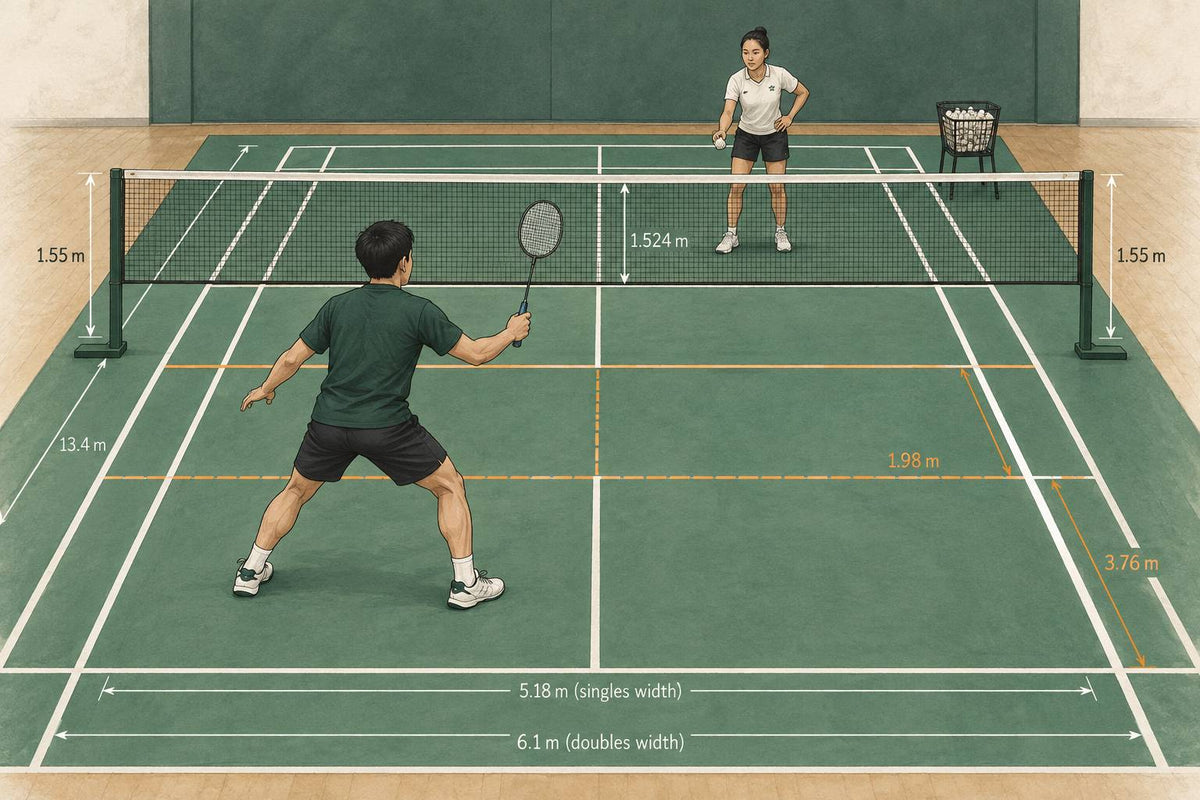
Run this drill with a feeder standing near the net and a working player covering the whole front court. The feeder tosses to five points in sequence, two forehand-side, two backhand-side, one at the middle seam, varying height and pace so the player reacts to a different angle on every rep.
For a right-handed player looking toward the net, number five spots from right to left between the net and short service line: 1 and 2 are on the forehand side, 3 is central, and 4 and 5 are on the backhand side. Mirror the map for a left-hander and adjust its width to the player. The feeder stands on the far side of the net and tosses overhand or underhand, whichever matches the flight of the shot being trained, calling or pointing to the spot while the player is still learning the pattern.
A published multi-feed drill for doubles front-court attack uses this shape: the feeder stands in the middle of the net or to one side, switching position between reps, and tosses at differing heights and speeds so the player plays a different angle every time, training a skill described as key to pressuring opponents and finishing rallies. Coach education backs the feeder's side of that logic: the rate of feed should stay slow enough for the player to reflect and reset while learning, with each toss's flight path matched to the shot it trains, before tempo rises toward match speed.
A workable structure is three sets of ten tosses, two per spot, resting 20 to 30 seconds between sets. Set the width and base so each feed can be reached under control; use one or two approach steps as the distance requires, a judgment call covered in our badminton net approach footwork guide.

Three ways to progress the drill
Once the five-spot pattern feels automatic, progress it three ways: call the spot number less often so the player reacts instead of anticipates, add a lift as an escape option so the player must choose whether to press forward, and hand the feed to a live rear-court partner so the drill becomes a real rally.
1. Fixed spot to random spot. Start by naming or pointing to the spot before every toss, which isolates footwork and contact from decision-making. Once the pattern is clean, stop announcing it and let the player read the toss itself, the shift that turns a rehearsed drill into usable court skill.
2. Add a lift as the escape shot. Every fourth or fifth toss, replace the net-height feed with a lofted lift toward the back of the court. The player must judge whether the toss is close enough to press or better left to travel, rather than lunging at everything on reflex, turning pure reaction into selective interception.
3. Add a live partner behind. Once footwork and selection hold up, add a rear-court partner and an opponent on the other side: the partner smashes or drops, the opponent returns, and the front player intercepts that reply inside an actual rally. Coach education frames that role in the same terms once a pair is attacking: cover the mid- and forecourt, take the shuttle early, intercept drives and pushes, and keep the attack alive. Our doubles front-court net play guide covers shot selection once the point is live; this drill only trains the interception itself.
The two faults that kill interception
Two faults undo this drill before footwork ever becomes the problem: a braced shoulder that turns a short downward press into a bigger swinging motion, and a racket left low between reps so every toss starts with a recovery movement instead of a strike. Both are self-checkable mid-set.
Fault 1: the braced shoulder. Tensing the shoulder to muscle the shuttle down shortens how far the arm can comfortably reach and turns a short, relaxed finger-and-wrist press into a longer swing that arrives late, netting the shuttle or popping it up. Self-check between reps: shake the hitting arm out. If the shoulder feels locked rather than loose, it is doing work that belongs to the fingers and wrist; the full contact mechanics for that press live in our net kill technique guide rather than repeated here.
Fault 2: the lowered racket. A front-court player should keep the racket raised above net height at all times, because dropping it means raising it again before any interception is possible, and a raised racket is easier to drop than a lowered one is to raise under pressure. This is also why the drill runs as a continuous feed rather than one shuttle at a time: net-kill technique itself ends with the same instruction, recover the racket quickly to anticipate the next return, and continuous feeding turns that recovery into a trained habit. Self-check: watch your racket hand between tosses; if it dips to your hip after each contact, you are rebuilding your base every rep instead of holding it.
Take this to your next session
Run three sets of the five-spot pattern before your next doubles match, and resist the urge to swing bigger when a rep goes long. The racket-up recovery between tosses is the actual skill this drill trains; everything else is just enough repetition to make it automatic.


Leave a comment
This site is protected by hCaptcha and the hCaptcha Privacy Policy and Terms of Service apply.