
Last updated: July 2026 · Written by the team at Badminton House
Quick Answer: Badminton Rear Court Footwork
Choose the pattern by time: use scissor when you can get behind the shuttle, china jump when you're late-but-stable, and survival steps when you're stretched.
Scissor
Best choice: Split step, move sideways, load the racket leg, then scissor to hit and recover forward when you have enough time.
China
Use a parallel jump into the forehand rear corner when the lift is flatter and you need a counter or defensive shot.
Survival
Use a lunge or extra adjustment step only when you cannot get behind the shuttle; regain balance before attacking again.
If you keep arriving late to the rear court, the fix is not “move faster” in a vague way. Rear-court footwork is about choosing the travel pattern that matches the shuttle: a scissor when you have time to get sideways and attack, a china jump when time is tighter, or a survival step when you are stretched. Start every read with a sharp split step, then judge distance before committing your feet. The goal is to arrive balanced enough to hit high and recover, not to copy one pattern for every lift.
In This Guide
Badminton Rear Court Footwork Is a Pattern Choice
Good badminton rear court footwork is not one fixed set of steps. It is a decision: how much time do you have, how far is the shuttle behind you, and how much energy do you want to put into the shot? Many missed or mishit shuttles come from arriving late, cramped, or off balance rather than from a broken swing.
That is why strong movers do not use one automatic pattern for every rear-corner shuttle. In the same corner, an elite player might rotate aggressively for a jump smash, use a scissor action to attack and recover, or take a more defensive step when the rally has already put them under pressure.
If terms like split step, chassé, lunge, or recovery base still feel new, start with Badminton Footwork Basics first. This guide assumes you know those building blocks, then shows how to choose between them in the rear court.
Start With the Split Step, Then Match Steps to Distance
Before choosing a rear-court pattern, make the first movement a directional split step. If the split is late or flat, the next steps become rushed and the whole pattern gets longer. For a deeper breakdown, see Badminton Split Step: Move Faster on Court.
The required step count depends on your starting position, the shuttle’s flight and your stride. Use enough steps to arrive balanced; fewer steps are useful only when they preserve timing and control.
Match the step to the distance. Use a two-step for short-to-mid movement when stability matters. Add a cross-step when the corner is farther away and you need to reduce step count. Use a chassé for final adjustment near the back line, and a lunge only when you need one last reach into a strong hitting posture.
Choose the Rear-Corner Travel Pattern: Scissor, China Jump, or Survival
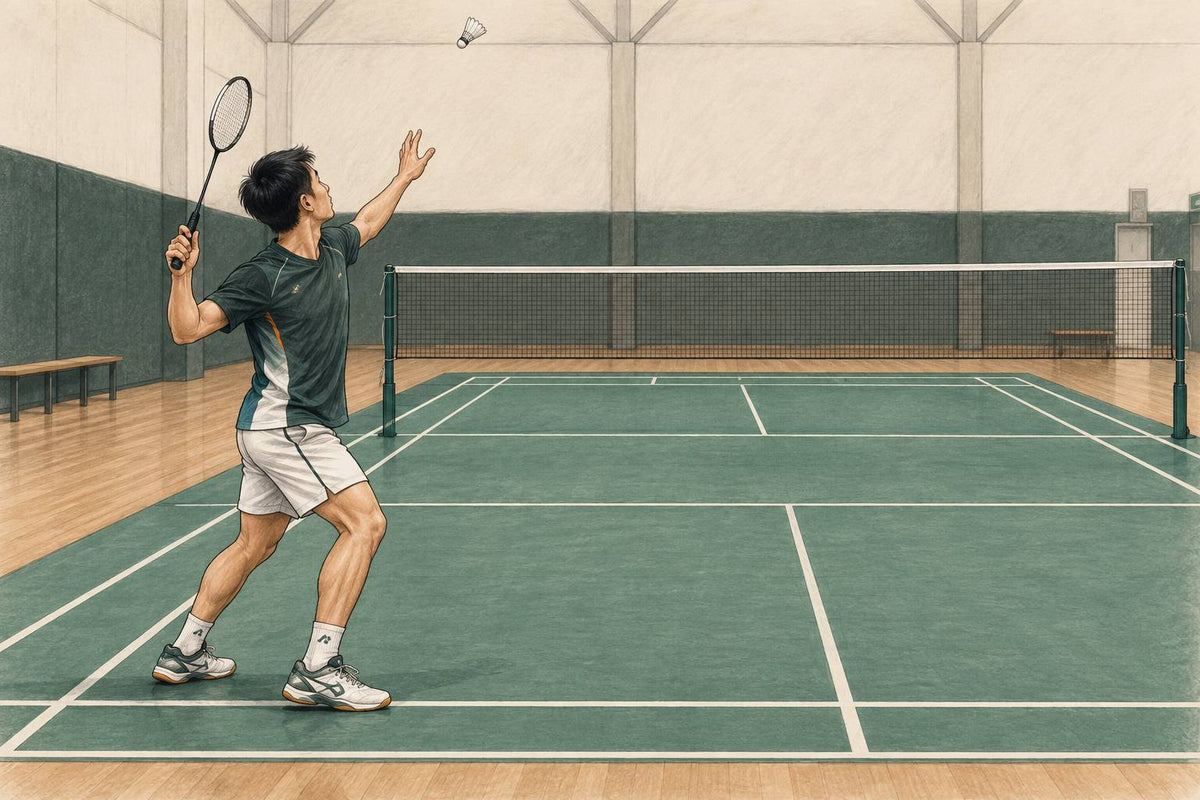
Use the scissor jump as your default learning pattern when you have slightly more time. It lets you load through the racket leg, rotate, and transfer energy through the legs, hip, and torso, so you can hit with more authority and start moving forward after contact. Learn this first; players who build their rear-court habits around the more passive option often stay passive too often. For the detailed mechanics, see the rear-court scissor jump guide.
- China jump: choose this parallel jump when you have little-to-medium time and need a counter or defensive shot. If the lift is flat and you cannot get behind the shuttle, treat it as a jump-out situation rather than forcing a full rotation.
- Defensive lunge: use this as the survival pattern when the rally has already put you under pressure and you only need to reach, control, and recover.
Arrive on Time, Stay Sideways, and Recover With Balance
Arrival is a timing skill, not just a speed goal. Match contact and landing to the stroke: in a scissor overhead, strike while airborne and land afterward. Do not apply a foot-before-contact lunge cue to every rear-court overhead. Use adjustment steps before take-off to create enough space for the shuttle.
For overhead preparation, stay sideways with your non-racket shoulder facing the net, then rotate through only as much as the shot needs. In a scissor kick, two common errors are pausing on the back leg, which breaks the weight transfer and ruins timing, and over-rotating, which moves the contact point away from where you prepared it. After contact, land slightly wider than shoulder width so your first recovery push can go to the next reply rather than wobbling back to balance.
Scissor-kick landings load the lower limbs, and elite-player landing data found the calf muscle group contributed about 41% of total eccentric joint work during landing.
Which Rear-Court Pattern Should You Choose?

Use this as your in-rally filter: time first, then whether you are behind the shuttle, then how much attacking energy you can safely transfer.
| Situation | Choose | Why it fits |
|---|---|---|
| You have time and can get behind the shuttle | Scissor jump | Best attacking option because the leg, hip, and torso rotation adds energy and helps you move forward after contact. |
| You have little to medium time | China jump | Useful for countering or defending when a full rotational scissor would arrive late. |
| You are stretched or late | Survival lunge or adjustment step | Prioritize balance and a strong hitting posture over a bigger jump. |
| You repeatedly need extra steps | Improve first push-off | A faster first move off the split step reduces the total steps needed to reach the rear court. |
Get 10% off your first order
Join the Badminton House list and we’ll email you a 10% welcome code — plus training guides, technique advice, and badminton updates.
By subscribing, you agree to receive Badminton House emails and can unsubscribe anytime.
Rear-court movement improves when you stop copying one pattern and start choosing the pattern that gives you time, balance, and recovery. Practise the choice slowly first, then add feeding speed only when you can arrive balanced and recover cleanly.
Your shoes are the one gear choice that affects every push-off, landing, and recovery step.
Check Badminton FootwearChoose grip and stability before chasing more speed.

Leave a comment
This site is protected by hCaptcha and the hCaptcha Privacy Policy and Terms of Service apply.