
Last checked: August 2026 · Written by the Badminton House player-led team.
Quick answer: place, hang, tension, measure, then close the ends
Put vertical posts on the doubles sidelines, remove every twist before tightening, and measure the net at three points. The top should be 1.55 metres over both doubles sidelines and 1.524 metres at centre. The small 26-millimetre centre drop is legal. Finish with a no-gap check at both posts.
A badminton net can look tidy from one sideline and still be too low at centre, twisted inside the top tape, leaning under tension, or open beside a post. A repeatable two-person routine catches those faults before the first serve and avoids fixing one measurement by creating another problem.
This guide covers an indoor court and the finished legal geometry. It is practical setup guidance, not formal facility certification. The full line layout sits in our badminton court dimensions guide; here, the task is to place and check the net correctly.
What makes a badminton net legal before anyone serves?
A legal setup has vertical 1.55-metre posts on the doubles sidelines, a correctly sized dark mesh and white top tape, a firm cable flush with the post tops, specified centre and side heights, and no gap beside either post. Check the finished state rather than judging the net by tension alone.
The current BWF Laws of Badminton set out these exact requirements:
- Posts: 1.55 metres high, vertical when the net is tensioned, and placed on the doubles sidelines whether singles or doubles is played.
- Mesh: dark cord of even thickness, with mesh openings from 15 to 20 millimetres.
- Net body: 760 millimetres deep and at least 6.1 metres wide.
- Top: a 75-millimetre white tape doubled over a cord or cable, with the cable stretched firmly and flush with the post tops.
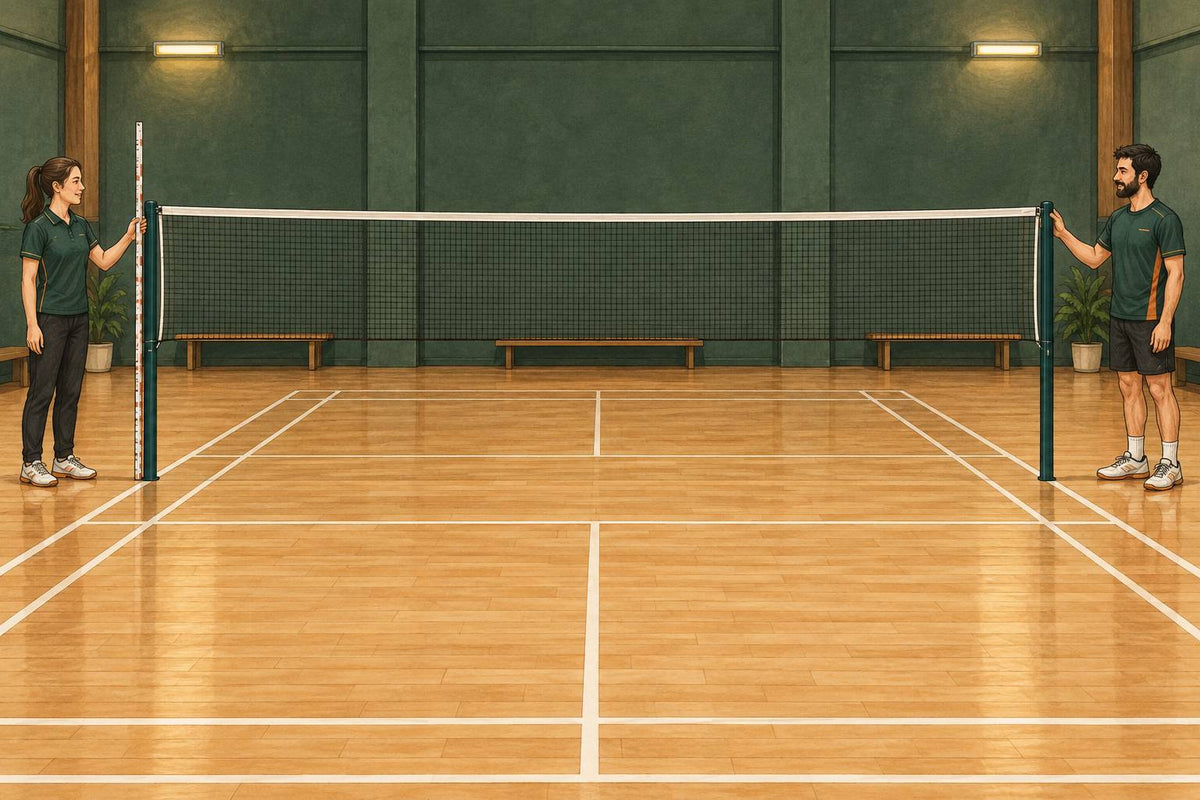
- Height: 1.524 metres at centre and 1.55 metres over each doubles sideline.
- Ends: no gap between net and post; tie the full depth to the post when necessary.
The centre is intentionally 26 millimetres lower than the sides. Do not pull until the top looks perfectly horizontal, and do not use a five-centimetre drop as a rule of thumb. Measure the specified points from the court surface to the top of the net.
Three measurements, not one: centre court plus both doubles sidelines. One correct side height does not prove the centre or opposite end is correct.
How do two people hang and tension a badminton net?
Let one person own post position and alignment while the other handles the net and top cable. Work from the floor upward: place and lock the posts, identify the untwisted top edge, attach both ends loosely, tension in small steps, then measure and close the post gaps. Do not correct instability with extra tension.
- Clear the net line. Move shuttles, baskets, bags, and loose equipment away from both post bases and the path between them.
- Place both posts. Align the centre of each post with its doubles sideline. Look from above or have the second person sight along the line.
- Set the posts vertical. Seat or lock each base as designed. If a post rocks or a lock does not hold, stop and ask venue staff to correct the equipment rather than relying on net tension.
- Find the top edge. Lay out enough net to identify the white tape and cable. Remove every spiral twist before fixing the second end.
- Attach the first end loosely. Keep the white tape facing consistently. The other person walks the free end directly across instead of dragging or pulling diagonally.
- Attach the second end. Look along the tape before tightening. If its visible width changes or the band rolls, detach one end and remove the twist.
- Tension in small steps. One person adjusts while the other watches both posts and the top line. Release and reseat a leaning post; do not add force to compensate.
- Measure all three points. Check centre first, then both doubles sidelines, adjusting gradually until the finished heights agree with the rules.
- Close both ends. Secure the full depth so there is no shuttle-sized path between net and post.
This order is Badminton House practical guidance derived from the required finished state; BWF does not prescribe these installation steps. Its advantage is diagnostic. When a height is wrong, you can ask whether the cause is post placement, post lean, a twisted top edge, uneven attachment, or cable tension instead of pulling at random.

Where should you measure badminton net height?
Measure vertically from the court surface to the top of the white tape at centre court and directly over both doubles sidelines. The targets are 1.524 metres at centre and 1.55 metres at each side. A centre-only check can miss a low end, while a side-only check can hide excessive sag.
Use a proper net-height stick when the venue has one. With a tape measure, keep the tape vertical and place its lower end on the playing surface, not on a raised post base or nearby floor transition. The person at the opposite side should confirm that the top tape is not being lifted by the measuring tool.
| Point | Legal top height | What a wrong result suggests |
|---|---|---|
| Centre court | 1.524 m | Cable tension, twist, or uneven end attachment |
| Left doubles sideline | 1.55 m | Post height, lean, base placement, or attachment position |
| Right doubles sideline | 1.55 m | Post height, lean, base placement, or attachment position |
Adjust one cause at a time. If one side is low, confirm that post is vertical and correctly extended before changing cable tension. If both sides are right but the centre is too low, inspect for a twist and then make a small, even tension adjustment. Recheck all three points after each change.
For a club that sets up several courts, use the same order on every court and note only exceptions: a post that needed reseating, an attachment that required the full-depth tie, or a net that could not reach all three measurements. The note is not a certificate. It tells the next setup team where to look first and helps venue staff identify equipment that repeatedly prevents a correct finished state.
Do not infer shot effects from an incorrect height. The purpose of measuring is simpler: bring the shared court to the stated geometry so both sides begin under the same rules. Once it is set, our serve and net-cord rule guide explains what happens when a legal serve touches the tape.
What are the four quick net faults and fixes?
Check four faults in the same order: wrong height, leaning post, twisted top tape, and an end gap. Each has a different first correction. Release tension before reseating hardware or removing a twist, then measure again. A net is ready only when alignment, height, stability, tape, and ends agree.
| Fault | Visible clue | First correction |
|---|---|---|
| Wrong height | Centre not at 1.524 m or either side not at 1.55 m | Recheck posts and twists, then adjust tension evenly |
| Leaning post | Sloped tape or a base that moves | Release tension, reseat and lock the base, then retension |
| Twisted tape | White band rolls, folds, or changes visible width | Detach one end, straighten the net, and reconnect |
| End gap | Daylight between mesh and post | Secure the net's full depth to the post |
Finish with a 30-second check: posts on doubles sidelines, both bases stable, top tape untwisted, centre and side heights measured, ends closed, and floor around the supports clear. When no measuring tool is available for casual play, perform the visual and stability check but do not call an eye estimate a formal measurement.
After setup, use the badminton net-shot technique guide for play near the tape. The equipment check and the stroke lesson solve different problems; a correctly installed net gives the technique practice a consistent reference.
A good setup is not the tightest-looking net. It is a vertical, measured, untwisted, gap-free system that matches the legal geometry at all three checkpoints.


Leave a comment
This site is protected by hCaptcha and the hCaptcha Privacy Policy and Terms of Service apply.