
Last checked: August 2026 · Written by the Badminton House player-led team.
Quick answer: build speed only after the exchange is controlled
Use one half-width mid-court channel and move through four stages: fixed racket side, alternating sides, controlled lateral movement, then a pressure game. Each stage has a visible pass condition and an easier regression. The exact counts are Badminton House practice rules, not official laws or universal training doses.
A half-court drive drill is most useful when both players can already make a basic flat contact but lose control as the exchange speeds up. The ladder below keeps the practice self-running: partners know the lane, the current task, what counts, and what to simplify when the rally breaks.
This is not a second lesson on grip or swing mechanics. Use our badminton flat-drive technique guide when the contact itself needs rebuilding. Use this article when the stroke exists and the missing piece is a sensible progression from predictable exchange to modest pressure.
What is the half-court drive drill?
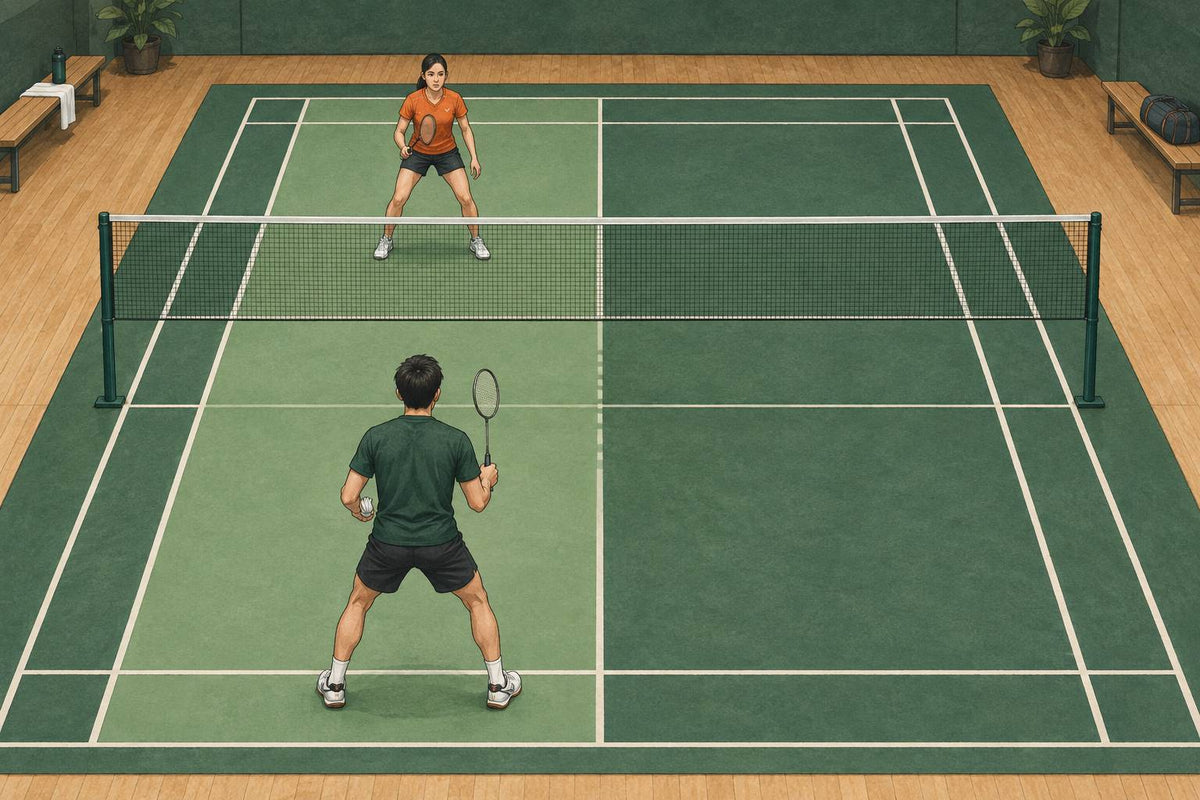
The half-court drive drill is a two-player flat-rally practice in one channel from the centre line to a doubles sideline. It reduces the target width so partners can repeat compact forehand and backhand drives, then adds one demand at a time instead of jumping straight from gentle feeding to an uncontrolled race.
Stand opposite each other around mid-court. Use the space between the short service line and rear doubles service line as the working length, and keep bags and spare shuttles outside both recovery paths. A shuttle touching the channel boundary counts as in because the BWF Laws state that a line forms part of the area it defines. The channel itself is a voluntary drill condition, not an alternate official court.
Give both players the same five setup cues: knees slightly flexed, body leaning a little forward, racket in front, racket head above the hand, and a short return to ready after contact. BWF Shuttle Time uses those observable points for forehand and backhand drive teaching. Its flat-play activities also begin at reduced speed, emphasize short racket movements and fast grip changes, and increase pace gradually. See the BWF Shuttle Time drive lessons.
Set the channel before the first feed: one half-width lane, flat drives only, one basket safely off court, and one player responsible for calling the next stage.
Begin slowly enough that the receiver can return the racket to the front. “Flat” does not mean skimming the tape at any cost. It means the shuttle travels on a controlled drive path that gives the partner a realistic next contact. A feed that forces a full reach, body turn, or emergency lift does not help you judge the receiver’s current stage.
How do you run the four-stage drive ladder?
Run the stages in order and move up only when both partners meet the current quality check. The repetition counts and pass criteria below are Badminton House coaching choices designed to make the drill easy to operate. They are adjustable working rules, not research-backed thresholds that every player must reach.
| Stage | Task | Move-up check | Regression |
|---|---|---|---|
| 1. Fixed side | Forehand-only, then backhand-only exchanges | 16 of 20 contacts stay flat and playable on each side | Slow the feed and allow one reset |
| 2. Alternate | Forehand, backhand, then repeat | 24 of 30 contacts are controlled and recoverable | Return to one side or shorten the set |
| 3. Move | Sender varies slightly left and right inside the lane | Three of four 20-second rounds end under control | Narrow the movement width |
| 4. Pressure | Open drive rally inside the channel, first to 7 | Players can explain why each rally ended | Play to 5 or remove scoring |
Stage 1 isolates the racket side. The receiver knows where the next shuttle is going, so the pair can find a pace that preserves a short action and ready position. Complete the forehand attempts before changing to backhand. If one side is clearly less stable, give it the slower feed rather than adding more rushed repetitions.
Stage 2 adds the grip-side change. Keep the order predictable. The purpose is to prepare the opposite face without moving the racket behind the body. If either player begins making a large shoulder turn or taking the racket near the head, return to ten controlled contacts on each fixed side.
Stage 3 adds only modest foot adjustment. The sender changes direction within the lane; the receiver moves the feet, contacts in a balanced space, and visibly recovers. This is not permission to fire at the outside edge. The sender owns feed quality, while the receiver owns movement and recovery.
Stage 4 adds consequence, not chaos. A point ends when a shuttle goes outside the channel, becomes an uncontrolled lift, or cannot be returned safely. Do not score deliberate body hits. The pressure game succeeds when both players still use recognizable drive actions and can name the first breakdown.
Swap the caller and the first sender when you repeat the ladder. One partner may be excellent at keeping feeds stable but less comfortable responding to them, so both roles deserve practice. Before Stage 4, each player should also state the agreed error calls in their own words. That small check prevents the pressure game from turning into a debate about whether a high shuttle, line contact, or difficult feed should count.
Which faults end the exchange first?
Most failed exchanges begin with one of four visible problems: the racket drops, the backswing grows, the receiver reaches instead of moving, or the sender creates an unplayable shuttle. Correct the first problem you can see and simplify the task. Asking for more speed after quality has disappeared only hides the useful diagnosis.
Racket below the hand: pause in the ready position and use the cue “front and up.” Make five slow forehand-to-backhand changes without a shuttle, then restart Stage 1. The reset is successful when the racket returns in front after each shadow contact.
Oversized backswing: reduce feed speed and ask the hitter to show the racket face earlier. Use ten gentle contacts in which the only score is whether the racket recovers before the next feed. Return to the ladder when the recovery is repeatable.
Arm reaching across the body: narrow the Stage 3 target, feed one direction at a time, and require a visible recovery step. The receiver should move into a usable contact space, not collect a point with a full-stretch rescue.
Unplayable sending: define a shared feed window between roughly hip and shoulder height and inside the lane. If the sender misses it, repeat the feed without charging the receiver with an error. Good partner practice depends on a feed that tests the chosen task rather than a different emergency skill.
One-error reset ladder
- Name the first visible problem in plain language.
- Change one variable: pace, width, side, or set length.
- Complete ten controlled contacts.
- Return to the failed stage and see whether the same problem appears.
If the main problem is deciding who takes a flat middle shuttle in doubles, leave this drill and use our flat-rally positioning guide. The half-court ladder is about maintaining the individual exchange, not assigning partner ownership.
How do you finish and record the drill?
Finish with one pressure game, then record the highest repeatable stage and the first reason control disappeared. The fastest rally you touched once is less useful than the stage both players can reproduce. A four-line note gives the next session a clear starting point without turning practice into a spreadsheet exercise.
Stage reached: 3
Best clean round: 18 seconds
First fault: racket dropped after backhand
Next start: Stage 2 with a slower feed
Before leaving, ask whether both players stayed in the lane, the sender kept feeds playable, the receiver recovered the racket in front, and pace increased only after control was stable. Record one cause—preparation, swing size, movement, or feed quality—and one regression to use next time.
For variety, change only one variable. Narrow the lane, start from one racket side, add a direction call, or award a bonus after five controlled contacts. Do not change speed, width, shot type, and scoring together; when the exchange improves or fails, the pair should know what produced the change.
Place the ladder inside a balanced practice rather than letting it consume the whole session. Our badminton practice-session plan shows where partner work can sit beside warm-up, movement, serving, and games. Use the target-drill scoring guide when accuracy, rather than exchange stability, becomes the next priority.
The ladder has done its job when both players can build a controlled flat exchange, identify the first breakdown, and choose the next sensible task. Progress the quality you can repeat—not the speed that lasted for one lucky rally.

Leave a comment
This site is protected by hCaptcha and the hCaptcha Privacy Policy and Terms of Service apply.