
Last updated: July 2026 · Written by the team at Badminton House
Quick Answer: Isometric Racket Head Shape
Choose an isometric racket head shape unless you specifically want the smaller, more traditional sweet spot feel of an oval frame.
Isometric
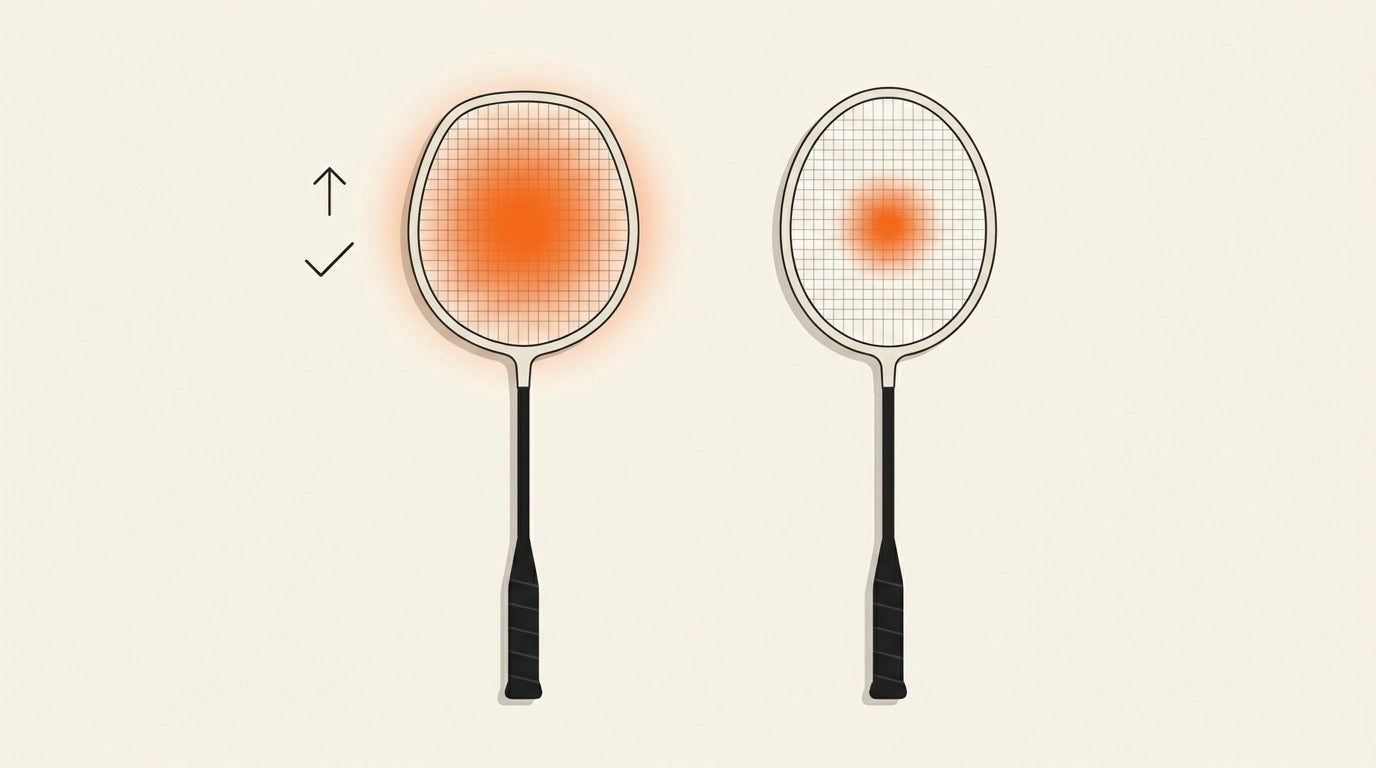
Best choice: the modern default for most Canadian players because the squared-off frame creates a larger, more forgiving sweet spot; Yonex states its ISOMETRIC shape has a 7% larger sweet spot than a conventional round frame.
Oval
Choose this only if you like a traditional, precise feel and can consistently contact the shuttle near the centre of the string bed.
Tension
If you still mishit often, head shape is only half the answer: tighter strings usually shrink the sweet spot for more control, while looser strings can enlarge it and add easier power.
If you keep hitting slightly off-centre and the shuttle dies, sprays wide, or feels different from shot to shot, the problem may not be only your swing. The shape of your racket head changes how forgiving the string bed feels, especially when rallies get fast and you do not contact the shuttle perfectly every time.
That is why the isometric racket head shape matters. Compared with the older conventional oval shape, an isometric frame has a more squared-off profile designed to create a larger, more forgiving hitting area. For many Canadian club players, beginners, and intermediates, that can mean more consistent clears, drives, blocks, and defensive lifts without needing perfect centre contact on every shot.
This guide explains what you actually feel on court: sweet spot size, off-centre forgiveness, oval-frame precision, and how string tension can make a forgiving racket feel tighter or more powerful. The goal is simple: help you understand whether head shape should influence your next racket choice.
Shopping for a racket in Canada? Check current CAD pricing, restock status, and available models in our badminton rackets collection. Orders over $200 ship free within Canada.
In This Guide
- What the Sweet Spot Means in a Badminton Racket
- What Is an Isometric Racket Head Shape?
- How Do Isometric Frames Create More Forgiveness?
- What Does a Conventional Oval Head Shape Feel Like?
- Who Benefits Most from an Isometric Head?
- Head Shape vs String Tension: Why Both Matter
- Yonex Examples and Canadian Shopping Notes
- Which Head Shape Should You Choose?
What the Sweet Spot Means in a Badminton Racket
The sweet spot is the area of the string bed where the shuttle leaves the racket most efficiently. When you contact the shuttle there, you get the best mix of power, control, and accuracy from the same swing.
When contact drifts away from that ideal area, the shot usually feels less solid. You may notice the shuttle coming off slower, flying shorter than expected, or missing the line even though your swing felt roughly right. That is what players mean when they say a racket feels "forgiving" or "unforgiving" on off-centre hits.
A simple way to feel it on court
- Clean centre hit: the shuttle feels crisp, stable, and easy to direct.
- Slightly off-centre hit: the shot may still work, but with less pace or precision.
- Bad mishit: the racket can twist in your hand, and the shuttle often loses both distance and accuracy.
This matters because badminton is full of imperfect contact: late defensive blocks, rushed drives, awkward overheads, and net interceptions where you do not have time to strike dead centre. A racket with a more usable sweet spot gives you a bigger margin for those moments.
That is where head shape enters the conversation. The isometric racket head shape is designed to enlarge the effective hitting area compared with a traditional round or oval frame, while a conventional oval shape concentrates the sweet spot closer to the middle of the string bed. The difference is not about replacing technique; it is about how much help the frame gives you when your timing is not perfect.
If you are choosing a racket in Canada, sweet spot size is one of the first comfort factors to understand. Weight, balance, flex, and string tension still matter, but the sweet spot explains why two rackets can feel very different even before you study the full spec sheet. For a broader buying framework, see our guide to choosing a badminton racket.
What Is an Isometric Racket Head Shape?

In plain terms, an isometric racket head shape is the broader, more squared-off badminton frame shape you see on many modern rackets. Instead of tapering into a classic oval, the top and sides look a little more rectangular, which gives the string bed a wider hitting area across the upper half of the frame.
Yonex’s official description is the clean number to remember: compared with a conventional round frame, its square-shaped ISOMETRIC racquet has a 7% larger sweet spot, delivering greater control without sacrificing power. In court terms, that means the racket is designed to be more forgiving when your contact is close to centre but not perfect.
How to recognize an isometric head
- The frame looks wider and less oval near the top.
- The hitting area appears more squared-off through the shoulders of the racket.
- The design goal is a larger effective sweet spot, not simply a different visual shape.
The shape works by making the main and cross strings more even in length across the string bed. That more even string layout helps enlarge the useful hitting zone, so off-centre contacts can feel steadier than they would on a narrower conventional frame.
For Canadian players comparing rackets online, treat head shape as one clue rather than the whole answer. An isometric frame can add forgiveness, but weight, balance, flex, grip size, and string setup still decide whether the racket actually fits your game. If you are browsing current options, start with the badminton rackets collection and compare the head shape alongside the specs, not in isolation.
How Do Isometric Frames Create More Forgiveness?

The practical reason an isometric racket head shape feels easier to use is string geometry. A more squared-off frame helps make the main strings and cross strings more even in length across the string bed. That more even string layout enlarges the effective hitting area, so the racket gives you a more consistent response when the shuttle is not struck perfectly in the centre.
Centre contact gives the cleanest power and accuracy; off-centre contact drops in quality. By evening out the string-bed geometry, an isometric frame makes more of the face behave like a useful hitting zone instead of concentrating the best response into one small central patch.
The mechanism in plain language
- Squarer frame: the top and side areas of the head are less tapered than a traditional oval shape.
- More even string lengths: the main and cross strings are closer in length across more of the string bed.
- Larger effective hitting area: more of the string bed can return the shuttle with useful power and direction.
- More forgiving contact: small timing or positioning errors are less punishing, especially during fast rallies, late defensive blocks, or rushed clears.
| Design element | What changes in the string bed | What you feel on court |
|---|---|---|
| Broader, squared-off head | The usable hitting area spreads farther toward the upper and side areas of the frame. | A late or slightly mistimed swing is less likely to feel completely dead. |
| More equal main and cross string lengths | The string bed responds more consistently across a wider area. | Clears, drives, and defensive lifts are easier to keep accurate when contact is not perfect. |
| Less concentrated sweet spot | The best response is not limited as tightly to one small central patch. | The racket feels more forgiving during fast exchanges, especially for developing players building consistency. |
That forgiveness does not mean every mishit becomes a clean winner. You still need good timing, footwork, grip, and preparation. But an isometric frame gives you a larger margin for error, which is why the shape has become the default choice across many modern badminton rackets.
Shopping note for Canadian players. If you are comparing isometric rackets, start with the Badminton House badminton rackets collection and check current availability. Orders over $200 ship free within Canada, and stock can change as Yonex Astrox models sell out or return.
If your off-centre hits still feel harsh, head shape may not be the only factor. String tension also changes how forgiving the string bed feels, so pair this section with the Badminton String Tension Guide for Beginners before choosing your next setup.
What Does a Conventional Oval Head Shape Feel Like?
A conventional badminton racket head is more elongated and narrow than an isometric frame. Instead of the squared-off top and wider upper string bed you see on many modern rackets, the oval shape pulls the hitting area into a tighter centre zone.
That tighter geometry creates a more concentrated sweet spot near the middle of the string bed. When you strike cleanly through that centre, an oval racket can feel very direct: the shuttle response is crisp, precise, and connected. When you miss that centre, the racket gives you less help. Power and accuracy drop off more noticeably than they do on a more forgiving isometric racket head shape.
Player feel in plain English: an oval head rewards clean timing and centre contact, but it is less forgiving when your shot lands high, low, or toward the side of the string bed.
For a long time, oval heads were the traditional badminton racket design. Players valued them for control and precision, especially if they already had consistent technique and liked a more old-school, focused hitting feel. A classic example is the Yonex Carbonex line, which is often associated with that traditional oval-head response.
For many Canadian beginners and club players choosing a first serious racket today, the trade-off is simple: an oval frame can feel accurate when your contact point is excellent, but it usually asks more from your timing. If you are still building consistent clears, drives, and defensive blocks, an isometric frame is usually the easier starting point. If you want help choosing based on weight, balance, and flex as well as head shape, see our badminton racket choosing guide.
Who Benefits Most from an Isometric Head?
The players who benefit most from an isometric racket head shape are the ones who do not always hit the shuttle perfectly in the centre of the strings. That usually means beginners and intermediate players first, but the same forgiveness is useful even at higher levels when rallies get fast, late, or off-balance.
Isometric heads are now the dominant default shape across modern badminton rackets, so this is not a niche feature you only find on one type of frame. Most Canadian players comparing current rackets will see this squared-off head shape far more often than the older conventional oval profile.
| Player type | Why isometric helps |
|---|---|
| Beginners | A larger sweet spot gives more margin when timing, grip, and footwork are still developing. Off-centre hits are less punishing, which makes clears, drives, and lifts feel more consistent. |
| Intermediate players | Players who can rally but still miss the centre under pressure get useful forgiveness on late defensive blocks, quick doubles exchanges, and recovery shots from the back corners. |
| Advanced players | The benefit is not just beginner-friendly forgiveness. Strong players also use isometric frames for added power and consistency when they are forced slightly off-centre during fast rallies. |
New to buying rackets? If you are still choosing your first frame, start with our beginner badminton racket guide for Canada before comparing premium models by head shape alone.
One important caveat: an isometric head does not automatically make every racket beginner-friendly. A stiff, head-heavy attacking racket can still feel demanding, even if the head shape is forgiving. Weight, balance, shaft flex, grip size, and string tension all change how easy the racket feels in real play.
For Canadian shoppers, that means head shape should be one checkpoint rather than the whole decision. Browse our badminton rackets collection to see current racket options and restocks; Badminton House offers free shipping within Canada on orders over $200.
Head Shape vs String Tension: Why Both Matter
The isometric racket head shape is only one part of the sweet-spot story. String tension changes how forgiving the string bed feels, too. In general, tighter strings create a smaller sweet spot with a firmer, more controlled response; looser strings can enlarge the sweet spot and help the shuttle come off the racket with easier power.
That matters because a forgiving head shape can be partly cancelled out if the racket is strung too tight for your timing. A beginner or developing club player may choose an isometric frame for easier off-centre contact, then make the racket feel harsh by using tension that demands very clean impact. On the other hand, an advanced player may prefer the crisper response of higher tension because they already hit the centre consistently and want more precision.
| Setup choice | Sweet-spot effect | Typical feel |
|---|---|---|
| Isometric head shape | Larger, more forgiving hitting area than a conventional round frame | More consistent results on slightly off-centre hits |
| Tighter string tension | Smaller sweet spot | More control and a stiffer, cleaner response |
| Looser string tension | Larger effective sweet spot | Easier power and a more forgiving feel |
Practical takeaway. If you want forgiveness, do not look at head shape alone. Match an isometric frame with a tension that suits your level, timing, and style. For a deeper breakdown, read our badminton string tension guide, or use the Badminton House stringing service if you want Canadian, player-focused tension advice before your next restring.
A good setup should feel predictable under pressure: clears should not require perfect contact every time, drives should not spray wildly, and net shots should still give you enough touch. The right combination of isometric shape and string tension gives you that balance.
Yonex Examples and Canadian Shopping Notes
If you see the word ISOMETRIC on a Yonex badminton racket, it is not just a generic description of a square-ish head shape. ISOMETRIC is a Yonex trademark and one of the brand’s signature frame ideas: the design was developed over 30 years ago, with isometric technology first invented by Yonex in 1980 for tennis and the first isometric badminton racket, the Yonex Isometric 500, released in 1992.
In modern Yonex badminton, Astrox and Arcsaber are two familiar isometric example lines. That does not mean every Astrox or Arcsaber feels the same. The head shape gives the frame its enlarged hitting zone, but the actual on-court feel still depends on the racket’s weight, balance, shaft stiffness, string, and tension.
Canadian shopping note. Badminton House lists Yonex Astrox models in CAD, but the current racket listings are sold out. Check current badminton racket availability for restocks and available options.
| Example | Why it matters for head shape | Canadian listing note |
|---|---|---|
| Yonex Astrox 100 ZZ Kurenai, Dark Navy | Premium Astrox example with an isometric head. Its stiff flex and head-heavy setup make it an advanced attacking racket, not a default beginner pick. | Listed at $299.99 CAD and currently sold out. |
| Yonex Astrox 100VA Game Grayish Beige | Astrox-series isometric example for players comparing modern Yonex frame families. | Listed at $349.99 CAD and currently sold out. |
| Yonex Arcsaber line | Another well-known Yonex isometric example line, often discussed by players who want a larger sweet spot with a different feel from Astrox. | Check current Canadian specialty availability before choosing a specific model. |
For Canadian players, the practical takeaway is simple: do not buy a racket only because it says ISOMETRIC. Treat the head shape as one part of the fit. A forgiving isometric frame can still feel demanding if it is too stiff, too head-heavy, or strung too tight for your level.
If you are comparing Yonex series, our Yonex Astrox vs Arcsaber vs Nanoflare guide is the better next step. If you are still deciding on weight and balance first, start with how to choose a badminton racket before narrowing down the exact model.
Check Current Racket Availability
CAD pricing · Free shipping within Canada on orders over $200 · Canadian badminton specialty shop
Which Head Shape Should You Choose?
For most players buying a modern badminton racket, an isometric racket head shape is the safer default because it is the dominant design today and gives more forgiveness on off-centre contact. A conventional oval frame still has a place if you specifically like a traditional, more precise feel and can consistently find the centre of the string bed.
| Choose this | If you want... | Why it fits |
|---|---|---|
| Isometric head | More forgiveness and more consistent shots when contact is not perfectly centred. | The squared-off shape helps enlarge the sweet spot by equalizing the length of the main and cross strings, which improves consistency on off-centre hits. |
| Isometric head | A practical racket shape for beginner or intermediate play. | The larger sweet spot is especially useful for developing players who are still building consistent timing and contact quality. |
| Conventional oval head | A traditional feel with a more concentrated sweet spot near the centre. | Oval frames have long been valued for control and precision, but they reward cleaner contact and are less forgiving away from the centre. |
| Lower tension pairing | A larger effective sweet spot and easier power. | Looser strings can enlarge the sweet spot and add power, which can pair well with an isometric frame for players prioritizing forgiveness. |
| Higher tension pairing | More control from a stiffer string bed. | Tighter strings typically make the sweet spot smaller while increasing control, so they suit players who already strike the shuttle consistently. |
Canadian shopping note. Yonex Astrox models are isometric-frame examples in the Badminton House badminton rackets collection; check the collection page for current availability, as listed models may sell out. If you are also adjusting tension, see the Canadian stringing service or our badminton string tension guide.
Get 10% off your first order
Join the Badminton House list and we’ll email you a 10% welcome code — plus subscriber-only restock alerts, giveaways, and honest gear advice from players.
By subscribing, you agree to receive Badminton House emails and can unsubscribe anytime.
If you are still unsure whether an isometric racket head shape fits your game, ask us before you buy. We play badminton ourselves, and we are happy to help you weigh head shape, balance, flex, and string tension against how you actually play. Send us a note through our contact page and we will point you in the right direction.
Canadian badminton specialty shop · Free shipping within Canada on orders over $200

Leave a comment
This site is protected by hCaptcha and the hCaptcha Privacy Policy and Terms of Service apply.