
Last updated: July 2026 · Written by the team at Badminton House
Quick Answer: Women's Doubles Patient Game
Win more rallies by delaying the finish until your pair has created a clear opening, not by smashing earlier.
Patient
Best choice: Use controlled lifts, drops, and placement to move opponents out of shape, then attack the loose reply.
Fast
Choose this only when your receive or first three shots consistently force a weak lift or net sitter.
Reset
If rallies get frantic, slow the exchange with safer height and deeper targets before trying to win the point.
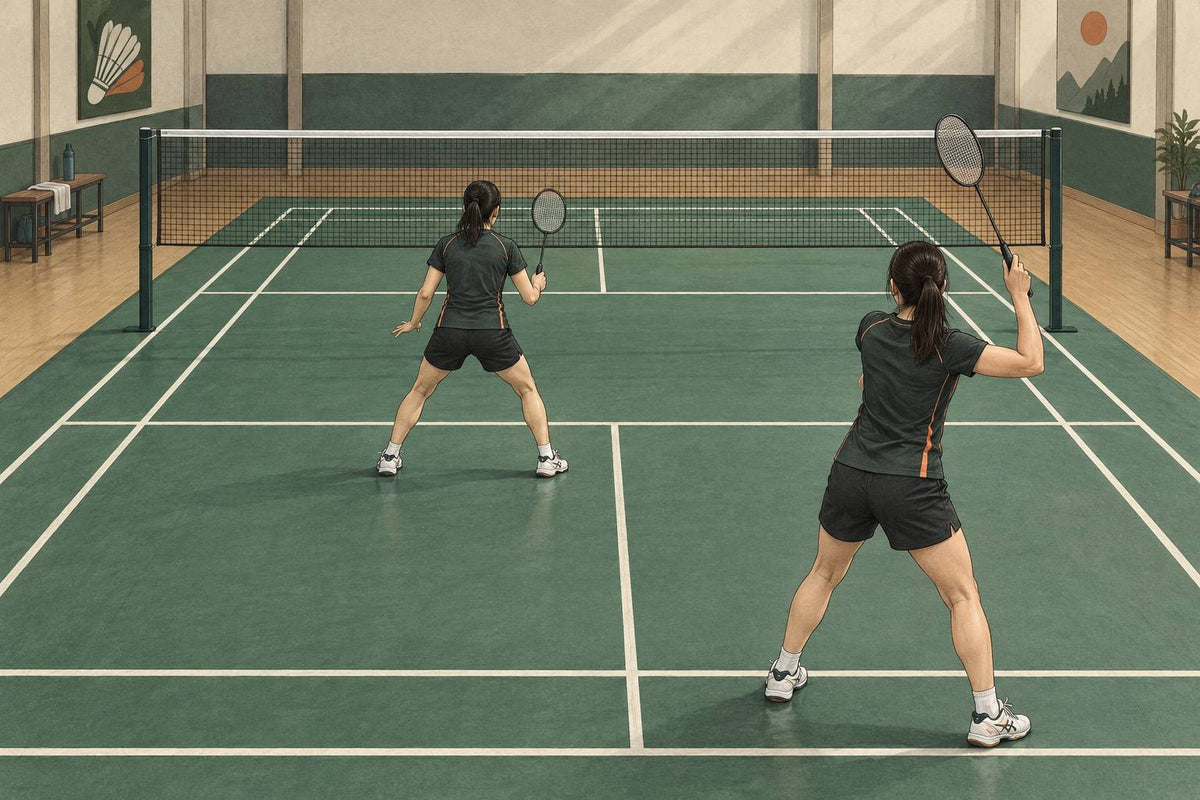
Women’s doubles rewards shot choice, recovery and a well-timed attack. Elite match analyses describe longer rally construction and greater use of placement than in men’s doubles, but your pair should choose tactics from the shuttle, court position and opponents in front of you.
This guide focuses on the patient game: how to stay brave enough not to overforce, while still moving the rally toward a winning position.
In This Guide
Why Women's Doubles Badminton Tactics Reward Patience

Women’s doubles badminton tactics are not just a softer version of men’s doubles. A peer-reviewed analysis of 66 elite doubles games from 30 international events between 2020 and 2022 found distinct tactical profiles across men’s and women’s doubles. The study characterises women’s doubles as slower-paced, multi-shot, and built around landing control: pairs look for the right attacking moment instead of forcing the finish too early.
That matches Gawin, Beyer and Seidler’s competition analysis of world-class doubles: women’s doubles showed longer real playing times, effective playing times, rally times, and work densities, while men’s doubles had greater shot-frequency intensity. In plain terms, the women’s doubles patient game is not passive. It is active pressure through repeated placement, defensive readiness, and controlled changes of pace until the opponent gives up a cleaner attacking chance.
Serve and Receive: Start the Rally Without Rushing the Finish

The patient game starts before the rally opens up. In elite doubles analysis, both men’s and women’s doubles concentrated serve patterns around position 1, but their supporting zones differed: men used position 4 more, women used position 6 more. The useful takeaway is not the numbering—it is that women’s doubles serve and receive patterns are disciplined, repeatable, and built to start a controllable rally rather than force a highlight finish.
On serve, think “stable first three shots”: low serve or occasional flick, ready racket, then a prepared reply to the most likely push, lift, or net return. On receive, do not treat every serve as a green light for a winner. Women’s doubles in the same analysis mainly received and served by placing the shuttle—placing it with control—so make the server move, keep the shuttle below tape height when possible, and earn the loose lift. For technique detail, see the doubles low and flick serve guide and return of serve guide.
Build Pressure by Court Zone, Not Just by Hitting Harder

Pressure comes from landing point: making the opponents hit from awkward height, late contact, or a poor body position. In women’s doubles, that often means choosing the shot that keeps control of the next contact, not the shot that looks most aggressive.
- Front court: elite women’s doubles favours picking or lifting more than forcing every net exchange into a flat push. A controlled lift can reset shape, move the attack behind the receiver, and avoid feeding an easy kill.
- Midfield: women’s doubles most often picks or lifts here, at about 27%, while men’s doubles relies more on flat drives around 35%. That does not mean giving up the rally; it means refusing a drive battle when the better pressure is depth and height control.
- Backcourt: smashes still matter, but they are paired with drops. Women’s doubles backcourt patterns include killing at about 47.8% and dropping at about 26.3%, so the threat is placement variation as much as power.
Manage Long-Rally Rhythm and the Next Point

Patience means staying precise as a rally develops. Broader elite-badminton research compares long rallies with the point immediately afterward; it should not be read as a prescribed rally length or a requirement to slow every women’s doubles exchange.
The long-rally study found differences in the next point’s duration and error patterns in particular match contexts. Those observations do not establish fatigue as the cause or show that every next rally will be shorter and more error-prone.
After one of those exchanges, treat the next point as a danger point. Use the next point as a prompt to refocus, rather than assuming either pair must now make an error. Use a clean serve or receive, accept one extra neutral shot, and change speed only when the court opens; this is where change-of-pace tactics matter most.
Patient-Game Takeaways for Your Pair
Patient women’s doubles is not defensive for the sake of surviving. It is rally construction: choosing the shot that keeps your pair organized while making the next opponent decision harder.
- Build before you finish. Win court position, then attack the loose reply instead of forcing a winner from a neutral shuttle.
- Lift with purpose. Use height, depth, and recovery time when the exchange calls for a reset.
- Place with discipline. Controlled pushes, blocks, and drops are valuable when they move opponents out of their preferred hitting rhythm.
- Vary the back-court attack. Pair smashes with drops so defenders cannot sit on one speed.
- Delay the power finish. A patient pair trusts that pressure can accumulate before the final hit.
Which Patient Game Should Your Pair Choose?
Use the patient game as your default, then adjust the risk level by rally state — match the shot below to what your side of the net needs right now.
| Choose this | When it fits |
|---|---|
| Landing-control patience | Best default when neither pair owns the attack. Build with lifts, drops, and placement until the court opens. |
| Backcourt mix | Use when you have time behind the shuttle: combine smashes with drops instead of committing to continuous power. |
| Post-long-rally reset | After a draining point, start cleaner and accept one more shot; use a clear next-point routine. |
| Tempo squeeze | Inside long rallies, raise or preserve tempo deliberately rather than rushing the first half-chance. |
Get 10% off your first order
Join the Badminton House list and we’ll email you a 10% welcome code — plus training guides, technique advice, and badminton updates.
By subscribing, you agree to receive Badminton House emails and can unsubscribe anytime.
Patient women’s doubles is a partnership habit: choose the right moment, protect the next shot, and make opponents hit one more difficult shuttle. We play badminton too, so if you want help matching tactics to your setup, contact us.
For a controlled doubles game, look for a racket that supports steady defence, clean touch, and repeatable placement. Use it as the gear check after the tactics work, not a shortcut around it.
Browse Badminton Rackets

Leave a comment
This site is protected by hCaptcha and the hCaptcha Privacy Policy and Terms of Service apply.