
Last reviewed: August 2026 · Written by the Badminton House player-led team
Quick answer
A useful badminton footwork drill with shuttles makes you move, lunge, collect, recover and reset with the same balance you need for a real shot. Place a few shuttles within controlled lunge reach, score the quality of every return to base, and stop the set before rushed collection replaces badminton movement.
Move fully
Approach, stable lunge, collect, recover and reset are one repetition.
Score quality
Count only repetitions with stable alignment and a clear recovery.
Add one demand
Increase placement, pace or uncertainty one at a time.
This is not a speed-collection contest. It is a simple way to make a player rehearse the part that often disappears in a rushed rally: arriving in balance, getting back out of the lunge and becoming ready again. The BWF Level 1 coaching manual includes a related practice in which a player reaches three shuttles with a lunge, collects one, pivots or hops around a marker, places it behind and repeats.
If you are still learning the individual movement pieces, start with badminton footwork basics. This drill assumes you can make a short controlled lunge before you try to repeat it under a timer.
What a shuttle pickup footwork drill should train
The shuttle gives the movement a physical target, but the target is not the whole skill. A complete repetition has five parts: start balanced, move to the shuttle, make a controlled lunge, collect it without collapsing forward, then recover to a ready area before the next repetition. BWF coaching material describes feeding as creating realistic practice opportunities and advises coaches to leave enough flight time and use a delivery rate slow enough for the player to prepare properly.
That is why a few well-spaced shuttles are more useful than a large pile. If the player can reach everything by bending from the waist, walking back upright or taking a frantic extra step, the drill no longer tells you whether the lunge and recovery are improving.
Use “facing the net” precisely: for forward-and-backward or cross-behind practice, keep your attention toward the net and tape where practical. Do not turn that into a universal rule: rear-court overhead movement can require a side-on or turning position.
Worked drill: three shuttles, one real recovery after each
Use this fixed version first. It is a Badminton House coaching template, not a validated performance test or a universal prescription.
Three-shuttle lunge-and-return
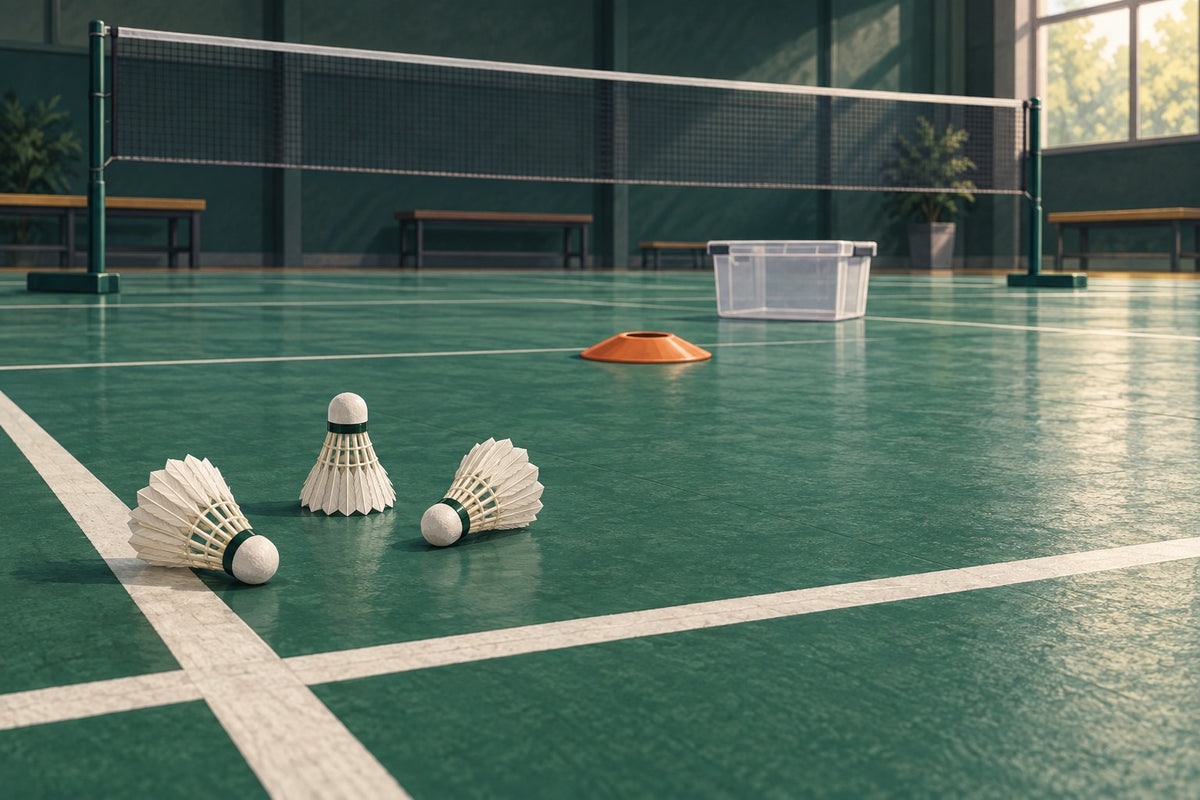
- Set the court: place a start marker near your normal base area. Put three shuttles in one front-court zone, each within a controlled lunge reach. Place an empty tube or small collection spot behind the start marker.
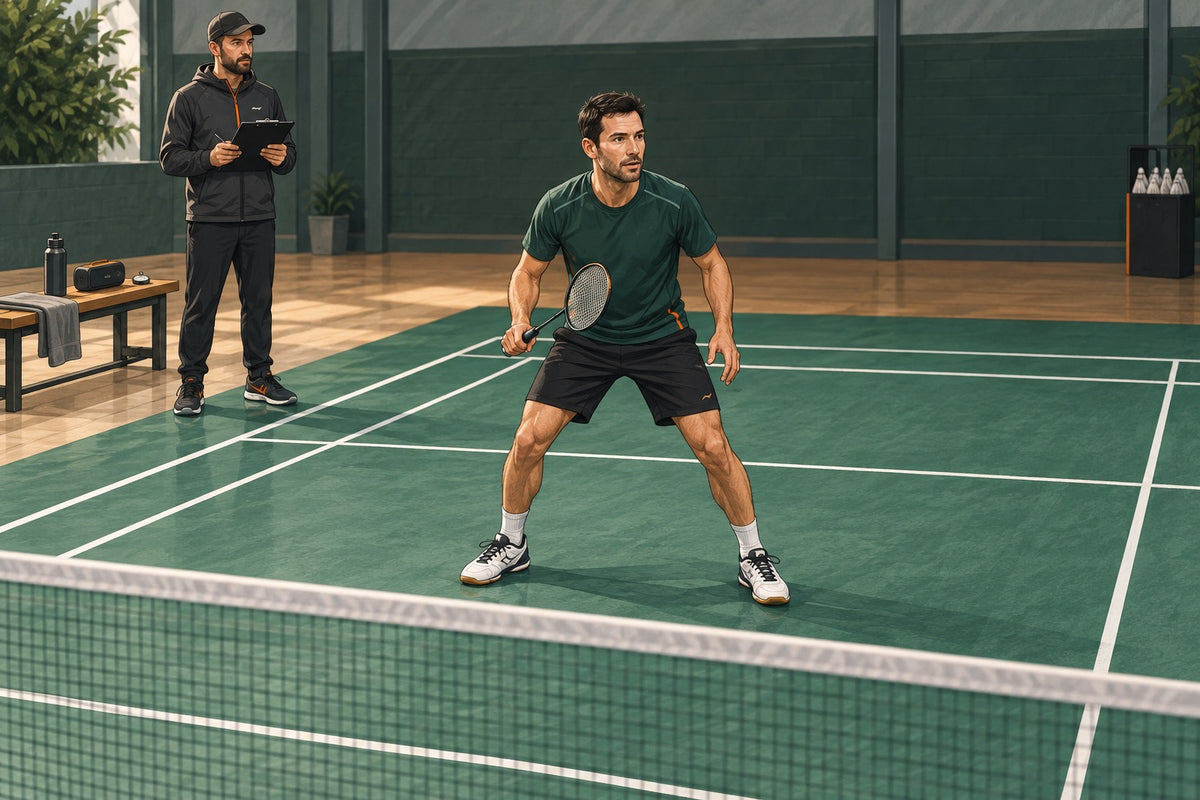
- Move: from a ready stance, use a small split step, travel to the first shuttle and finish in a stable lunge. For a standard front-court pattern, the lead foot points toward the shuttle and the knee follows that direction.
- Collect and recover: pick up one shuttle, push out of the lunge, return around the start marker and place the shuttle in the collection spot. Reset your stance before moving again.
- Time the round: start the timer on the first movement and stop it when the third shuttle is placed. Record the time only beside the quality score; a quicker time is not better if the movement degrades.
Run the same layout on the other front-court side before adding speed. The useful check is whether the player can point the lead foot toward the shuttle, keep the knee aligned with it and leave the lunge under control.
| Quality check | Score | Quality reset |
|---|---|---|
| The player reaches with a full controlled approach and lunge | 1 point | No point for an upright reach or a rushed bend |
| Lead foot, knee and body remain controlled toward the shuttle | 1 point | Reset if the knee collapses inward, the foot slips or balance is lost |
| The player recovers to the marker and is ready before the next shuttle | 1 point | No point for walking back or leaving directly from the previous lunge |
A perfect three-shuttle round scores 9. The score is a coaching observation tool, not a ranking. Repeat a lower-tempo round or take more rest when a player cannot keep the same shape.

Use editorial starting targets, not made-up level standards
There is no universal BWF shuttle-count, timer or work-to-rest target for beginner, intermediate and advanced players in this drill. Start with a dose that leaves the lunge and recovery recognizable, then adjust from what you observe.
| Starting point | Badminton House editorial target | Boundary |
|---|---|---|
| New to lunging | 2 rounds of 3 pickups per side, with 45–60 seconds of rest | Slow down or stop the round as soon as balance or alignment changes |
| Developing the pattern | 3–4 rounds of 4 pickups per side, with 30–45 seconds of rest | Add an extra pickup or reduce rest, never both in the same change |
| Pattern already stable | 4–6 rounds of 6 alternating pickups, with 30–45 seconds of rest | Keep the fixed placement until every recovery remains clean |
For a broader quality-first approach to adding uncertainty, see badminton drill progression. Move up only when the present version stays recognizable.
Rotate partners and progress the movement without losing the skill
With three players, use one worker, one observer-timer and one resetter. The observer calls the three quality checks; the resetter places the shuttles back while the worker rests. Rotate after a complete two-side round. This keeps the drill moving without asking a tired player to judge their own landing every time.
- Progression 1: alternate front corners. Keep the same three-shuttle pattern, then switch side after each pickup only once both single-side rounds are stable.
- Progression 2: use a visual cue. The observer points left or right after the player returns to base. The player still receives enough time to prepare; guessing is not the objective.
- Progression 3: add a fed shuttle. Replace one floor shuttle with a controlled hand feed only after the player can arrive, lunge and recover cleanly. Racket feeding belongs later, when a more game-like pace is needed.
- Regression: remove a location, lengthen rest or return to a shadow repetition when recovery becomes rushed.
Pair this drill with shadow badminton footwork training when you need to rehearse the movement without collection, and with multi-shuttle drills only after the worker can keep the same movement under a controlled feed.
Protect the lunge before you add volume
Warm up before repeated lunges. BWF’s Level 1 material frames warm-up as preparation for the session’s specific physical and technical demands, with pulse-raising work commonly lasting about 3–10 minutes. Use a clean indoor surface and court shoes with reliable grip; a sliding lead foot turns a useful repetition into a poor risk.
End the set if you feel pain, instability, repeated slipping or a loss of landing control. Do not work through those signs to finish a timer. For the wider movement foundation, use split-step timing and ankle sprain prevention alongside this drill.
The practical rule is simple: collect the shuttle only if you can still show the movement you want to own in a rally. A smaller, balanced lunge and a clean recovery are more valuable than a faster count.

Leave a comment
This site is protected by hCaptcha and the hCaptcha Privacy Policy and Terms of Service apply.