
Last updated: July 2026 · Written by the team at Badminton House
Quick Answer: Badminton Grip Switching
For fast forehand-to-backhand switching, start loose in a neutral ready grip, rotate the handle with your fingers during the backswing, then squeeze only at impact.
Default
Best choice: use a relaxed neutral handshake-style grip so the racket can move quickly into either forehand or backhand, especially in fast net exchanges and defence.
30° roll
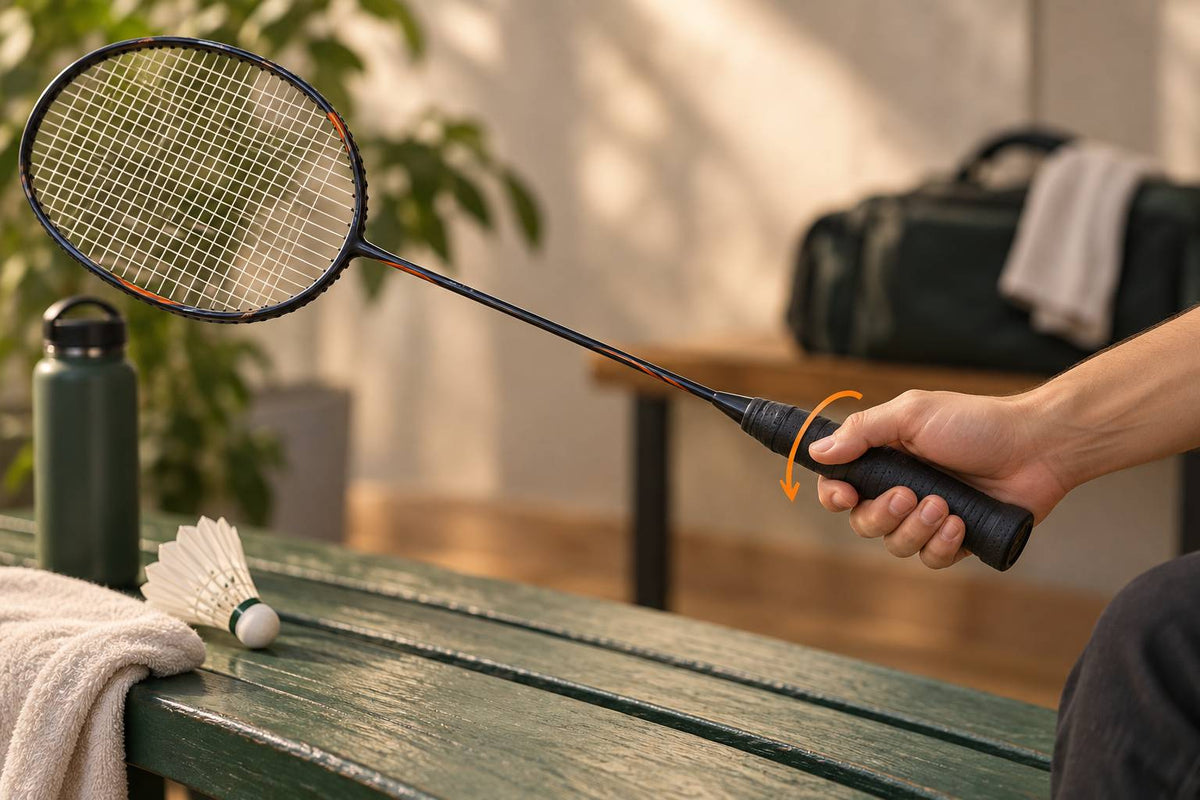
If you are already in a forehand/basic grip, roll the handle roughly 30 degrees in your fingers into the backhand/thumb grip instead of twisting your whole wrist.
Timing
Make the switch while your racket is going back and you are still moving to the shuttle; arrive ready to hit, tighten briefly on contact, then relax again.
You line up for the shot, your feet get there, and then the racket face betrays you: forehand grip for a backhand block, backhand thumb still in place for a forehand drive, or a panicked wrist twist that sends the shuttle wide. That is the problem badminton grip switching solves.
Fast grip changes are not just a beginner detail. In doubles drive exchanges, net interceptions, and smash defence, you often have only a split second to turn the handle from forehand to backhand and still strike cleanly. The players who look “quick with their hands” are usually not muscling the racket around; they are starting loose, letting the handle move in the fingers, and tightening only when the shot is made.
This guide breaks badminton grip switching into a trainable skill for Canadian club players: how to stay ready, how the handle rotates, when the switch should happen, and how grip feel can either help or slow you down.
Dial in your gear while you work on your hands. Browse Badminton House’s Canadian badminton collections in CAD, with free shipping within Canada: shop badminton gear.
In This Guide
- Why Is Badminton Grip Switching Its Own Skill?
- Start From a Loose Neutral Ready Grip
- How Does the Handle Rotate From Forehand to Backhand?
- Use Fingers, Not a Wrist Twist
- Switch During the Backswing, Not After You Arrive
- Shadow Drill: Rotate the Handle In Your Fingers
- How Do Grip Size and Overgrip Feel Affect the Switch?
- Which Grip-Switching Focus Should You Choose?
Why Is Badminton Grip Switching Its Own Skill?
This is not another static grip tutorial. If you are still learning where the thumb, index finger, and V-shape belong for each basic hold, start with our beginner guide to holding a badminton racket first. This section is about what happens after that: changing grips fast enough for a live rally.
Badminton grip switching is the skill of rotating the handle between forehand, backhand, and neutral positions while the rally is still moving. The shuttle travels extremely fast, so you often need to change from a ready hold into the right hitting grip within a split second. If your hand is locked into one grip, you may technically “know” the forehand and backhand grips but still arrive late with the wrong racket face.
That is why grip switching deserves its own practice time. In one rally, you might cycle from a backhand-style serve hold, to a forehand clear, to a backhand net shot, then back to a forehand attacking shot. The challenge is not memorizing those grips one at a time; it is making the handle turn cleanly in your fingers without disrupting your timing, balance, or shot preparation.
The key idea: treat grip changes like footwork and split-step timing. They are movement skills, not just hand positions.
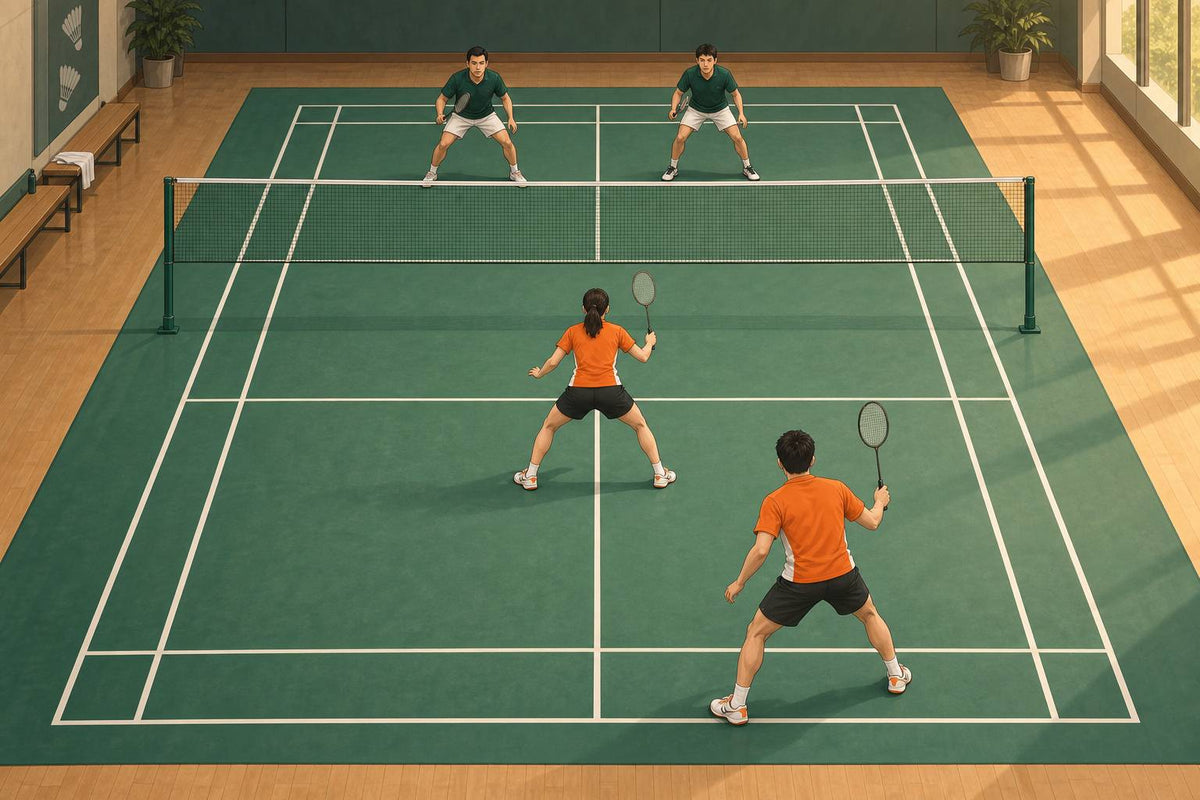
The skill becomes especially important in forecourt doubles drive exchanges. In those flat, fast rallies, the shuttle can come to either side of your body with very little warning. A loose neutral ready grip lets the handle turn quickly toward forehand or backhand, so your racket face is ready before the shuttle reaches you.
- Static grip knowledge tells you where your hand should finish.
- Grip switching trains how the handle gets there during pressure.
- Good switching keeps you relaxed between shots, then lets you tighten at impact for control and finger power.
Start From a Loose Neutral Ready Grip

Fast badminton grip switching starts before the shuttle is hit. If you wait in a full forehand grip or a locked backhand thumb grip, you have already made the next switch harder. A loose neutral ready grip gives the handle room to rotate into either side within a split second.
Set it up like a handshake: let the racket handle sit naturally in your hand, then wrap the little, ring, and middle fingers around the lower part of the handle. The hold should feel secure, but not clamped. Think of cradling an egg — firm enough that it will not fall, soft enough that you are not crushing it.
- Lower fingers wrap first: your little, ring, and middle fingers support the handle instead of squeezing from the whole palm.
- Leave a gap between index and middle fingers: this gives the index finger space to guide the handle when you turn toward a forehand shape.
- Rest the thumb lightly between bevel edges: do not press it flat too early; it should be ready to slide into a backhand thumb position when needed.
- Keep a small gap under the heel of the thumb: if the base of the thumb is glued to the handle, the racket cannot roll freely in your fingers.
- Stay relaxed until the shot: the grip tightens at the end of the switch, not while you are waiting.
Quick self-check. Hold your racket in ready position and ask: can the handle turn inside your fingers without your wrist twisting? If not, your grip is probably too tight, too deep in the palm, or too bulky. For setup help, see our badminton grip size guide and overgrip vs replacement grip guide.
From this neutral start, the switch is small. For a right-handed player moving toward backhand, the racket turns to the right and the thumb extends behind the handle. Moving toward forehand, the racket turns to the left and the thumb-index shape forms more of a “V” on the handle. The important part is that the handle turns in the fingers; the hand should not have to rebuild the whole grip from scratch.
In doubles defence and forecourt exchanges, this neutral grip is your reset position after almost every touch. Hit, relax, return to neutral, then let the next shuttle decide whether the handle rolls toward forehand or backhand.
How Does the Handle Rotate From Forehand to Backhand?

For right-handed players, the simplest way to understand badminton grip switching is this: from your loose neutral grip, the handle turns right for backhand and left for forehand. The racket is not being cranked around by your wrist; the handle is rolling inside your fingers so the racket face arrives at the correct angle.
Right-Handed Grip Switch Checkpoints
| Grip target | Handle direction from neutral | Hand shape you should feel |
|---|---|---|
| Backhand | Turn the racket to the right. | Extend the thumb behind the handle. This is why the backhand grip is also commonly described as a thumb grip. |
| Forehand | Turn the racket to the left. | Form the familiar thumb-index “V” shape on the handle, similar to the basic forehand hold. |
| Bevel | Stop between the forehand and backhand positions. | Use it as a transitional grip when the next shot could be either side, especially in fast exchanges. |
From a basic or forehand grip, the backhand switch is a finger roll of roughly 30 degrees to the right (for right-handed players), finishing with the thumb flat on the wider bevel. That number matters because many players overdo the movement: they turn the whole hand, twist the wrist, or rebuild the grip from scratch. In a real rally, especially in doubles drives or net exchanges, the switch is smaller and faster than most players expect.
Backhand: roll into the thumb grip
For the backhand position, let the handle roll in the fingers until the thumb can sit behind the handle and support the shot. You are not trying to point the thumb straight up the shaft for every backhand situation; the key is that the thumb becomes the main pressure point behind the handle so the racket face can be controlled quickly.
This is why a backhand block, lift, or defensive push feels very different from a forehand. The thumb gives you a direct platform behind the racket face. If the thumb is still floating on the side of the handle, you may reach the shuttle but the racket face often feels unstable.
Forehand: roll back into the V
To return to forehand, roll the handle back the other way until the thumb and index finger form the V shape again. The lower fingers keep the racket secure, while the thumb and index finger guide the angle. This lets the racket face return to a forehand clear, drive, push, net shot, or smash preparation without pausing to re-grip.
If you are learning the basic hand positions first, read Badminton Grip How to Hold Racket: Canada Beginner Guide. Once the forehand, backhand, and neutral positions are familiar, the skill becomes making the handle travel between them smoothly.
Use the bevel as the in-between gear
The bevel grip is useful because it sits between forehand and backhand. Think of it as the “maybe” position: not fully committed to a forehand V, not fully committed to a backhand thumb grip. That makes it practical when you are under time pressure and the shuttle could be taken on either side of the body.
For example, if you are crouched in defence and the next shot might come at your hip, racket shoulder, or body line, a bevel position can reduce the distance the handle needs to rotate. From there, you can roll slightly toward thumb grip for a backhand block or slightly back toward the V for a forehand drive.
Handle feel matters. If your grip is built up so thick that the bevels disappear, fast switching gets harder to feel. For fit details, see our G4 vs G5 vs G6 grip size guide and overgrip vs replacement grip guide. Badminton House prices are in CAD, with free Canadian shipping when you are choosing gear.
Use Fingers, Not a Wrist Twist
The fastest badminton grip switching does not come from turning your whole wrist like a doorknob. It comes from letting the handle rotate inside a relaxed hand, then tightening only when the racket is set for the shot.
Think of the thumb and index finger as the steering fingers. They guide the racket face from forehand toward backhand, while the pinky and ring fingers lightly support the racket’s weight so it does not wobble or fall out of position. The handle should feel controlled, but not trapped.
Coaching cue: steer, support, squeeze
- Thumb and index finger: guide the handle as it rolls into the next grip.
- Pinky and ring fingers: lightly support the racket so the head stays balanced.
- Whole hand: stays loose during the switch, then squeezes briefly at contact.
- Wrist: stays available for the stroke instead of doing the grip change by itself.
A tight hold is the usual reason players feel late when switching grips mid-rally. If you clamp the handle before the shuttle is hit, the small hand muscles cannot move quickly enough to rotate the racket cleanly. That is why the switch often feels fine in slow practice but breaks down in doubles drives, net exchanges, and smash defence.
For a backhand change, the fingers roll the handle into the thumb-grip position, with the thumb becoming more active behind the handle. For a forehand change, the fingers roll the handle back so the thumb and index finger form the familiar V shape. The important part is that the racket changes orientation inside the hand before you swing.
"If your wrist is doing all the switching, your racket face will usually arrive late."
A simple self-check: hold your racket in ready position, loosen your fingers slightly, and rotate between forehand and backhand without moving your forearm much. If the racket face changes smoothly, your fingers are doing the job. If your whole wrist, elbow, or shoulder has to turn, relax your grip and make the movement smaller.
This finger-first habit also protects your next shot. Once the handle has already rotated in your fingers, the wrist and forearm are free to help with control, push, lift, block, or drive instead of wasting time finding the grip.
Switch During the Backswing, Not After You Arrive
The biggest timing gap for club players is switching the grip too late. If you move first, arrive at the shuttle, then start hunting for the backhand or forehand grip, the rally is already rushing you. The handle needs to rotate while you are moving and while the racket is going back.

Think of badminton grip switching as part of the stroke preparation, not a separate step after the footwork. Start from a loose neutral hold, let the handle turn in your fingers as the racket begins its backswing, then finish the grip just before contact. The final squeeze or thumb push gives the shot its crispness; the transition itself stays light.
Timing cue: loose while you travel, set during the backswing, firm at the hit. For the pressure side of that habit, see Badminton Grip Pressure: Relax, Then Squeeze at Impact.
Use the shuttle’s flight as your trigger
You do not need to wait until your feet are perfectly planted. As soon as you read the next shot, your racket hand should begin preparing the correct face angle. In fast forecourt exchanges and doubles defence, that small head start is what lets the racket arrive ready instead of late.
| Rally situation | When the switch starts | What finishes the shot |
|---|---|---|
| Net shot into a lift | As you push or lunge toward the shuttle, let the handle roll into the forehand or backhand lifting grip. | The fingers firm up at the end so the lift leaves cleanly instead of floating off a loose face. |
| Flat drive or quick defence | As the shuttle crosses your body line, rotate the handle during the short preparation phase. | A short finger squeeze stabilizes the racket face for the block, drive, or counter-push. |
| Backhand defence | Turn into the thumb-grip position while the racket is coming into the defensive backswing. | The thumb pushes through the handle at the end, especially when lifting or driving upward from defence. |
A simple club-night checkpoint
After your next Canadian drop-in or league rally, ask yourself one question: was the racket already in the right grip when the swing started forward? If the answer is no, do not try to make your wrist faster. Move the switch earlier.
- Too late: you arrive, pause, then twist the handle before hitting.
- Better: you read the shuttle, move, and let the handle rotate as the racket draws back.
- Best: the grip is already set before the forward swing begins, with the final finger action saved for contact.
Shadow Drill: Rotate the Handle In Your Fingers
You do not need a court to train badminton grip switching. This is one of the easiest skills to practise at home because the goal is not to hit hard; it is to teach your fingers to move the handle quickly without squeezing.
Start from your forehand or basic grip. Let your thumb, pointer, and middle finger control the racket handle. Your ring finger and pinky should only support the weight of the racket lightly, so the handle can rotate inside your hand instead of getting locked in your palm.
Finger-Rotation Shadow Drill
- Begin in forehand/basic grip. Hold the racket relaxed enough that the handle can move, but not so loose that it wobbles out of control.
- Rotate with the fingers. Use the thumb, pointer, and middle finger to roll the handle into a backhand/thumb position. Do not turn the wrist to fake the grip change.
- Return to neutral. Let the racket settle back into a loose ready hold so you can move either direction again.
- Cycle through positions. Move forehand → neutral → backhand → neutral for 30 to 60 seconds, keeping the motion quiet and smooth.
- Tighten only at the finish. Briefly squeeze as if contacting the shuttle, then relax immediately so the next switch is ready.
The key is that the racket should rotate inside your fingers. If your whole hand, forearm, or wrist is doing the work, slow down. You are training finger dexterity, not a big arm movement.
This drill also builds finger strength. That matters in fast net exchanges and defensive blocks, where you need to stay relaxed, change grip, then add a short squeeze at the moment of contact.
How to Progress It
- Random switching: Instead of repeating the same pattern, call out “forehand,” “backhand,” or “neutral” in random order and rotate on command.
- Shadow with movement: Add one small step or lunge before each switch so you practise changing grip while moving, not after you have already arrived.
- Transition-point practice: Pair grip changes with common shot links, such as net shot to lift or block to drive.
- Multi-shuttle drills: Have a feeder alternate forehand and backhand feeds so the grip change becomes part of the stroke preparation.
- Live rally practice: During cooperative rallies, actively return to neutral after each shot so the next forehand or backhand switch is not rushed.
At-home training tip. This pairs well with other no-court habits in our badminton drills at home guide, especially during cold Canadian weeks when court time is limited.
If the handle feels impossible to rotate cleanly, the issue may not be your fingers alone. A grip that is too thick, too slippery, or too worn can make you squeeze harder than necessary. For setup help, see our badminton grip size guide and overgrip vs replacement grip guide. Badminton House lists prices in CAD and offers free shipping within Canada, though grip and overgrip availability can change as inventory grows.
How Do Grip Size and Overgrip Feel Affect the Switch?
Badminton grip switching is mostly a finger skill, but the handle has to let your fingers do their job. If the grip is too bulky, too round-feeling, worn out, or slippery, you will naturally squeeze harder. Once you squeeze, the racket stops rotating freely from forehand to backhand.
The bevel edges matter here. A clean handle feel helps your thumb, index finger, and middle finger know where the racket face is without looking. Too much grip tape can hide those edges, making the handle feel more like a cylinder than an octagonal badminton handle. That can make fast switches less precise, especially in doubles drives, net interceptions, and backhand defence.
Quick feel test. Hold your racket in a relaxed neutral grip and roll it slightly toward backhand using only your fingers. If you cannot feel the bevels, or if you need to clamp down to stop the handle slipping, your grip setup may be working against your switch.
Too thick: the handle stops talking to your fingers
A thicker grip is not automatically wrong. Some players like a fuller handle for comfort. The problem starts when the build-up becomes so thick that you lose bevel feedback. When the edges are muted, it is harder to know whether your racket is in a true forehand, bevel, or backhand position.
For fast switching, you usually want enough grip to feel secure, but not so much that the racket cannot rotate inside a relaxed hand. If you are stacking overgrips to make the handle larger, compare your setup with the practical sizing notes in our badminton grip size guide, and see how to add thickness cleanly in our guide to building up badminton grip size.
Too slippery: the hand starts over-squeezing
The opposite problem is a grip that has lost traction. A worn or slippery grip reduces control, so players often compensate by squeezing harder than necessary. That makes forehand-to-backhand switching slower because the handle is locked in the palm instead of floating lightly in the fingers.
If the racket twists unpredictably on contact, or if you feel like you must hold tight before every drive or block, the grip surface may be part of the issue. Fresh grip material can improve traction, sweat absorption, comfort, and racket stability in the hand. For the differences between overgrip, replacement grip, and towel grip, see our badminton grip guide.
| What you feel | Likely grip issue | What to try |
|---|---|---|
| You cannot feel the bevel edges clearly | Grip build-up may be too thick | Reduce extra layers or choose a thinner feel so the handle can rotate in your fingers |
| The racket slips unless you squeeze | Grip surface may be worn or slippery | Replace the worn grip surface so you can stay relaxed until impact |
| Switching feels slow even in shadow drills | Handle may be too bulky, too slick, or held too tightly | Loosen the hand first, then adjust grip thickness or surface only if the problem remains |
| Backhand thumb position feels hard to find | Bevel feedback may be unclear | Practise slow finger rotations while paying attention to the edge under the thumb |
Keep the goal simple: secure, relaxed, and easy to rotate
The best grip setup for switching is not the thickest or the tackiest one by default. It is the one that lets you start relaxed, rotate the handle quickly in the fingers, then squeeze only at the hitting moment. If the handle makes you tense early, your technique will feel late even when your footwork is on time.
For racket options, check the badminton racket collection for current racket availability. When racket and grip options are available, prices are shown in CAD, with free shipping within Canada. For now, use the grip-size and overgrip guides above to diagnose the feel of the racket already in your hand.
Which Grip-Switching Focus Should You Choose?
If badminton grip switching feels slow, do not start by swinging harder. Choose the fix that matches the problem you feel during rallies: your ready grip, your finger action, your timing, or the way the handle feels in your hand.
| Choose this focus | If this is happening | What to do next |
|---|---|---|
| Loose neutral ready grip | You are late deciding forehand vs backhand, especially when the shuttle comes fast. | Start handshake-style, keep the lower fingers wrapped, leave small gaps around the fingers and thumb heel, and keep the hold relaxed so the handle can turn quickly. |
| Finger rotation | You feel like you are twisting your wrist to change grips. | Use the thumb and index finger to roll the handle instead. From a basic forehand grip, the move toward backhand is roughly a 30-degree roll, then the thumb extends behind into the backhand thumb-grip position. |
| Earlier timing | You arrive at the shuttle first, then try to fix the grip at the last moment. | Switch during the backswing while moving to the shuttle. This matters most in fast forecourt exchanges and doubles drive situations. |
| Relax-squeeze cycle | Your racket feels locked in your hand, or you struggle to recover for the next shot. | Keep the racket loose through the transition, tighten at contact for finger power, then relax again so you are ready for the next forehand, backhand, or neutral grip. |
| Thinner, cleaner grip feel | The bevels feel hidden, the handle feels bulky, or a slippery grip makes you squeeze too hard. | Review your grip build-up and overgrip setup. Too much wrap can hide the handle edges; a worn or slippery grip can reduce control and make you over-squeeze. |
Gear note for Canadian players. As covered in the grip-size section, the most relevant gear for this skill is the grip or overgrip feel, not a new racket. If you want to compare setup details, read our G4 vs G5 vs G6 grip-size guide and overgrip vs replacement grip guide. Badminton House lists Yonex Astrox rackets such as the Astrox 100 ZZ Kurenai, Dark Navy and the Astrox 100VA Game Grayish Beige, but use those as racket examples rather than a grip-switching shortcut. Badminton House prices are in CAD and Canadian orders ship free.
Get new badminton guides by email
Join the Badminton House list for occasional emails with new guides, technique tips and news from our club in Moncton.
By subscribing, you agree to receive Badminton House emails and can unsubscribe anytime.
Grip switching is one of those skills that feels small until a rally gets fast. We play badminton ourselves, so if you are trying to fix a slow forehand-to-backhand change, choose a better grip feel, or understand whether your racket handle setup is working against you, contact us and we will help you think it through.
Build a setup that lets your fingers move.
Browse our current Canadian badminton collections, and if a grip or racket option is not listed right now, ask us for honest guidance before you buy.
Browse Current CollectionsCAD pricing · 14-day returns · Canadian badminton specialty shop

Leave a comment
This site is protected by hCaptcha and the hCaptcha Privacy Policy and Terms of Service apply.