
Last updated: July 2026 · Written by the team at Badminton House
Quick Answer: Badminton Drills at Home
For Canadian winter training, start with shadow footwork because it needs only a bit of floor space and keeps your split step, recovery rhythm, and court movement patterns sharp.
Default
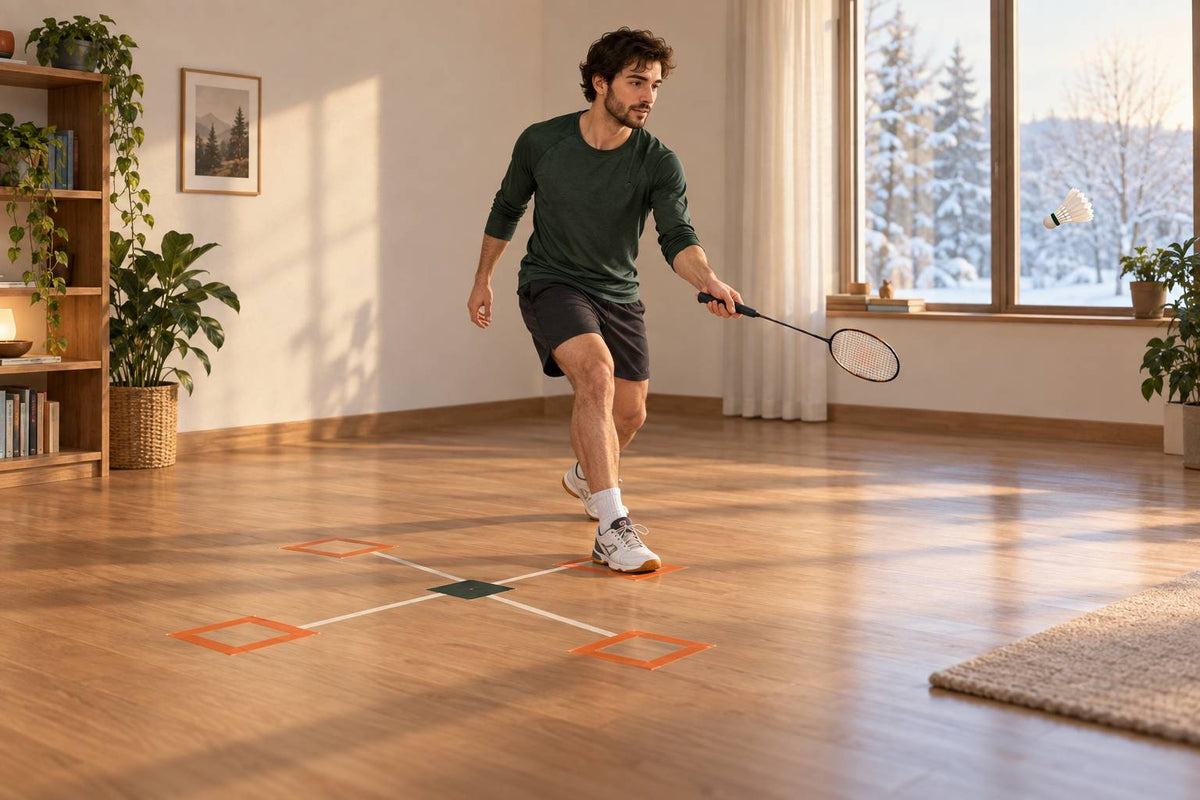
Shadow footwork: mark a small grid, move to each corner, return to base, and use 30 seconds on / 30 seconds rest for 5–6 rounds once your technique is controlled.
Shuttle
If you have a racket, shuttle, and enough ceiling height, do keep-ups with forehand and backhand grips, then add controlled wall drives for touch, timing, and consistency.
Fitness
When space is tight, use bodyweight circuits, wrist and forearm work, jump rope, resistance bands, or tennis-ball reaction drills to support the muscles and reactions you use on court.
Canadian winter can make badminton feel like a stop-start sport: courts are booked, roads are messy, and you may only have a hallway, basement, garage, or living room to work with. The good news is that badminton drills at home can still keep your timing, footwork, reactions, and racket touch moving in the right direction.
You do not need much: safe floor space, a racket, a shuttle if your ceiling allows it, and a clear plan. This guide covers practical no-court drills for Canadian players — shadow footwork, keep-ups, wall drives, reaction work, indoor strength training — plus the simple gear that makes winter practice easier.
Practising touch at home? Nylon shuttles are a practical choice for keep-ups and wall-drive work because they handle casual tapping better than feather shuttles. Check current shuttlecock availability at Badminton House, which ships across Canada.
In This Guide
- Why Do Badminton Drills at Home Work When Courts Are Limited?
- Shadow Footwork: Build Court Movement Without a Court
- Keep-Ups, Wall Drives and Small-Space Shuttle Skills
- Reaction and Wall Drills for Faster Hands
- Off-Court Speed and Strength Work You Can Do Indoors
- What Gear Do You Need for At-Home Badminton Practice?
- Which At-Home Badminton Drill Should You Choose?
Why Do Badminton Drills at Home Work When Courts Are Limited?
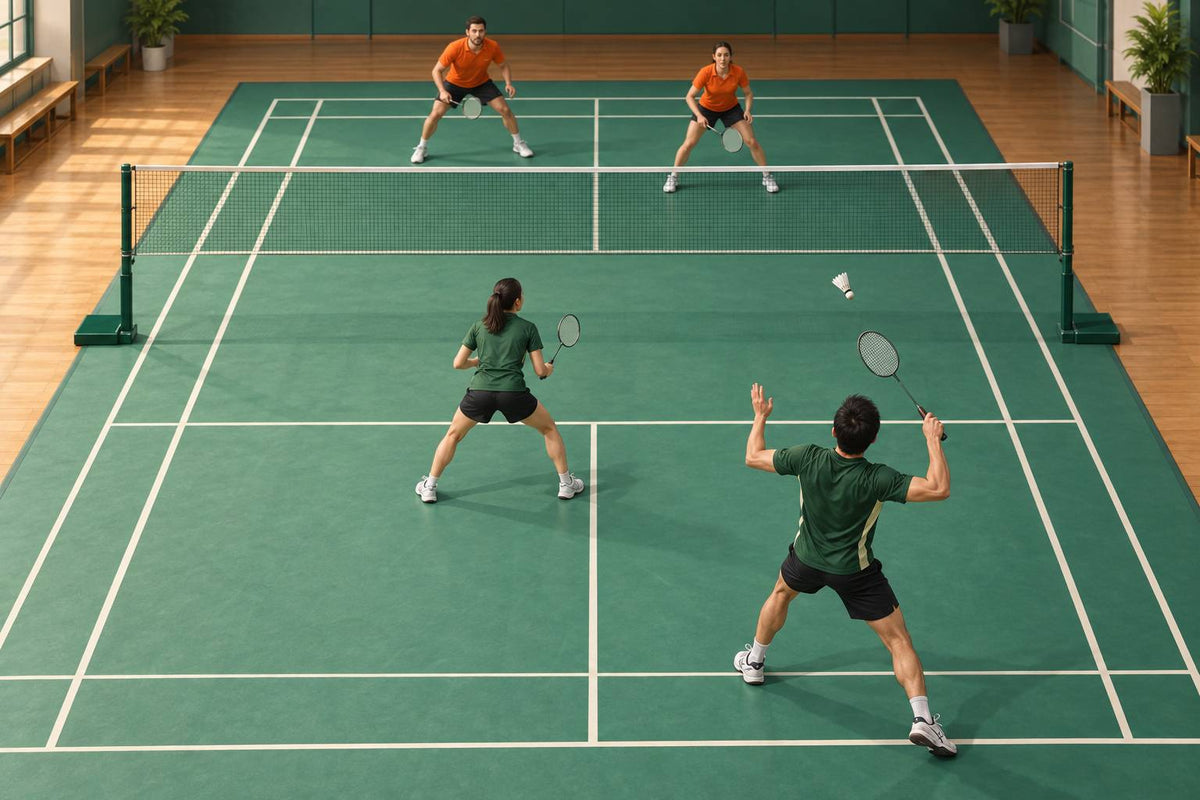
Home training is not a full substitute for matchplay. You still need real rallies, opponents, court spacing and shuttle timing to develop your game properly. But when Canadian winter, busy school gyms, full drop-in sessions or limited court bookings make regular play harder, badminton drills at home can keep your game from going cold between court sessions.
The biggest benefit is consistency. Even 15–30 minutes of focused work at home can help maintain and build fitness, improve footwork patterns, sharpen coordination and reaction speed, strengthen key muscle groups, and keep you mentally connected to the game. That matters because badminton rewards repeatable movement: split step, push off, recover, reset, then go again.
You also do not need much space to make progress. A small patch of floor can handle shadow footwork. A racket and shuttle can work touch and timing if you have enough ceiling clearance. A wall, ball or simple bodyweight circuit can build faster hands, better balance and stronger legs without needing a full court booking.
Think of home practice as maintenance plus sharpening.
- Maintenance: keep your legs, calves, core and shoulders active when you are not playing as often.
- Patterning: rehearse footwork routes and recovery rhythm so court movement feels familiar.
- Sharpening: train touch, grip changes and reaction habits in small spaces.
If your main goal is conditioning rather than technique, pair this guide with our badminton stamina and fitness guide for Canadian players. Use that for fitness-specific sessions, and use the drills below to keep your badminton movement, coordination and feel for the shuttle alive until your next court time.
Shadow Footwork: Build Court Movement Without a Court

Shadow footwork is practising badminton movement patterns — split step, travel to a corner, recover to base — without hitting a shuttle. It is the best no-court foundation drill because it rehearses recovery rhythm, split-step timing, and badminton-specific fitness with no net, partner, or shuttle required.
The goal is not to run around your living room at full speed. The goal is to move like you would on court: start from a base position, travel to a corner, recover to base, then repeat with balance and control.
Set up a small footwork grid
- Choose your base: stand in the middle of your available space, like your neutral recovery position on court.
- Mark four corners: use a small grid or existing floor lines to represent front-right, front-left, rear-right, and rear-left movement.
- Move corner to corner: travel to one corner, shadow the shot shape, then return to base before moving again.
- Check your body position: use a mirror or record yourself on video to review posture and balance.
Recording yourself is especially useful because footwork often feels cleaner than it looks. Watch whether you return to the same base position, whether your upper body stays balanced, and whether your recovery has a clear rhythm instead of becoming a shuffle.
Start with a clean corner sequence
Use a simple pattern first. For example: front-right, base, front-left, base, rear-right, base, rear-left, base. Keep the movement controlled enough that every recovery is deliberate.
| Stage | What to practise | Focus |
|---|---|---|
| 1 | Move to each corner and return to base. | Posture, balance, and consistent recovery position. |
| 2 | Add a split step before moving. | Timing the first push once your technique is solid. |
| 3 | Shadow for 30 seconds, then rest for 30 seconds. | Repeat for 5–6 rounds without letting form fall apart. |
| 4 | Simulate real rally pace. | Only increase speed after the movement pattern is dependable. |
Technique first, pace second. If your balance disappears, slow the drill down. Add split steps and rally tempo only once the corner movement and base recovery are solid.
What to look for on video
- You return to base after each corner instead of drifting around the room.
- Your posture stays balanced when you reach the front and rear corners.
- Your rhythm looks like badminton movement, not random cardio steps.
- Your split step is added as a timing cue, not as extra bouncing for its own sake.
If you need a refresher on the basic movement shapes before building this into a winter home routine, start with our badminton footwork basics guide, then bring the same patterns into your small-grid shadow sessions.
Keep-Ups, Wall Drives and Small-Space Shuttle Skills

If you have a racket, a shuttle and a high enough ceiling, you can still train touch, timing and consistency without booking a court. The goal is not to smash indoors; it is to make clean contact, switch grips smoothly and keep the shuttle under control.
Before you start, clear breakables, give yourself space from windows and lights, and keep every swing compact. Home shuttle drills work best when they are quiet, repeatable and controlled.
1. Keep-Ups: The Best No-Court Touch Drill
Start with simple keep-ups: tap the shuttle continuously upward using a relaxed grip and a short hitting action. Keep the racket face open enough to lift the shuttle, but not so open that it floats into the ceiling.
- Forehand only: use a forehand grip and count how many clean taps you can make without chasing the shuttle around the room.
- Backhand only: switch to a backhand grip and keep the motion small, using the fingers more than the full arm.
- Alternate sides: forehand, backhand, forehand, backhand. This is where the drill becomes useful for real rallies because you are training grip changes.
- Height control: aim for the same shuttle height on every tap instead of simply surviving the rally.
If your grip changes feel clumsy, pause the drill and review the basics in our badminton grip guide. Keep-ups should feel like finger control, not a shoulder workout.
2. Controlled Wall Drives
Wall drives are useful when you want faster contact practice in a small area. Stand a safe distance from a clear wall, use compact drive swings, and try to keep the shuttle returning at chest to shoulder height. The point is to keep a rally going, not to hit as hard as possible.
- Start slow: hit soft, flat drives until you can control the rebound.
- Use both sides: alternate forehand and backhand to train quick grip changes and finger movement.
- Set a target: choose a small safe area on the wall and try to hit near it repeatedly.
- Stop before form breaks: once you start lunging or swinging wildly, reset and slow the drill down.
For apartments or shared spaces, keep this drill gentle and choose a surface that will not mark or damage easily. If wall drives are too noisy where you live, stay with keep-ups and serve drills instead.
3. Net-Kill Simulation Into a Cushion or Mattress
You can practise the feeling of a sharp downward net kill without hitting into the floor. Place a cushion or mattress in front of you, hold the shuttle above it, and make short downward taps into the soft target. The contact should be crisp, compact and controlled.
- Keep the racket head high: start with the racket already prepared, as if you are waiting at the net.
- Use a short action: the drill should feel like a quick tap, not a full smash.
- Recover after every tap: bring the racket back up immediately so you are ready for the next shuttle.
This pairs well with our badminton net shot technique guide, especially if you are trying to improve control around the front court.
4. Short-Serve Practice Over a Makeshift Net or Measured Line
Short-serve practice is one of the most useful home drills because it rewards repetition and precision. Set up a makeshift net or use a measured line as your visual reference, then practise sending the shuttle on a low, controlled trajectory.
- Mark your start point: stand in the same place every rep so you can compare serve quality.
- Pick a landing zone: use tape, a towel edge or another safe marker to define the area you want to hit.
- Repeat in small sets: hit 10 serves, reset, then hit another 10 with the same routine.
- Watch the flight path: a useful short serve should travel with a controlled arc, not pop up loosely.
For the serving rules and technique details behind the drill, see our low and high serve guide. If you are marking lines at home, our badminton court dimensions guide can help you understand what those targets represent on a real court.
5. Coffee-Cup Precision Serve Drill
For a simple precision challenge, place a coffee cup at one end of a room and try to serve the shuttle into it from the other end. Use a cup or container that will not break, and place it where missed shuttles will not hit anything fragile.
Do not rush this one. Use your normal serve routine, aim small, and track how many attempts it takes to land one shuttle in the target. The benefit is not just accuracy; it is learning to repeat the same preparation, contact point and follow-through under a clear target.
| Drill | What It Trains | Home Setup |
|---|---|---|
| Keep-ups | Touch, timing, consistency, forehand and backhand grip changes | Racket, shuttle and high ceiling |
| Wall drives | Compact contact, grip change, finger movement and rally rhythm | Clear wall, controlled swing space and soft pace |
| Net-kill taps | Sharp downward contact and quick racket recovery | Cushion or mattress as a soft target |
| Short serves | Serve trajectory, repeatable routine and landing precision | Makeshift net, measured line or safe floor marker |
| Coffee-cup serve | Fine accuracy and consistent contact point | Unbreakable cup or small container placed as a target |
A good home touch session can be as simple as five minutes of keep-ups, five minutes of wall drives and five minutes of serves. Keep the pace controlled, stop if the room setup is not safe, and save the full-power shots for the court.
Reaction and Wall Drills for Faster Hands
Once your basic touch is under control, reaction work is where home practice starts to feel more like badminton. The goal is not to hit harder. It is to make your grip change, fingers, eyes and first movement happen sooner.

Wall drills are especially useful because the rebound forces you to reset quickly. Keep the movement compact: relaxed grip, short preparation, finger squeeze at contact, then immediately change back to neutral. If you are practising inside during a Canadian winter, use a wall-safe option and protect the space around you. HECS balls — soft yarn training balls handmade in Canada for racket-sport wall practice — are one way players do this kind of wall work at home without damaging walls.
Fast hands checklist
- Start with your racket or hands in front of your body, not hanging by your side.
- Stay loose until the catch, tap or rebound; tension slows the fingers down.
- Use short sets so the drill stays sharp instead of turning into tired scrambling.
- Stop before technique gets messy, then repeat with better quality.
1. Wall rebound for grip change
Stand close enough to the wall that you cannot take a big swing. Tap a soft ball or shuttle-friendly object into the wall and react to the rebound with small forehand and backhand movements. The key is the grip change: forehand face, neutral, backhand face, neutral. Keep your elbow in front and let the fingers do the work.
If the rebound becomes predictable, change your angle slightly or vary the height. That forces faster hand adjustment without needing court space.
2. Ball-drop catches
Hold a ball at shoulder height, release it, and catch it after one bounce or before it reaches the floor. To make it more badminton-specific, begin from a ready stance with your knees soft and your hands in front. This trains the same alert start you need before drives, net kills and defensive blocks.
3. Partner tennis-ball drop drill
Have a partner hold one tennis ball in each hand. They choose one to drop without telling you, and you catch it before it hits the ground. Start close, then increase the distance only when you are reacting cleanly. This is simple, competitive and very easy to do in a basement, hallway or garage with enough safe floor space.
4. Unpredictable wall bounces
Throw a ball against a wall and react to the bounce. The uneven timing makes this different from a neat rally pattern: you have to read the bounce, move your hand quickly and recover. Keep the throws controlled and avoid hard throws in small rooms.
5. Mirror drills
Mirror drills work well with a partner. One person leads with small hand feints, split-step timing or short side-to-side movements; the other person copies as quickly as possible. Keep it low-impact and precise. You are training recognition and response, not trying to win a footrace in your living room.
6. Smartphone reaction or tapping apps
A smartphone reaction or tapping app can add variety when you are training alone. Use it for short bursts, then connect the result back to badminton by returning to ready position after every tap. The useful habit is: react, reset, react again.
| Drill | Best for | Home setup tip |
|---|---|---|
| Wall rebound | Grip change and finger movement | Use a wall-safe ball and keep the swing short. |
| Ball-drop catch | First-step reaction and hand speed | Start from a badminton ready stance, not standing upright. |
| Partner tennis-ball drop | Reading cues and reacting under surprise | Your partner drops one of two balls without warning. |
| Unpredictable wall bounce | Eyes, hands and quick recovery | Throw lightly and leave enough clear floor space. |
| Mirror drill | Cue recognition and body control | One partner leads; the other copies with clean, compact movement. |
| Reaction/tapping app | Solo reaction variety | Reset to ready position after every tap. |
If your hand speed feels limited by how you hold the racket, review the basics in our badminton grip guide. A cleaner grip change usually makes these reaction drills feel faster without adding effort.
Off-Court Speed and Strength Work You Can Do Indoors
The best badminton drills at home are not only racket-and-shuttle drills. In a Canadian winter, when court time can be harder to book or travel to, your supporting work can keep your legs sharper, your hands quicker, and your movement rhythm closer to match speed.
Think of this section as the work that supports your on-court skills: bodyweight strength, wrist and forearm control, jump-rope rhythm, and simple off-court tools like ladders or bands when you have access to them.
1. Build a bodyweight circuit around badminton muscles
You do not need weights to train strength at home. A useful badminton-focused circuit should target the areas you use repeatedly on court: legs, core, shoulders, and stabilisers. The goal is not to turn your living room into a gym; it is to make your body better at holding posture, recovering to base, and staying balanced through repeated changes of direction.
- Legs: focus on the lower-body strength that supports lunges, recovery steps, and repeated court movement.
- Core: train your ability to stay controlled while reaching, rotating, and recovering.
- Shoulders: support the repeated overhead and defensive actions used in rallies.
- Stabilisers: work on balance and control so your footwork does not collapse when you move quickly.
If you already follow a badminton fitness plan, keep the strength work simple enough that you can repeat it consistently. For more conditioning ideas, see our badminton stamina guide.
2. Add wrist and forearm work for sharper racket control
Wrist and forearm strength directly affects how sharp and accurate your shots feel. That matters for quick blocks, drives, net kills, serve control, and late defensive touches where you do not have time for a full swing.
Three practical at-home options are:
- Resistance-band wrist rotations: useful when you have a band and enough clear space to move smoothly.
- Towel wringing: a simple no-court drill for grip, wrist, and forearm engagement.
- Forearm curls: a direct way to train the forearm strength that supports racket control.
Keep the movement controlled rather than rushed. In badminton, the transfer comes from cleaner racket control, not just forcing the wrist harder.
3. Use jump rope to stay light on your feet
Jump rope is useful for badminton because it works on stamina, trains your calves, and builds the habit of staying on your toes as you move around the court. That makes it a strong winter add-on when you cannot get regular rally volume.
You can pair jump rope with shadow footwork: rope first to wake up your rhythm, then move into split-step and recovery patterns. If your footwork basics still feel uncertain, review our badminton footwork basics before trying to make the movements faster.
| Indoor work | What it supports | Badminton transfer |
|---|---|---|
| Bodyweight circuit | Legs, core, shoulders, stabilisers | Better support for movement, recovery, posture, and balance |
| Wrist and forearm drills | Wrist rotations, towel wringing, forearm curls | Sharper, more accurate shot feel |
| Jump rope | Stamina, calves, staying on your toes | More active feet and better movement rhythm |
| Footwork ladder | Speed through repeated step patterns | Helps after you already understand your basic footwork |
| Resistance bands | Harder footwork exercises off court | Adds resistance so your legs are prepared when the resistance is removed |
4. Footwork ladders and resistance bands: useful, but optional
A footwork ladder can be helpful once you have figured out the basics of your footwork and want to speed up your movement. The basic method is simple: lay it out on the ground and time yourself moving through the boxes as quickly and cleanly as you can.
Resistance bands can also be effective for off-court work. They can make footwork exercises harder; when the resistance is removed, your legs are better prepared to move without it.
Gear note for Canadian players. Badminton House does not currently list dedicated footwork ladders, resistance bands, or jump ropes. For those tools, check Canadian badminton specialty retailers or your local club’s pro shop; for current badminton accessories, you can also check our accessories collection.
5. Put it together without overcomplicating it
A good indoor session does not need to include every drill. Choose one strength focus, one hand-control focus, and one movement focus. For example: bodyweight circuit, towel wringing or forearm work, then jump rope or ladder-style footwork. That gives you a balanced session without turning home training into a chore.
Before you start hard movement work in a cold basement, garage, or condo space, warm up properly. Our badminton warm-up exercises guide is a useful companion for winter training days.
What Gear Do You Need for At-Home Badminton Practice?
You do not need a full home gym to keep your touch sharp through a Canadian winter. For most no-court badminton drills at home, the useful minimum is simple: a racket, a durable nylon shuttle, a bit of safe floor space, and enough clearance for the drill you are doing.
Best simple setup: use a familiar racket plus nylon shuttlecocks for keep-ups, controlled wall drives, and soft net-kill tapping. Badminton House carries shuttlecocks and badminton rackets; check live availability before planning your order.
For indoor keep-ups and wall drives, nylon shuttles make more sense than feather shuttles for casual tapping because they are more durable. Yonex Mavis 350 Nylon Shuttlecocks are a practical indoor choice for repeated contact drills where you care more about consistency and durability than match-grade feather feel.
| Gear | Use at home | Practical note |
|---|---|---|
| Badminton racket | Shadow swings, grip changes, keep-ups, serve-feel work | Use a racket you already know well, or browse rackets when live stock is available. |
| Nylon shuttle | Keep-ups, wall drives, soft tapping drills | A durable option for winter home practice; Yonex Mavis 350 Nylon Shuttlecocks are carried by Badminton House. |
| Marked floor space | Shadow footwork, split-step timing, recovery-to-base patterns | Tape, socks, or safe visual markers can help you create a small movement grid. |
| Optional training tools | Footwork speed, calf stamina, wrist and forearm strength, reaction work | For ladders, jump ropes, resistance bands, or grip trainers, check Canadian badminton specialty retailers or your local club’s pro shop. |
Collection links point at the category rather than a single listing, so they stay useful as stock moves — check what is available when you are putting together a winter training kit for a club, school, or family.
Check Shuttlecock Availability
Ships across Canada · Customer service Mon–Fri 9am–5pm Atlantic Time
If your home space is tight, prioritize safety over intensity: clear breakables, avoid full-power swings near walls, and keep wall drives controlled. The goal is not to recreate matchplay indoors; it is to keep your hands, timing, and movement patterns alive until you are back on court.
Which At-Home Badminton Drill Should You Choose?
Pick the drill that matches your space, ceiling height, and what you most want to improve before your next court session.
| Choose this if... | Best drill focus | What it trains | Simple setup |
|---|---|---|---|
| You want the most court-transferable option without hitting a shuttle | Shadow footwork | Movement patterns, recovery rhythm, split-step timing, balance, and on-court fitness | Mark a small grid, move to each corner, return to base, and use a mirror or video to check posture |
| You have a racket, shuttle, and enough ceiling height | Keep-ups | Touch, timing, consistency, and switching between forehand and backhand grips | Tap the shuttle continuously with forehand and backhand grips in a clear indoor space |
| You want faster hands and cleaner grip changes | Wall drills | Grip change, finger movement, reaction speed, and controlled rally rhythm | Use controlled wall drives, or a wall-safe ball option for hand-speed work |
| You need a low-space precision drill | Serve-target practice | Serve precision and trajectory control | Place a coffee cup at one end of a room and try to hit into it from the other end |
| You want to support your legs, core, shoulders, and stabilisers | Bodyweight circuit | Strength for the muscle groups used on court | Use bodyweight movements rather than weights; pair with wrist and forearm work such as towel wringing or resistance-band wrist rotations |
| You already know the basics of footwork and want more speed | Footwork ladder | Quicker movement within a set pattern | Lay the ladder on the ground and time how fast you can step through each box |
| You have a partner available | Ball-drop reaction drill | Reaction speed and first-step sharpness | Have a partner hold one ball in each hand, drop one without warning, and catch it before it hits the ground |
If you are choosing just one starting point, shadow footwork is the safest default because it does not require a court, shuttle, wall, partner, or high ceiling. If your home session includes keep-ups or controlled wall drives, the gear section above covers simple racket-and-shuttle options such as Yonex Mavis 350 Nylon Shuttlecocks carried by Badminton House; check live stock before planning around a specific item.
For technique carryover, pair this section with Badminton Footwork Basics, How to Serve in Badminton, and Badminton Fitness Training.
Get 10% off your first order
Join the Badminton House list and we’ll email you a 10% welcome code — plus subscriber-only restock alerts, giveaways, and honest gear advice from players.
By subscribing, you agree to receive Badminton House emails and can unsubscribe anytime.
At Badminton House, we play badminton ourselves, so we know home training has to be practical: safe space, simple drills, and gear that actually matches your routine. If you want help choosing what to use for shadow swings, keep-ups, grip work, or your return to club night, contact us and we’ll help you sort it out.
Keep your game moving between court sessions.
Browse badminton gear carried by Badminton House for practice, club nights, and your next on-court upgrade.
Browse Badminton GearNeed help choosing? We’re happy to point you in the right direction.

Leave a comment
This site is protected by hCaptcha and the hCaptcha Privacy Policy and Terms of Service apply.