
Last updated: July 2026 · Written by the team at Badminton House
Quick Answer: Teaching Kids Badminton
Teach kids badminton through playful shuttle games, not formal technique: most children can try a racket at 4–5, handle gentle skill-building from 6–7, and 2–3 short sessions a week is plenty. Use a light junior racket, durable nylon shuttles, and praise effort over results.
Default
Best choice: keep it fun, praise effort, and use easy shuttle-toss or hanging-shuttle games so your child feels successful before learning “proper” strokes.
Age
Kids as young as 4–5 can try holding a racket, while more structured practice usually fits better around age 6–7 when coordination is stronger.
Routine
If they enjoy it, 2–3 sessions a week is plenty; coaching can wait until your child shows real interest and wants to improve.
Teaching kids badminton can feel tricky if you are a parent, not a coach. You want your child to learn the game properly, but you also do not want every backyard rally, school-gym hit, or community-centre session to turn into a lecture. The good news: you can introduce badminton without coaching experience by keeping it playful, using simple words, and building around small wins your child can actually feel.
Start with the shuttle, not the scoreboard. For kids, durable nylon shuttles are usually the most practical choice for early rallies and tossing games; check current options in our shuttlecocks collection.
In This Guide
- Keep It Fun First: Your Job Is Confidence, Not Coaching
- What Age Should Kids Start Badminton?
- What Gear and Space Do Kids Need to Start Badminton?
- Start With Shuttle Games Before Formal Strokes
- Teach the First Grip and Hit With Kid-Friendly Language
- How Often Should Kids Play Badminton?
- Which Badminton Path Should You Choose for Your Child?
Keep It Fun First: Your Job Is Confidence, Not Coaching
You do not need coaching experience to introduce badminton. At the beginning, simple games at home, in a driveway, at a school gym, or in a park are enough: toss the shuttle, see how many times they can tap it upward, aim for a target, or try a parent-child rally where the only rule is “keep it going.” Formal coaching can wait until your child shows real interest and wants to improve.
That approach fits the Canadian long-term athlete development direction for badminton: early skill development should be positive and fun. For parents, the key takeaway from the Active Start and FUNdamentals stages is simple — make movement feel like play before it feels like training. You can read the Canadian badminton LTAD overview through Badminton Ontario.
Parent rule of thumb: if your child finishes a session feeling proud, curious, or eager to show someone what they learned, the session worked — even if the strokes looked messy.
Confidence grows from small wins. Instead of correcting every swing, notice the effort and improvement: “You watched the shuttle longer that time,” “You tried again after missing,” or “That was your best contact so far.” Praising effort, persistence, and problem-solving helps kids connect improvement with practice rather than with being naturally “good” or “bad” at badminton.
- Start with success: use easy tosses, short distances, and targets they can actually hit.
- Praise the process: reward watching the shuttle, trying again, and staying relaxed more than winning the rally.
- Keep corrections tiny: give one simple cue at a time, then let them play again.
- End before frustration takes over: a short, happy session is better than pushing until badminton feels like homework.
When your child starts asking for more rallies, more court time, or stronger opponents, that is the moment to think about lessons, clubs, or junior pathways. If you want to see what comes after parent-led play, our Junior Badminton Canada guide explains the next steps without rushing the process.
What Age Should Kids Start Badminton?
The honest answer: there is no one perfect age. Many kids can pick up a racket around 4 or 5, especially if the “lesson” is really just tossing shuttles, chasing them, and celebrating contact. More structured badminton training usually makes more sense around 6 or 7, when coordination and motor skills are developing enough for kids to copy simple movements.
| LTAD stage | Age range | What it means for parents |
|---|---|---|
| Active Start | 0–6 | Keep it playful: running, throwing, catching, balancing, and simple racket-and-shuttle games. |
| FUNdamentals | Girls 6–8 · boys 6–9 | This is a good window for more consistent beginner play, simple grips, basic movement, and short rallies. |
| Learn to Train | Girls 8–11 · boys 9–12 | Kids can start learning more real badminton habits, especially if they already enjoy playing. |
Parent takeaway. If your child is under 6, think “play with a racket.” From about 6–7, think “gentle skill-building.” From 9–12, coordination often improves quickly, so kids who are interested may be ready for more regular practice or lessons.
The 9–12 range matters because it is an important motor-coordination window. Children in that age band often absorb movement patterns quickly, which is why early badminton experiences can pay off later. That does not mean a 10-year-old needs pressure, rankings, or year-round tournaments. It means this is a valuable time to help them move well, watch the shuttle, recover balance, and enjoy the feeling of improving.
If your child starts later, that is fine too. Badminton is widely played in Canada from elementary school settings to clubs, so there are many entry points. A child who begins at 11 or 12 with enthusiasm can still build skills quickly, especially if the first few months are positive instead of overly technical.
Once your child shows real interest beyond home or backyard play, you can look at the next step in Junior Badminton Canada: Lessons to Junior Nationals. For now, the best age to start is the age when badminton feels like a game they want to come back to.
What Gear and Space Do Kids Need to Start Badminton?

You do not need a perfect court to start teaching kids badminton. For the first few sessions, the goal is simply to create a space where your child can swing freely, see the shuttle clearly, and enjoy small wins without worrying about rules, lines, or scoring.
A home hallway, driveway, backyard, park, school gym, or rented court can all work if the space is safe. Move breakable objects out of range, give your child room behind and beside them, and keep the first games short enough that the setup still feels casual. If you want a simple outdoor setup for family rallies, see our portable badminton net set guide for Canada.
Parent setup rule: choose the easiest space that lets your child hit often. A backyard game with lots of contact is more useful than a full court where every rally ends after one swing.
Start With a Safe, Low-Pressure Space
For younger kids, reduce the court before you add more technique. Stand close together, toss gently, and let them hit from a comfortable distance. If you are indoors, avoid practicing near windows, lamps, TVs, low ceilings, or crowded furniture. If you are outdoors, expect wind to make the shuttle harder to control; that is normal, so turn it into a game rather than a correction session.
- Home: best for shuttle tosses, hand-eye games, and very short hits.
- Backyard or park: best for relaxed family rallies and movement games.
- Gym or badminton court: best once your child wants to rally longer or play with other kids.
If you use a real court, keep the playing area smaller at first. Half-court rallies, service-box games, or “hit it over the net anywhere” are more kid-friendly than asking a beginner to cover a full court immediately.
Use a Lighter, Shorter Kids’ Racket When Available
A child should not have to fight the racket. Kids’ badminton rackets are lighter and shorter than adult rackets, which makes it easier for children to learn basic hitting skills. If the racket is too long, heavy, or awkward, your child may compensate by using a stiff arm, choking up too far on the handle, or turning every swing into a big body movement.
When choosing a first racket, look for comfort before performance labels. Your child should be able to hold the handle without strain, lift the racket quickly, and make repeated gentle swings without the racket pulling their arm down. If you are comparing handle sizes for small hands, our G4 vs G5 vs G6 badminton grip size guide explains how grip sizing works.
Badminton House’s badminton rackets collection is the right place to check for available rackets. For a deeper parent-focused comparison, read our best junior badminton racket guide for kids in Canada.
Choose Nylon Shuttles for Learning
For teaching kids badminton, nylon shuttles are usually the practical starting point. Compared with feather shuttles, nylon shuttles fly slower, travel a shorter distance, cost less, and last longer, which makes them better suited to beginners who are still learning timing and contact.
| Gear Choice | Best Use for Kids | Why It Helps |
|---|---|---|
| Nylon shuttle | First rallies, backyard games, parent-led practice | Slower flight, shorter distance, lower cost, and better durability for repeated learning hits. |
| Feather shuttle | Club play, coaching sessions, competitive training | Better for advanced feel and formal play, but less practical for early kid practice because feathers wear out faster. |
The Yonex Mavis 350 is a natural beginner-friendly nylon shuttle option in the Badminton House shuttlecocks collection. The same principle applies regardless of which model you land on: for early learning, start with nylon before moving to feather shuttles.
Keep the Setup Simple Enough to Repeat
A good kid-friendly setup is one you can use again tomorrow: one racket that feels manageable, a few nylon shuttles, and a safe space where your child can miss without embarrassment. Add a net, court lines, or more formal rules only when your child is already asking to play more.
If you are building a family order, Badminton House ships across Canada. Start with what keeps the game easy, playful, and repeatable.
Start With Shuttle Games Before Formal Strokes
Before you teach clears, serves, or footwork, give your child time to simply understand the shuttle. Badminton feels different from sports with a ball: the shuttle slows down, turns in the air, and rewards good timing more than brute force. Simple shuttle games help kids build coordination and focus without feeling like they are being corrected every few seconds.

Use a beginner-friendly shuttle. For home practice, start with the shuttlecocks collection and choose nylon when available; it is the practical learning option for kids.
Game 1: Toss and Catch the Shuttle
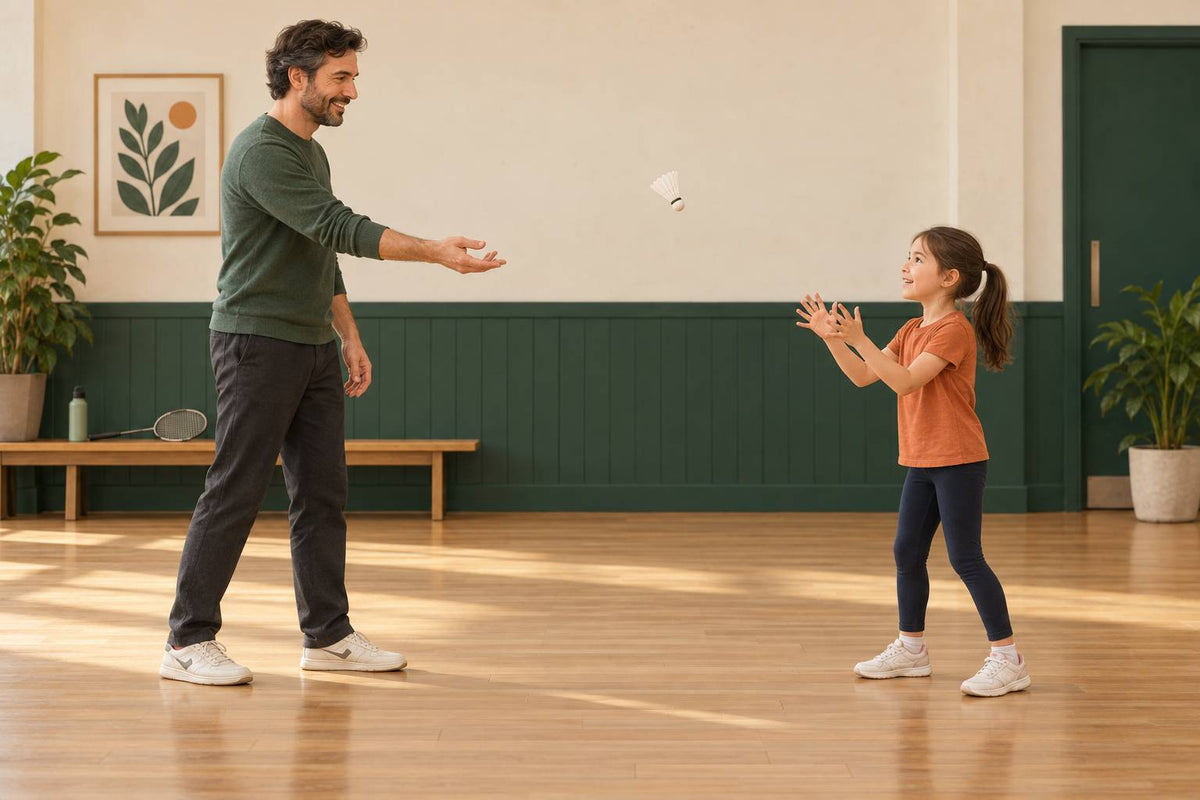
Start without the racket. Give your child one shuttle and ask them to toss it up gently and catch it by the cork or feathers/skirt. Then switch hands. Then try a parent-child version where you toss softly and they catch.
- What it teaches: watching the shuttle, judging its fall, and using soft hands.
- Make it easier: toss higher and slower so they have time to track it.
- Make it a win: count catches, not mistakes. “Can we get three catches together?” works better than “Don’t drop it.”
If your child is very young, let them catch with two hands. If they are older or already coordinated, challenge them to clap once before catching or catch after one bounce off their palm.
Game 2: Throw the Shuttle to a Target
Next, turn the shuttle into a throwing game. Put a laundry basket, hula hoop, towel, or jacket on the floor and ask your child to land the shuttle on the target. Let them throw underhand, overhand, or however feels natural at first.
This sounds almost too simple, but it matters. Throwing and handling the shuttle helps kids understand which end is heavy, how it turns, and why the cork leads the flight. That awareness makes the first racket hits much less random.
- Parent cue: “Point the cork where you want it to go.”
- Focus cue: “Watch it until it lands.”
- Confidence cue: “That one was closer — your aim is getting better.”
Game 3: Racket Balance and “Pancake” Touches
Now add the racket, but do not ask for a full swing yet. Have your child place the shuttle on the string bed and try to balance it while walking slowly. Then ask them to make tiny upward taps, like flipping a pancake only a few centimetres high.
Keep the racket face open and the movement small. Kids often want to swing big right away, but small taps teach control, relaxed grip pressure, and the feeling of the shuttle coming off the strings.
- Try this challenge: “Can you do five tiny taps without chasing the shuttle?”
- If it is too hard: let the shuttle start on the strings instead of tossing it first.
- If it is too easy: alternate forehand-side and backhand-side taps without naming them formally yet.
If you are unsure whether the racket is the right size for a child, read the Best Junior Badminton Racket Guide for Kids in Canada before browsing current badminton rackets.
Game 4: Hit a Shuttle Hanging at a Fixed Height
A hanging shuttle is one of the easiest ways to create a first “real hit.” Tie or clip a shuttle so it hangs around your child’s comfortable hitting height, then let them tap the cork with the racket. Because the shuttle is not moving away from them, they can focus on the contact point instead of chasing.
Use very simple language:
- “Eyes on the cork.”
- “Tap, don’t whack.”
- “Freeze after you hit it.”
- “Can you make it swing straight?”
This activity is especially useful for kids who get frustrated by missing a moving shuttle. The contact is predictable, so they can succeed quickly. You can also turn it into a game: three gentle taps in a row, five straight swings, or one tap where the shuttle comes back toward the same spot.
Game 5: Parent Feed — One Easy Shuttle at a Time
Only after the fixed shuttle feels fun should you move to a moving shuttle. Stand close and toss one shuttle softly toward your child’s racket side. Do not rally yet. Feed one, celebrate the contact, reset, and feed again.
For the first few sessions, a successful attempt can be any of these:
- They watched the shuttle all the way to the racket.
- They made contact, even if it went sideways.
- They stayed balanced after hitting.
- They tried again without getting upset.
That last one matters. Praise the effort after every mini-round, not just the clean hits. A child who feels safe missing will learn faster than a child who is worried about being corrected.
A Simple 10-Minute First-Shuttle Session
| Time | Activity | Parent Focus |
|---|---|---|
| 2 minutes | Toss and catch | Eyes on the shuttle, soft catches, lots of praise. |
| 2 minutes | Throw to a target | Aim and focus, not perfect technique. |
| 2 minutes | Balance and tiny taps on the racket | Small movements and relaxed hands. |
| 2 minutes | Hit a hanging shuttle | Clean contact and confidence. |
| 2 minutes | One-shuttle parent feeds | Celebrate attempts and stop while it is still fun. |
If your child wants more at-home ideas later, move gradually into the activities in Badminton Drills at Home. For backyard or driveway play, the portable badminton net guide can help you set up a more game-like space without turning the session into formal training too soon.
Teach the First Grip and Hit With Kid-Friendly Language

For a child’s first grip lesson, skip the technical lecture. Hand them the racket and say: “Shake hands with the racket.” That simple forehand-grip image is easier for kids to copy than talking about bevels, V-shapes, pronation, or racket-face angles.
Parent cue: If your child looks confused, your instruction is probably too long. Use one short phrase, demonstrate once, then let them try.
A simple first-grip sequence
- Show the racket like a hand: Hold the handle out to them as if the racket is saying hello.
- Ask for a handshake: “Shake hands with the racket using your hitting hand.”
- Keep the grip relaxed: If they squeeze hard, say “gentle hands” instead of giving a long correction.
- Point the racket toward the shuttle: Let them feel where the strings are facing before they swing.
- Try one easy contact: Toss or hold the shuttle in a predictable spot so they can focus on meeting it, not chasing it.
Use kid language instead of coach language
Kids learn faster when the cue connects to something they already understand. Instead of naming every body part and racket angle, use a short image they can repeat.
| Instead of saying… | Try saying… | Why it works |
|---|---|---|
| “Use a forehand grip.” | “Shake hands with the racket.” | It turns the grip into a familiar action. |
| “Track the shuttle all the way to contact.” | “Eyes on the birdie.” | It keeps attention on the most important target. |
| “Adjust your racket-face angle.” | “Show the strings to the shuttle.” | It gives them a visual checkpoint without overexplaining. |
| “You missed because your timing was late.” | “Great watch. Try meeting it a little sooner.” | It corrects without making the miss feel like failure. |
Celebrate contact before you correct technique
The first win is not a clean clear to the back line. The first win is contact. Then it might be contact twice in a row, a shuttle that goes over the net, or a child who remembers to watch the shuttle without being reminded.
“Correct one thing at a time, and praise the part that improved before you mention the next fix.”
When to add a little more technique
Once your child can make relaxed contact, you can slowly add one cue at a time: side-on body position, a small step toward the shuttle, or a gentle follow-through. Keep each cue short enough that they can remember it while moving.
If you want a parent-friendly refresher on grip basics, read our badminton grip guide. If the handle feels too large or too slippery for a smaller hand, our G4 vs G5 vs G6 grip size guide explains how grip sizing works for badminton rackets.
How Often Should Kids Play Badminton?
If your child is enjoying badminton, 2–3 sessions a week is plenty. Daily pressure is unnecessary, especially in the early stage when your real goal is not perfect technique — it is helping them associate badminton with confidence, play, and achievable progress.
Think of the routine as a rhythm, not a training program. Some weeks that might mean a short hit in the driveway, one family rally game, and one gym or club visit. Other weeks, school, weather, homework, or mood will get in the way. That is normal. A child who keeps wanting to come back will learn more over time than a child who feels pushed into practice.
Parent rule of thumb: end while they still want one more rally. That keeps badminton feeling like a treat, not a chore.
A simple weekly rhythm
| Session type | What it should feel like | Parent focus |
|---|---|---|
| Play session | Games with the shuttle, easy rallies, target challenges, or backyard play. | Praise effort, curiosity, and trying again. |
| Family rally | You play with them instead of standing aside and correcting every swing. | Make them feel like a playing partner, not a student being tested. |
| Group hit | Invite another child or a few friends when possible. | Let the social side reduce pressure and make learning feel natural. |
What to say after every session
The ride home matters. The first comment should not be about missed serves, footwork, or whether they won. Build a growth mindset by praising the things they can control:
- Effort: “I liked how you kept trying after that tricky shuttle.”
- Courage: “You tried a new shot today — that was brave.”
- Focus: “You watched the shuttle much better in the last few rallies.”
- Enjoyment: “What was your favourite game today?”
This does not mean you never teach. It means correction should come after confidence. If the session ends with encouragement, your child is more likely to ask to play again.
Play with them, not over them
One of the best things a parent can do is actually pick up a racket. You do not need to be a coach. In the beginning, your presence matters more than your technique. Feed easy shuttles, laugh at your own misses, and give them chances to succeed.
When possible, invite other kids. Learning alongside other children can lower pressure because the child is no longer the only person being watched. It also turns badminton into a social activity — something Canadian kids may already see at school gyms, community centres, clubs, and family gatherings.
Know when to take the next step
If your child starts asking to play more often, wants to rally with other kids, or becomes curious about lessons and competitions, that is a good sign they may be ready for a more structured pathway. For families wondering what comes after parent-led play, read Junior Badminton Canada: Lessons to Junior Nationals.
If your child likes the idea of a short, energetic badminton environment without jumping straight into year-round training, camp-style programs can be a useful bridge. See Badminton Summer Camp Canada: Junior Parent Guide for options to think through.
Keep the pattern simple: play, praise, rest, repeat. That is enough to build a child who enjoys badminton — and enjoyment is what gives real skill development a chance to grow.
Which Badminton Path Should You Choose for Your Child?
Use your child’s age, interest level, and confidence as the guide. For most families, the right first step is not formal coaching — it is simple, playful hitting games that create achievable wins.
| Choose this | Best fit | Parent focus |
|---|---|---|
| Home or park shuttle games | A child around 4–5, or any beginner who is just picking up a racket for the first time. | Keep it fun, use shuttle-handling warm-ups, and praise small improvements instead of correcting every miss. |
| Light structured practice | A child around 6–7 who has better coordination and wants a little more challenge. | Use kid-friendly language, simple grip cues like “shake hands with the racket,” and short repeatable games. |
| Group play with other kids | A child who learns better socially or feels pressure when practising one-on-one with a parent. | Let the group energy do some of the teaching. Playing with other children can lower pressure and help skills develop faster. |
| Coaching or lessons | A child who already shows real interest and wants to improve skills beyond casual play. | Do not rush it at the beginning. Parent-led games are enough to start; coaching helps once motivation is already there. |
| 2–3 sessions per week | A child who enjoys badminton and asks to play regularly. | Protect enthusiasm. Two to three sessions a week is plenty for kids who enjoy it; daily practice can create burnout. |
| Junior pathway next step | A child moving from playful learning into club, lesson, or competition interest. | Canada’s LTAD model puts early emphasis on fun and skill development, with FUNdamentals around girls 6–8 and boys 6–9, then Learn to Train around girls 8–11 and boys 9–12. For what comes after parent-led play, see Junior Badminton Canada: Lessons to Junior Nationals. |
Gear note for parents. If you are setting up kid-friendly practice, you can check the Badminton House shuttlecocks collection and the portable badminton net guide for simple home or backyard options.
Get 10% off your first order
Join the Badminton House list and we’ll email you a 10% welcome code — plus subscriber-only restock alerts, giveaways, and honest gear advice from players.
By subscribing, you agree to receive Badminton House emails and can unsubscribe anytime.
If you are teaching kids badminton and want a second opinion on racket fit, shuttle choice, or when to move from backyard games into lessons, contact us. We play badminton ourselves, and we are happy to help Canadian parents keep the first steps fun, low-pressure, and matched to the child.
Need a simple next step? Start with a comfortable racket setup, then build confidence one playful rally at a time.
Browse Badminton RacketsCanadian badminton specialty shop · Player-led gear advice · Parent-friendly equipment guidance

Leave a comment
This site is protected by hCaptcha and the hCaptcha Privacy Policy and Terms of Service apply.