
Last updated: July 2026 · Written by the team at Badminton House
Quick Answer: Common Badminton Mistakes Beginners Make
The 10 most common beginner badminton mistakes are gripping too tightly, using one grip for every shot, a tennis-style frying-pan grip, arm-only swings, hitting every shuttle at the same height, feeding the middle of the court, poor movement patterns, standing flat-footed, skipping recovery to base, and inconsistent serves. Fix grip pressure, ready footwork, and serve consistency first, because those habits affect almost every rally.
Default
Best first fix: relax your grip, switch between forehand and backhand grips, stay on the balls of your feet, and recover to a central base after each shot.
Power
If your clears and smashes feel weak, stop swinging with your arm only; use your legs, core, shoulder rotation, and weight transfer instead.
Control
If rallies feel predictable, stop hitting every shuttle too flat or into the middle; aim for useful height, earlier contact, and corner-to-corner placement.
If you are new to badminton and feel like every rally falls apart for a different reason, you are not alone. The shuttle goes long, your backhand has no control, your clears feel weak, your feet freeze, and suddenly a simple drop-in game at a Canadian gym feels much faster than it looked from the sidelines.
The good news: the common badminton mistakes beginners make are usually predictable and fixable. Most early problems come from grip errors, arm-only swings, poor shot height, hitting too centrally, flat-footed movement, slow recovery, or inconsistent serves. Once you can name the mistake, you can train the correction before it turns into a habit.
Start with the base. Technique matters most, but proper badminton footwear supports the ready stance and quick movement you will work on in this guide. Badminton House ships across Canada; browse badminton shoes.
In This Guide
- Mistakes 1–3: Grip Errors That Kill Control and Power
- Mistake 4: Swinging With Your Arm Only
- Mistakes 5–6: Hitting Too High, Too Flat, or Too Central
- Mistakes 7–8: Poor Footwork and Standing Flat-Footed
- Mistakes 9–10: No Recovery Base and Inconsistent Serves
- Build a Simple Fix-It Practice Loop
- Which Mistake Should You Fix First?
Mistakes 1–3: Grip Errors That Kill Control and Power

Grip is where many common beginner badminton mistakes start. If the racket is held too tightly, held the same way for every shot, or carried over from tennis as a frying-pan grip, the rest of your technique has to compensate. Grip habits are very trainable once you slow the movement down and practise the change deliberately.
Need the full grip breakdown? Use this section as the quick diagnosis, then study the detailed badminton grip guide for forehand, backhand, bevel, panhandle, and relaxed-pressure tips.
Mistake 1: Gripping the racket too tightly
A tight grip feels secure, but it usually does the opposite for your shots. Squeezing the handle slows racket-head speed, which reduces power. It also limits wrist flexibility, makes quick reactions harder, and can put unnecessary strain on your wrist over time.
The fix is to hold the racket more like a relaxed handshake: secure enough that it will not fly out of your hand, but loose enough that your fingers can adjust the handle. Between shots, keep the hand relaxed. As you prepare to hit, let the fingers guide the racket instead of locking the whole forearm.
| If this happens | What your grip may be doing | Simple correction |
|---|---|---|
| Clears feel weak even when you swing hard | You may be squeezing too early and slowing the racket head | Relax the fingers before the swing and avoid locking the wrist |
| Net shots pop up or feel clumsy | The grip is too tense for a small, controlled touch | Hold the handle lightly and let the fingers make the small adjustment |
| Your wrist feels overworked after play | You may be muscling the racket instead of keeping the hand relaxed | Return to a handshake-style hold and reduce constant squeezing |
Mistake 2: Using one grip for every shot
Many beginners try to hit forehands, backhands, net shots, drives, and defensive blocks with the same grip. That works for a few easy forehand shots, but it quickly breaks down when the shuttle moves to your non-racket side. Using a forehand grip for everything makes backhands weak and imprecise because the racket face is not set up cleanly for the shot.
The fix is not to memorize every grip perfectly on day one. Start with two practical habits:
- Forehand grip: use it for normal forehand-side shots where the racket face can meet the shuttle naturally.
- Backhand grip: rotate the handle in your fingers so the thumb can support backhand-side contact.
- Grip change habit: practise switching while standing still before trying it at full rally speed.
A simple check: if your backhand only works when the shuttle comes slowly and directly to you, the grip change is probably late or missing. Slow the rally down, reset the hand, and make the switch part of your preparation instead of a last-second rescue.
Mistake 3: Bringing a tennis or frying-pan grip into badminton
Players who have tennis experience often arrive with a strong, face-forward grip. In badminton, that frying-pan style can feel powerful at first because it points the racket face squarely at the shuttle. The problem is that it reduces the wrist and finger flexibility needed for quick badminton shots, especially when the shuttle is beside you, behind you, or on the backhand side.
Instead of holding the racket like a pan, return to the handshake idea. The handle should sit in the hand so you can rotate it quickly between forehand and backhand positions. Your fingers should be able to make small changes without your whole arm twisting awkwardly.
Quick Fix: The Grip Reset
Relax
Default habit: loosen the fingers between shots so the racket can move quickly and the wrist stays free.
Switch
Practise forehand-to-backhand grip changes with the racket in front of you before adding movement.
Check
If your backhand feels weak or your wrist feels locked, pause and reset to a handshake-style hold.
Gear will not fix a bad grip, but a racket that feels manageable in your hand can make learning easier than fighting a setup that is too demanding. If you are browsing from Canada, you can compare current options in our badminton rackets collection. Badminton House ships across Canada.
Mistake 4: Swinging With Your Arm Only
One of the most common badminton mistakes beginners make is trying to hit every clear, drive, drop, and smash with arm strength alone. It feels natural at first: the shuttle is coming, you reach back, and you swing harder. The problem is that badminton power is not supposed to come from the arm by itself.
When you swing with only your arm, shots usually become weaker and less consistent. You may also feel tired early because the small muscles around the shoulder and arm are doing work that should be shared by your legs, hips, core, shoulder rotation, and forearm. Over time, this can raise injury risk because the force is concentrated in the arm and shoulder instead of being distributed through the body.
The fix: connect the full body
- Start from the legs: load through your lower body before the swing instead of reaching only with your arm.
- Use your core: let your trunk help create power so the shoulder is not doing everything alone.
- Rotate the hips and shoulders: turn into the shot, then unwind through the swing.
- Transfer weight forward: move from the back foot toward the front foot as you strike, especially on overhead shots.
Think of the swing as a chain: legs set the base, hips and core rotate, the shoulder follows, and the arm finishes the motion. If one link is missing, you either lose power or compensate by muscling the shuttle.
A simple way to train this is shadow badminton. Stand without a shuttle, rehearse the shot slowly, and feel the sequence: load, rotate, transfer, finish, recover. Do it at half speed first. If your balance falls apart, slow down again. Clean mechanics matter more than swinging hard.
Footwork is what lets this full-body swing happen. If you arrive late, cramped, or off-balance, you will almost always revert to an arm-only hit. For the movement patterns that support better body positioning, read Badminton Footwork Basics.
Quick practice cue
Before your next overhead shot, say this in your head: “turn first, swing second.” That one cue helps you stop reaching with the arm and start using the body behind the racket.
Gear is secondary to technique here, but stable indoor court footwear can make it easier to plant, rotate, and transfer weight with confidence. If your movement feels slippery or unstable, browse our badminton footwear collection; for racket options, start with the broader badminton rackets collection rather than assuming a high-end frame will fix an arm-only swing.
Mistakes 5–6: Hitting Too High, Too Flat, or Too Central

Once your grip and swing start improving, the next common badminton mistakes beginners make are shot-selection habits: hitting every shuttle at the same height, and sending too many replies straight back through the middle. Both habits make your rallies predictable. Your opponent does not have to solve anything; they can stand comfortably, read your next shot early, and start dictating the rally.
Mistake 5: Hitting every shuttle at the same height
Beginners often swing at every shuttle as if it should travel on the same flat path. The problem is that badminton is not only about getting the shuttle over the net. Shot height changes what your opponent can do next. If your shot sits too high near the mid-court, it gives the other player an easier attacking chance. If every shot is flat, you stop using the front and back of the court properly.
A better habit is to match the shot to the contact point. When the shuttle is above net level and you are under control, use a clear to push your opponent back. When the opponent is deep or leaning backward, add a drop shot so they have to move forward. You are not trying to play fancy shots; you are making the court bigger.
Beginner fix: stop asking, “Can I hit it over?” and start asking, “Should this shuttle go deep or short?” If you need the short-shot mechanics, work through our badminton drop shot technique guide.
Mistake 6: Hitting too many shots to the middle
The middle feels safe, so beginners aim there constantly. It keeps the shuttle in play, but it also keeps your opponent comfortable. If most of your shots land through the centre channel, your opponent does not have to move front-and-back or side-to-side, and your attack becomes easy to read.
Your goal is not to paint the lines. Your goal is to make your opponent take extra steps. A badminton court is 13.4 m (44 ft) long and 5.18 m (17 ft) wide in singles, so corner-to-corner placement forces real running instead of comfortable reaching. Aim more often toward the four corners: deep forehand, deep backhand, front forehand, and front backhand. Even a simple clear to one rear corner followed by a drop toward the opposite front corner teaches you the real shape of singles badminton.
| Beginner habit | Why it hurts | Better cue |
|---|---|---|
| Flat reply to the middle | The opponent can wait in balance and read the rally early. | Aim to a corner unless you have a clear reason not to. |
| Same-height shot every time | You miss chances to move the opponent deep or bring them forward. | Use clears to create depth and drops when the short court is open. |
| Trying to win with one hard shot | It becomes predictable and often leaves you out of position. | Build pressure by changing depth and direction first. |
A simple Canadian club-night target is this: for the next game, do not judge yourself only by whether you win the rally. Count how often you make your opponent move to a corner. That shift alone turns “just return it” badminton into tactical badminton.
For a fuller plan on using length, patience, base position, and the four corners, read our beginner singles strategy guide. Those ideas pair directly with this fix: change the shuttle’s height, change its destination, and stop feeding the middle.
Mistakes 7–8: Poor Footwork and Standing Flat-Footed

Footwork is where a lot of beginner rallies fall apart. You may feel like your racket technique is the problem, but often the real issue is that you arrive late, off-balance, or too close to the shuttle. Once that happens, your shot choices shrink fast: instead of choosing a clear, drop, drive, or net shot, you are just reaching and hoping.
Two of the most common badminton mistakes beginners make are poor movement patterns and standing flat-footed between shots. Together, they make the court feel much bigger than it is.
Mistake 7: Running with poor movement patterns
Many new players chase the shuttle by running straight at it, crossing their feet heavily, or taking big uncontrolled steps. This works for a casual rally, but it breaks down quickly when the shuttle moves you side-to-side or front-to-back. Poor footwork affects your positioning on the court, makes you late to shots, and limits your ability to recover for the next rally ball.
Crossing steps are especially risky for beginners because they can twist your body away from the shuttle and make it harder to stop, lunge, or change direction. In badminton, you want movement that gets you to the shuttle quickly and leaves you balanced enough to hit with control.
Fix it: build a simple movement rule
- Start in a ready stance with your feet about shoulder-width apart.
- Use structured forward or sideways movement instead of scrambling with random running steps.
- Keep your body controlled enough that you can stop, hit, and recover.
- Practise without the shuttle first so the movement pattern becomes automatic.
If you want the full beginner breakdown, read our badminton footwork basics guide. It covers base position, split step, chasse, lunge, scissor kick, recovery, and simple drills you can use before your next drop-in or club night.
Mistake 8: Standing flat-footed
Standing flat-footed is the quiet mistake that makes every shot feel rushed. If your weight is sunk into your heels, your first step is slow. By the time you start moving, the shuttle is already lower, farther away, or behind your ideal contact point.
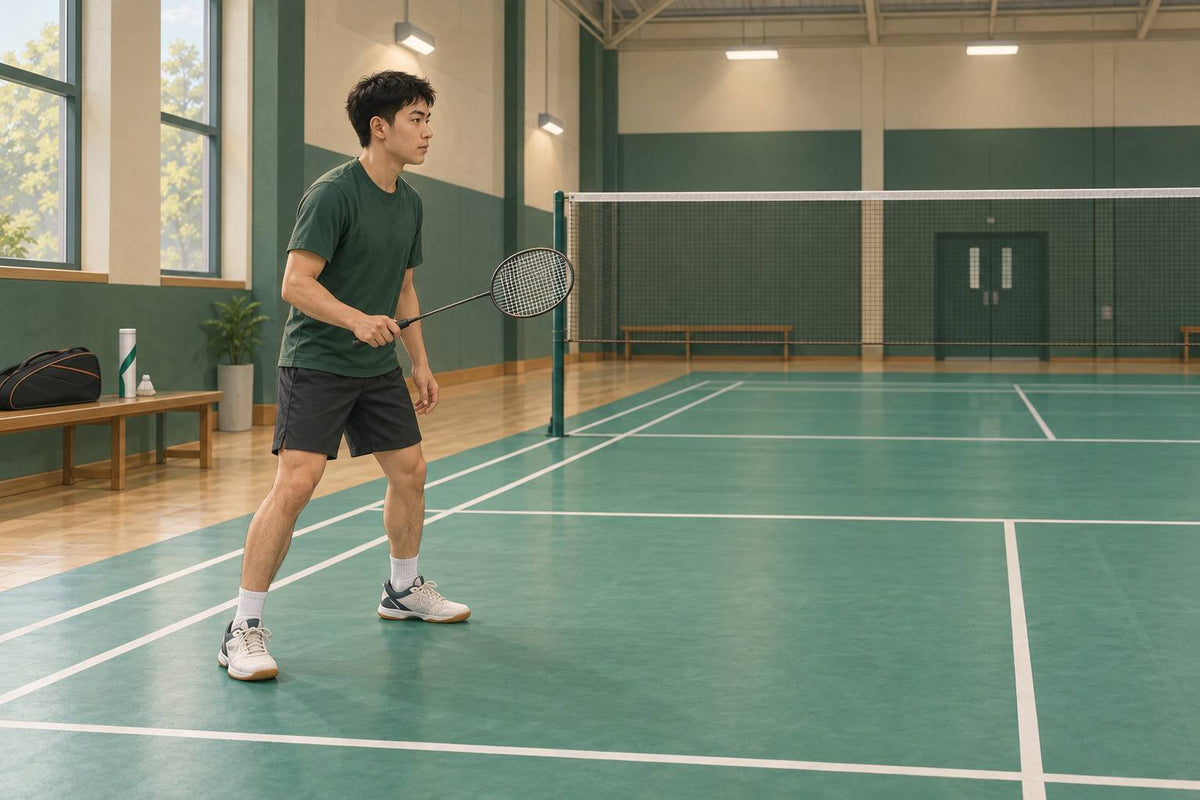
The fix is not to bounce wildly around the court. The fix is to stay ready: feet shoulder-width apart, knees soft, weight slightly forward, and your body prepared to push off in any direction. Think “light on the balls of the feet,” not stiff or tense.
| Beginner habit | Why it hurts | Better cue |
|---|---|---|
| Standing on the heels | The first step is slow, so you arrive late and hit under pressure. | Keep your weight slightly forward and stay light on the balls of your feet. |
| Feet too narrow | You lose balance when the shuttle changes direction. | Set your feet about shoulder-width apart before your opponent hits. |
| Big crossing steps | You can overrun the shuttle and struggle to stop or recover. | Use controlled forward or sideways movement so you can hit from a balanced position. |
| Waiting after your shot | You give yourself less time for the next shuttle. | Recover immediately after contact so you are ready again. |
Gear is secondary, but shoes matter. Technique comes first, but proper indoor court shoes can make ready-stance work easier and safer than playing in running shoes. See our Canadian badminton footwear collection; Badminton House ships across Canada.
For your next practice, keep the goal simple: after every shot, ask, “Was I balanced before I hit?” If the answer is no, slow the drill down and rebuild the movement. Better footwork will not just make you faster — it will give you more time, cleaner contact, and more shot options.
Mistakes 9–10: No Recovery Base and Inconsistent Serves
The last two beginner mistakes happen before and after the rally’s main shot: you either do not reset after hitting, or you start the point with a serve that is easy to attack, inconsistent, or illegal.
Mistake 9: Admiring your shot instead of recovering
A lot of new players hit a clear, drop, lift, or net shot and then stay where they finished. The problem is simple: badminton moves faster than your reaction time feels. If you finish at the back corner and do not recover toward a central base, the next shuttle can make you late before you even start moving.
Recovery does not mean sprinting blindly to the exact middle after every shot. It means rebuilding the habit of finishing your stroke, pushing back toward a balanced base position, and being ready for the next movement. In singles, that base is strongly tied to court coverage and four-corner pressure, which is why the recovery habit connects directly to badminton footwork basics and beginner singles strategy.
Quick fix: add a recovery step to every drill
- After every shot, say “recover” in your head before watching the shuttle.
- Push off the outside leg and move back toward your base position.
- Land balanced, not upright and frozen.
- Only then prepare for the next shot.
A useful beginner rule: if you are always reaching, lunging late, or taking the shuttle beside your body, your issue may not be the shot itself. It may be that your previous shot had no recovery attached to it.
Mistake 10: Treating the serve like a formality
Beginners often rush the serve because it feels like the “easy” part of the rally. But weak serving gives away the opening advantage. If your serve is illegal, too loose, or landing in random places, you are starting points under pressure instead of starting them with control.
The fix is not to learn trick serves first. Start with legal low serve basics and high serve basics, then make the placement repeatable. A low serve should help you begin the rally without immediately lifting the shuttle for your opponent. A high serve, especially in beginner singles, should give you time to recover into a ready base instead of standing and watching.
| Serve problem | Why it hurts | Beginner correction |
|---|---|---|
| Rushed setup | You lose rhythm and make more faults. | Use the same stance, grip pressure, and pre-serve routine every time. |
| Random placement | Your opponent can step in early or wait comfortably. | Pick one target and repeat it before adding variation. |
| Loose serve | You invite an immediate attack or lose control of the first exchange. | Practise legal low and high serves until your contact and landing zone are repeatable. |
If you are unsure what makes a serve legal, or when to use a low serve versus a high serve, start with the step-by-step badminton serving guide. Fixing the serve is one of the fastest ways for beginners to stop giving away free pressure at the start of each point.
Practice loop for this pair: serve to a target, recover to base, split into ready position, then play the next shot. That one loop trains the point’s beginning, middle, and reset instead of treating them as separate skills.
Build a Simple Fix-It Practice Loop
The fastest way to clean up common badminton mistakes beginners make is not to chase ten fixes at once. Pick one visible error, train it for a short block, then test it in real rallies before moving on.
Start by recording a few rallies from behind the court or from the side. Many beginner mistakes are hard to feel in the moment: a grip that stays too tight, a split step that never happens, a late contact point, or a serve that changes height every attempt. Video makes the pattern obvious.
A beginner-friendly weekly loop
Step 1
Choose one mistake. For example: loose grip, split step, recovery base, serve consistency, or hitting to the corners instead of the middle.
Step 2
Drill the fundamental first. Master grip changes, ready stance, footwork, and serve mechanics before trying flashy trick shots or advanced deception.
Step 3
Play points with the same focus. If today’s goal is recovery base, judge the session by whether you return to base after each shot—not by whether you won every rally.
Step 4
Record again. Compare the new video with the old one. If the mistake is improving, keep it for another session; if it is stuck, get feedback before the habit becomes ingrained.
Stamina matters too. Badminton demands endurance, speed, and agility, so beginners who fade halfway through a game often see their technique fall apart at the same time. A practical target is 2–3 focused training sessions per week: one technique session, one movement or fitness session, and one match-play session if your schedule allows.
If you want faster correction, coaching can save weeks of guessing. A qualified coach can spot grip, timing, footwork, and serve problems quickly, while drop-in play and leagues give you the repetition needed to make the fix hold under pressure. If you are deciding what format fits you best, read Badminton Lessons vs Drop-In vs League Play.
Gear should support the fix, not replace it. If flat-footed movement is your biggest issue, proper indoor court footwear can help you move and stop more confidently; browse badminton footwear. If your racket feels like it is fighting your swing, compare options in the badminton rackets collection, but keep the priority on clean technique first.
Ask Badminton House — Get Beginner Gear Help
Canadian badminton support · Mon–Fri 9am–5pm Atlantic Time · Ships across Canada
Which Mistake Should You Fix First?
If everything feels messy at once, do not try to rebuild your whole game in one session. Pick the mistake that is costing you the most points right now, then use one simple fix until it feels automatic.
| Choose this first if... | Main mistake | What to fix | Next guide |
|---|---|---|---|
| Your shots feel weak, stiff, or uncontrolled even when you reach the shuttle. | Grip pressure and one-grip-for-everything habits | Hold the racket more like a relaxed handshake, avoid squeezing, and practise switching between forehand and backhand grips so the wrist and fingers can work. | How to hold a badminton racket |
| You get tired quickly or feel like every clear, smash, or lift comes from your shoulder. | Arm-only swinging | Use your legs, core, shoulders, and hips together. Practise shadow swings without a shuttle so weight transfer and rotation become part of the motion. | Kinetic chain power |
| You arrive late, cross your feet, or stand still after hitting. | Poor footwork, flat-footed stance, and no recovery base | Start from a ready stance with feet about shoulder-width apart, use structured movement patterns, and return toward centre court after each shot. | Badminton footwork basics |
| You keep lifting or driving the shuttle into comfortable attacking height for your opponent. | Hitting too high, too flat, or at the same height every time | When the shuttle is above net level, use the right shot for the situation: clear to push the opponent back, or drop when a softer front-court reply fits the rally. | Drop shot technique |
| Your rallies are long, but opponents never seem under pressure. | Predictable middle-court placement | Stop feeding the middle. Move opponents into different corners, front-and-back and side-to-side, so they have to cover more court. | Singles strategy for beginners |
| You lose points before the rally really starts. | Serve faults or inconsistent serve placement | Make the serve a repeatable routine. Learn the legal rules, practise low and high serves, and aim for placement that starts the point on your terms. | How to serve in badminton |
| You are trying flashy shots but still missing fundamentals. | Skipping the basics too early | Prioritize grip, footwork, serve, and simple shot placement before adding advanced deception or trick shots. | Lessons vs drop-in vs league |
Gear note for flat-footed beginners. If your biggest issue is ready stance and court movement, proper indoor court shoes can help you practise footwork more confidently. The Babolat Shadow Tour Men's Badminton Shoes – Orange is a non-marking option with lateral midfoot support, worth a look in our footwear collection.
Get new badminton guides by email
Join the Badminton House list for occasional emails with new guides, technique tips and news from our club in Moncton.
By subscribing, you agree to receive Badminton House emails and can unsubscribe anytime.
Fixing beginner mistakes is a lot easier when you have a second set of eyes on your grip, footwork, serve, and gear setup. We play badminton ourselves, so if you are not sure what to work on next, contact us for practical advice and we will help you choose the next sensible step.
Ready to build better beginner habits with proper court gear?
Shop Badminton FootwearShips across Canada · 14-day returns · Canadian badminton specialty shop

Leave a comment
This site is protected by hCaptcha and the hCaptcha Privacy Policy and Terms of Service apply.