Badminton Guides

Get access to our latest news by signing up for our newsletter.

Injury & RecoveryClose-up of black rigid athletic tape applied in an Achilles support pattern on the back of a calf and foot, anchor strips at the upper calf and midfoot joined by vertical support strips over the heel.

Taping Achilles for Badminton: A Step-by-Step Support Method

A step-by-step Achilles taping procedure: materials, foot position, anchor and strip order, and the checks that confirm the tape restricts pain without cutting circulation, plus what taping can and...

Shoes & GearTwo indoor badminton court shoes side by side on a hardwood court: the left shoe shows a frayed, worn toe and smoothed outsole tread, the right shoe looks comparatively fresh.

Why Your Left Badminton Shoe Wears Out First

Real badminton lunge research explains why one court shoe wears out before the other, most often the left shoe for right-handed players, and what specific wear locations on the sole actually mean.

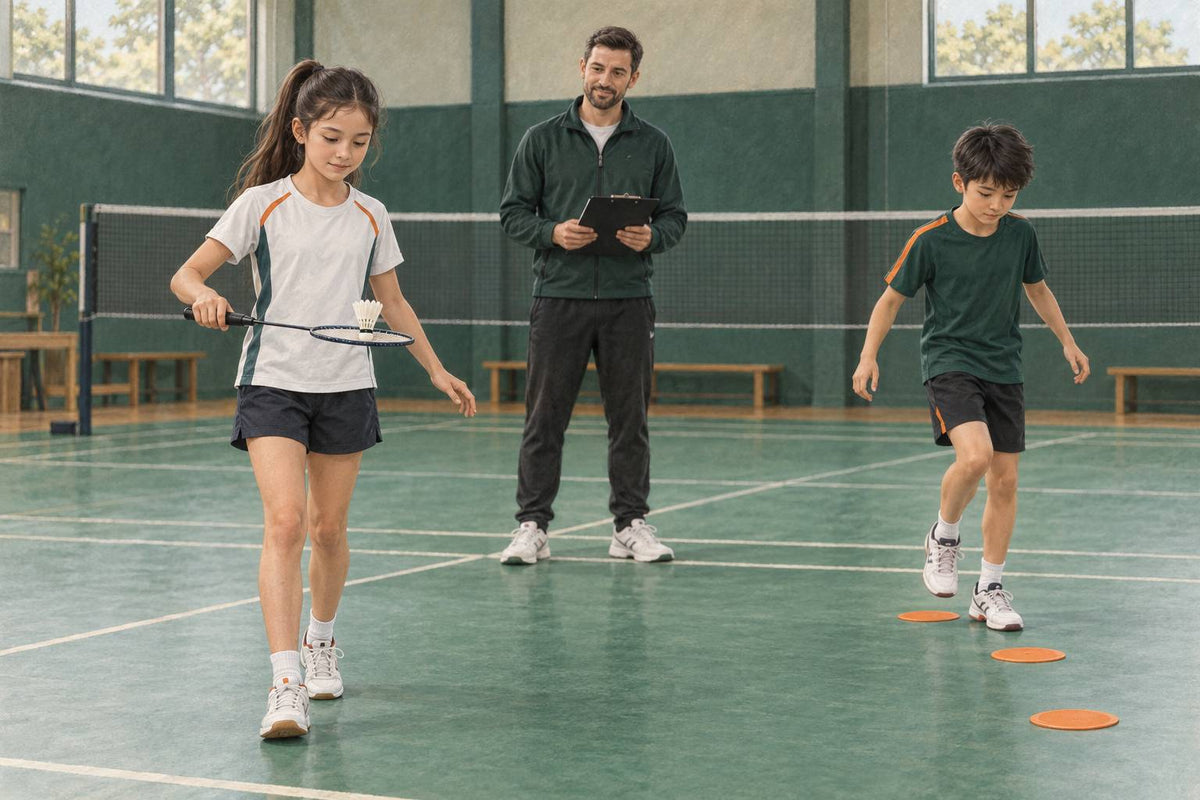
Beginner GuidesA coach crouches beside a young badminton player on a courtside bench during a between-games break in an indoor hall.

Junior Badminton Coaching Rules: Why Advice Waits for the Break

The Laws of Badminton allow advice only while the shuttle is not in play. Many junior circuits tighten that further: below under-17, coaching often waits for the break between games, and beginner d...

Shoes & GearSide-by-side illustration comparing a flat 1935 low-top canvas court shoe with a modern cushioned, structured badminton shoe.

Jack Purcell Badminton: The Champion Behind the Shoe

Jack Purcell was Canada's dominant badminton player of the late 1920s and early 1930s, acclaimed world professional champion in 1933. In 1935 he co-designed the canvas shoe that still carries his n...

Technique & TacticsOverhead diagram of a badminton doubles front court with five numbered feed spots near the net and a player in ready position with the racket raised.

Doubles Net Interception Drill: Continuous Feed Practice

A continuous-feed drill for the front doubles player: five feed spots across the net, feeder tempo, three progressions, and the two faults, a braced shoulder and a lowered racket, that kill interce...

Rackets & StringsClose-up of two entry-level metal badminton rackets and plastic shuttlecocks laid on an indoor floor

Budget Badminton Rackets: 5 Checks Before You Buy

A five-check method for judging any budget badminton racket by its specifications: frame and shaft material, weight code and balance, the stated tension cap, joint construction, and grip size, each...

Tournaments & PlayersElevated view of three indoor badminton courts in one hall: two players shake hands over the net on the finished nearest court while a fresh pair waits at the sideline, and matches continue on the two courts behind.

Short Badminton Scoring Formats: Games to 11 and 15

BWF's Laws sanction exactly three short formats when agreed in advance: a single game to 21, a best-of-three to 15, or a best-of-five to 11. The 15-point format becomes the worldwide default from J...

Rackets & StringsTwo hands holding two badminton rackets with their heads resting on a table edge, one shaft bending noticeably more than the other in a side-by-side stiffness comparison.

Badminton Racket Shaft Stiffness: Why Brand Labels Differ

Yonex, Victor and Li-Ning each grade badminton racket shaft stiffness on their own word or number scale, and none publishes what a given grade means in physical terms. See what each brand actually ...

Beginner GuidesClose-up of a badminton shuttlecock resting on a racket's strings, the racket-and-shuttle contact point beginner control drills train.

Badminton Racket Control Drills for Complete Beginners

BWF's Shuttle Time curriculum and the coaching book Badminton: Steps to Success both teach grip and racket-and-shuttle control before movement or real strokes, with numeric targets like 20 consecut...

Injury & RecoveryTwo badminton doubles partners reaching for the same shuttle at the mid-court seam, rackets close together in a side by side defensive stance.

Badminton Racket Clash: Protect Hands and Frames

Doubles racket clashes cluster at the mid-court seam because side by side is the standard defensive shape and attackers are coached to smash straight down that seam. Pre-deciding who owns the middl...

Training & FitnessOverhead diagram of a badminton court with a rear feeder and a front feeder on one side of the net and a single defender covering the whole court alone on the other side.

2v1 Badminton Drill: Build Defence With Three Players

A 2v1 badminton drill only trains defence when the single player's job changes zone by zone, the pair attacks with real discipline, and the defending role rotates before contact quality breaks down...

Places to PlayA wheelchair badminton player in a sports wheelchair plays a low backhand in a training hall, with courts and spare sports chairs behind her.

Wheelchair Accessible Badminton Venue: A Club Checklist

A venue can host wheelchair badminton when the whole journey from parking to court is step-free, doors clear a sports wheelchair, the court has clear run-off, and toilets, changing and chair storag...