
Last updated: July 2026 · Written by the team at Badminton House
Quick Answer: Yonex vs Asics Badminton Shoes
For most badminton players, start with Yonex for badminton-specific cushioning and grip; consider Asics when wider-feet comfort or extra lateral stability is your main concern.
Yonex
Best default: choose Yonex if you want a proven badminton shoe feel with Power Cushion support and reliable traction on clean courts and many dusty multipurpose gyms; check Badminton House footwear availability before choosing your size.
Asics
Try Asics if you prioritize cushioning, lateral stability, or a wider-feet reputation, but do not buy on reputation alone: some Asics court models fit tight in the forefoot and are indoor-court crossovers rather than badminton-only shoes.
Backup
If neither fit feels right, compare other non-marking court shoes by millimetre length, heel hold, and side-to-side support; Badminton House ships across Canada, so socks or accessories can help round out a shoe order.
Choosing between Yonex vs Asics badminton shoes is not as simple as “Yonex for badminton, Asics for wide feet.” Yonex is the default name many players look for because of its badminton-specific Power Cushion lineup, while Asics has a strong reputation for cushioning, stability, and often a roomier forefoot feel. But the real answer depends on your court surface, foot shape, injury history, and whether you play on clean badminton mats or dusty multipurpose gym floors.
This guide is written for Canadian players who need a practical fit decision before ordering online. We’ll compare the feel of Yonex Power Cushion against Asics GEL and FlyteFoam, explain why sizing does not translate cleanly between brands, and point out where Asics court shoes can work well as indoor-court crossovers. The goal is not to crown one brand for everyone — it is to help you avoid the wrong shoe for your feet and your home court.
Start with real badminton court shoes. Check current Canadian availability in our badminton footwear collection, which ships across Canada.
In This Guide
- Fit and Width: Is Asics Really Wider Than Yonex?
- Cushioning: Yonex Power Cushion vs Asics GEL and FlyteFoam
- Grip: Clean Badminton Mats vs Dusty Multipurpose Gyms
- Stability and Weight: Who Should Prioritize What?
- Sizing: Does Your Yonex Size Equal Your Asics Size?
- Canadian Buying Notes: What Badminton House Carries
- Which Should You Choose?
Fit and Width: Is Asics Really Wider Than Yonex?

The common shortcut in the Yonex vs Asics badminton shoes conversation is simple: Asics is often described as the wider forefoot option, while Yonex is treated as the safer badminton-specific default. That shortcut is useful, but it is not enough to buy shoes by brand name alone.
Asics court shoes do have a reputation for cushioning, stability, shock absorption, and often a wider forefoot fit. For some players, especially those who feel squeezed in narrow indoor shoes, that reputation is the reason Asics enters the shortlist. The catch is that real fit depends on the specific model. In hands-on testing, the Asics Court Control fit tight around the front of the shoe, and wide-footed players were specifically advised to try it on first rather than assuming it would automatically feel roomy.
Wide feet? Do not buy by brand reputation alone. Use Asics as one option to try, but also compare badminton-specific Wide models from Yonex and read our wide-foot badminton shoe guide for Canada.
Why “Asics is wider” can still go wrong
A wider forefoot reputation does not guarantee comfort if the toe box shape, sidewall structure, or upper stiffness does not match your foot. This matters in badminton because your foot is not just sitting inside the shoe. It is braking, lunging, pushing sideways, and loading the outside edge during recovery steps.
The Asics Court Control example is the exact caveat: even within a brand known by many players for a more forgiving forefoot, that model can feel tight at the front. It also uses an external bulge below the pinky-toe area for lateral stability, which may help the shoe feel secure for some players but will not magically solve every wide-foot issue.
| Common assumption | Better way to think about it |
|---|---|
| “I have wide feet, so I should buy Asics.” | Try Asics, but do not assume every Asics court model is roomy. The Court Control can feel tight at the front. |
| “Yonex is only for narrow feet.” | Yonex also offers specific Wide variants in the 65Z and Cascade Drive series, so wide-footed players should not rule Yonex out. |
| “If the length is right, the fit is right.” | Badminton fit is length plus forefoot volume, heel hold, side support, and toe comfort during lunges. |
Where Yonex fits into the wide-foot conversation
Yonex should not be dismissed just because Asics has the wider-fit reputation. Yonex has badminton-specific shoe lines, and wide-footed players should pay attention to the actual version name. The important detail is that Yonex has specific Wide variants in its 65Z and Cascade Drive series.
That distinction matters. A standard-width Yonex shoe and a Yonex Wide variant are not the same buying decision. If your pain point is pressure across the ball of the foot or the outside of the pinky toe, look for the wide version rather than assuming the whole Yonex brand will fit one way.
For women’s sizing and fit, the same principle applies: avoid converting only by the number on the box. Foot shape, forefoot width, heel hold, and sock thickness can change the result. For a deeper women-specific breakdown, see our women’s badminton shoes Canada fit guide.
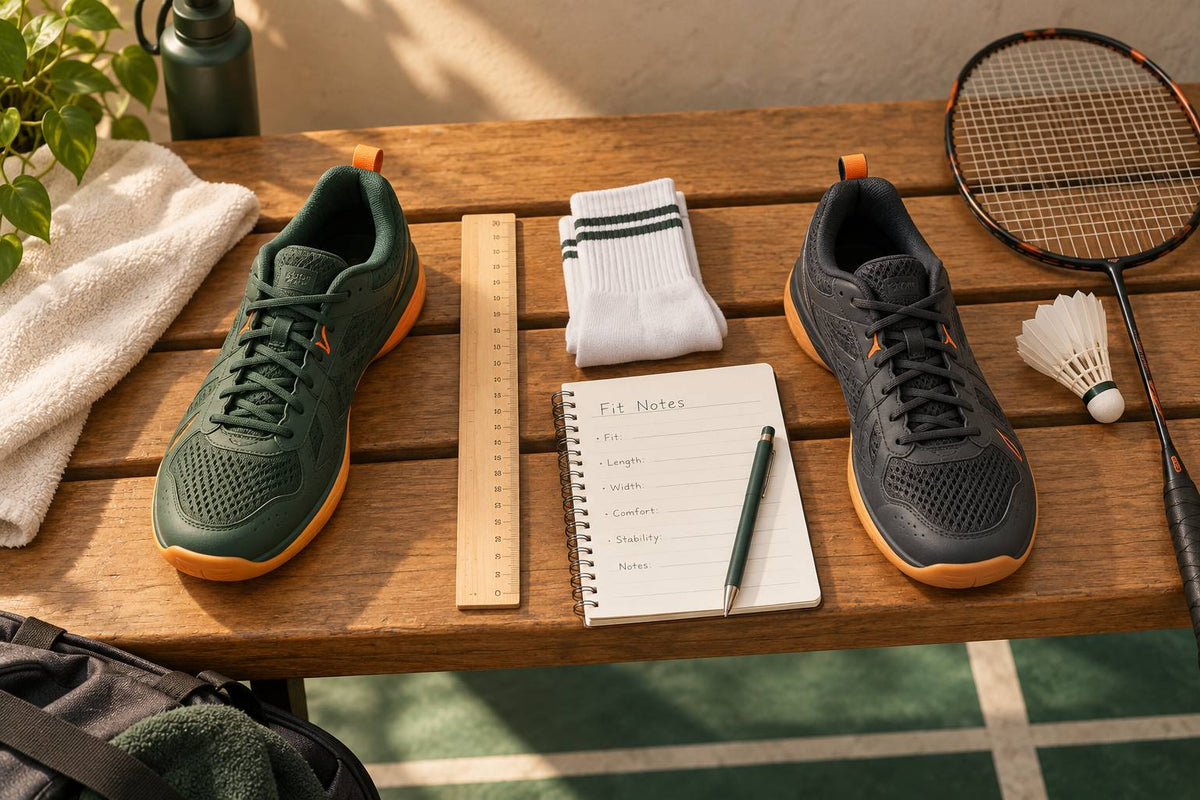
Quick fit test before you commit
- Check the forefoot first: your toes should not feel pinched when you bend into a lunge position.
- Check the pinky-toe side: pressure on the outer forefoot is a warning sign for wide-footed players.
- Check heel lock: a wider forefoot is not helpful if your heel lifts during split steps or recovery movements.
- Check with badminton socks: use the socks you actually play in, not thin dress socks or bare feet.
- Leave room for play: feet can swell during badminton, so a shoe that feels tight at rest can feel worse after hard rallies.
Bottom line: Asics is a legitimate option for players who need forefoot space and stability, but it is not automatically the wide-foot winner. Yonex remains very relevant because of its badminton-specific construction and Wide variants in key series. If you are shopping in Canada, compare the actual model, width version, and return fit before treating either brand as the answer by default.
Cushioning: Yonex Power Cushion vs Asics GEL and FlyteFoam
Cushioning is where the Yonex vs Asics badminton shoes debate gets interesting, because the two brands feel different underfoot. Yonex Power Cushion technology is built around absorbing shock on landing and converting that impact energy into forward propulsion, which is why many badminton players associate Yonex with quick recovery after lunges, jumps, and split-step landings.
Asics approaches the same problem from a broader indoor-court and sports-science background. Its court shoes are known for cushioning, stability, and responsive feel, with GEL cushioning and FlyteFoam appearing across its indoor-court lineup. One important context point: Asics does not only make badminton-specific shoes; many Asics models used by badminton players are indoor-court crossover shoes originally positioned for sports such as volleyball, squash, and other gym-court movement.
| Cushioning system | What it tends to feel like | Best fit for |
|---|---|---|
| Yonex Power Cushion | A softer, badminton-specific landing feel designed to absorb impact and help you move into the next step. | Players who want light-feeling movement, repeated jump-landings, and fast recovery between shots. |
| Asics GEL / FlyteFoam | A cushioned, responsive court-shoe feel, often paired with a stability-first platform. | Players who like a planted indoor-court shoe feel and want cushioning with lateral support. |
An older player comparison between an Asics Gel Blade and a Yonex SHB65 captured the difference in plain language: the Asics GEL felt bouncier but heavier, while the Yonex felt lighter and more comfortable. Treat that as a useful feel cue, not a final verdict on current models, because both brands have updated their shoe lines since then.
How to choose by landing feel
- Choose Yonex first if you want a lighter-feeling badminton shoe that helps you stay quick after lunges and jump landings.
- Try Asics if you like a bouncier, more cushioned court-shoe feel and do not mind a potentially heavier ride.
- Prioritize comfort over brand loyalty if you have knee, heel, or arch concerns; the best cushioning system is the one that fits your foot securely without pressure points.
If you want a deeper explanation of how Yonex cushioning works in badminton movement, read our Yonex Power Cushion technology guide. If your main concern is impact or discomfort, pair shoe choice with the practical checks in our badminton knee pain guide.
Grip: Clean Badminton Mats vs Dusty Multipurpose Gyms

Grip is where the Yonex vs Asics badminton shoes debate gets more court-specific. In CKYew’s independent hands-on test, the tested Asics indoor-court crossover shoes and the Yonex Power Cushion 65 were all sufficiently grippy on dedicated rubber-mat badminton courts and in squeaky-clean halls. The difference showed up when the floor got dusty: the Asics outsoles became slippery, while the Yonex Power Cushion 65 with its Radial Blade outsole kept traction better.
That matters in Canada because many players split time between two very different environments. One night might be on proper badminton mats at a dedicated club. The next might be in a school gym, community centre, church hall, or multipurpose recreation facility where dust, volleyball lines, basketball traffic, and dry winter air can all make the floor less predictable.
Practical grip rule: if you mostly play on clean badminton mats, both Yonex and suitable Asics indoor-court models can work. If your regular courts are dusty shared gyms, give extra weight to outsole grip and consider Yonex first. For the basics of safe indoor soles, read our non-marking badminton shoes guide.
| Court surface | What the test suggests | Canada fit-guide takeaway |
|---|---|---|
| Dedicated rubber-mat badminton courts | The tested Asics models and Yonex Power Cushion 65 gripped sufficiently. | Choose based more on fit, cushioning, stability, and weight. |
| Clean indoor halls | Both sides of the comparison were still acceptable for traction. | Asics can be a real option if the fit and stability feel right on your foot. |
| Dusty school or community gyms | The Asics outsoles became slippery, while the Yonex Power Cushion 65 with Radial Blade outsole maintained traction better. | Prioritize reliable grip over brand reputation alone, especially for fast doubles, lunges, and recovery steps. |
This does not mean every Asics court shoe is “bad for badminton.” It means the floor you actually play on should influence the decision. If your home club keeps its courts clean and uses proper mats, the grip gap may not be the deciding factor. If your regular drop-in is a dusty multipurpose gym, the safer choice is the shoe that still bites when the floor is not ideal.
At Badminton House, the Yonex side of this comparison is the one we support directly when the model is available in our footwear lineup. Check the footwear collection for current Yonex and Babolat options, prices, and sizes. If you are shopping specifically for Asics, try them through Canadian specialty retailers or a club pro shop where you can test the outsole feel on an indoor court surface similar to your regular gym.
Stability and Weight: Who Should Prioritize What?
This is where the Yonex vs Asics badminton shoes decision becomes less about brand loyalty and more about your movement profile. Asics court shoes are often praised for strong stability, lateral stability, and — in the Court Control FF3 specifically — toe-to-heel stability. Yonex Power Cushion, on the other hand, is commonly described as the stronger choice for high-impact badminton movement: repeated lunges, jump landings, split steps, and fast recoveries.
The practical trade-off is simple: if you feel unstable side-to-side, Asics deserves a serious try-on. If your priority is badminton-specific impact absorption and fast recovery between movements, Yonex is usually the safer default to compare against first.
| Shoe example | Measured pair weight | What the number means on court |
|---|---|---|
| Asics Court Control FF3 | 676g/pair | A stability-first crossover court shoe, especially relevant if you value a planted toe-to-heel feel. |
| Asics Blast FF3 | 682g/pair | The heaviest measured example here; consider it if support matters more than a feather-light feel. |
| Asics Blade FF | 566g/pair | Much lighter than the other Asics examples, so it is the Asics option to notice if speed matters. |
| Yonex Power Cushion 65 | 667g/pair | An all-around badminton benchmark: not the lightest, but built around badminton impact and recovery demands. |
| Yonex Aerus Z | 529g/pair | The lightest measured example in this group; best suited to players who prioritize quick feet and low shoe weight. |
Those weights also show why “Asics equals heavy” and “Yonex equals light” are too simplistic. The Asics Blade FF at 566g/pair is lighter than the Yonex Power Cushion 65 at 667g/pair, while the Yonex Aerus Z at 529g/pair is clearly the speed-focused outlier. Model choice matters more than the logo.
Choose by movement priority
- Prioritize Asics-style stability if you often feel your foot rolling outward, you want a firmer planted base, or you prefer a court shoe with strong lateral support. This connects back to the fit-and-width discussion: try the actual model on rather than assuming the wider-fit reputation will solve everything.
- Prioritize Yonex Power Cushion if your game includes frequent jump smashes, deep rear-court recovery, hard lunges, or knee-sensitive landings. Yonex is the more badminton-specific default for high-impact movement.
- Prioritize lighter models if you play fast doubles, defend a lot, or rely on quick first-step reactions. In the measured examples, Yonex Aerus Z and Asics Blade FF are the speed-oriented weights to notice.
- Prioritize supportive models if you are returning from ankle issues, play long singles rallies, or need confidence pushing off under fatigue. For more on support trade-offs, see our badminton shoe ankle support guide.
For most Canadian club players, the best answer is not “buy the lightest shoe.” A shoe that is too minimal can feel amazing in warm-up and still leave you less confident on hard lateral stops late in a match. If you are newer to proper court footwear, our guide to badminton shoes vs running shoes explains why lateral support matters so much more in badminton than straight-line cushioning.
Badminton House lists court footwear in our footwear collection. Use the live collection to confirm whether the Yonex SHB65Z4M Power Cushion 65 Z4 or another non-marking court shoe is the best current fit for your size and budget.
Sizing: Does Your Yonex Size Equal Your Asics Size?
The biggest sizing mistake in a Yonex vs Asics badminton shoes comparison is assuming your number transfers cleanly across brands. It often does not. Treat each brand as its own fit test, especially if you are ordering online in Canada and trying to avoid returns.
A useful real-world example: one experienced reviewer wears UK 9.5 in Yonex and Victor badminton shoes, UK 10 in Li-Ning badminton shoes, but UK 9 in Asics indoor court shoes. That is not a tiny difference if you are trying to lock your foot down for lunges, split steps, and sideways recovery.
| Brand in the example | Reviewer’s UK size | What it means for you |
|---|---|---|
| Yonex | UK 9.5 | Use your Yonex size as a starting point only, not as a universal badminton-shoe size. |
| Victor | UK 9.5 | Even when two badminton brands match for one player, that does not guarantee the next brand will. |
| Li-Ning | UK 10 | Some brands may require going up numerically, even for the same foot. |
| Asics | UK 9 | Asics may fit differently enough that you should try it as a separate decision, not simply convert from Yonex. |
Practical fit rule: compare by foot feel first, number second. Your heel should stay locked, your toes should not jam on hard stops, and the forefoot should feel secure without pinching before you commit to a Yonex or Asics size.
Also be careful when applying Asics running-shoe advice to badminton. Some Asics fit guidance suggests allowing extra room because the foot can swell during play, but badminton is not straight-line running: you also need lateral containment for lunges, jumps, and sudden braking. Too much extra room can make the shoe feel comfortable at first and sloppy once the rally gets fast.
The better approach is to separate three questions: length, forefoot width, and midfoot/heel lockdown. A shoe can be the right length but still too tight across the toes, or roomy in the forefoot but unstable around the heel. That is why brand loyalty is a weak sizing strategy: a player who loves Yonex rackets, Asics running shoes, or a previous pair of court shoes still needs to try the badminton shoe on its own terms.
- If you already wear Yonex badminton shoes: do not automatically buy the same UK, US, or EU number in Asics. Start with your foot length and re-check the actual fit.
- If you already wear Asics running shoes: do not assume that running-shoe size is your badminton-court size. Court movement needs more side-to-side security.
- If you are between sizes: prioritize heel lockdown and toe clearance during badminton movements, not just standing comfort.
- If you have wide feet: Asics has a wider-fit reputation, but individual Asics court models can still feel snug in the forefoot, so try-on matters.
If you are comparing against a Yonex option available through Badminton House, start with our badminton footwear collection, then use the next section to think through Canadian availability and buying notes.
Canadian Buying Notes: What Badminton House Carries
For Canadian shoppers, this is the practical buying-status section for the guide: Badminton House's footwear collection is built around Yonex and Babolat court shoes; Asics badminton and court shoes are not part of that lineup. If the Asics fit profile sounds right for you, look through Canadian specialty retailers or ask your club pro shop what they can source.
Shop the current Badminton House footwear lineup. Start with our badminton footwear collection for the Yonex and Babolat options we carry, then use the fit notes in this guide to decide whether you should also try Asics elsewhere.
| Shoe | Current Badminton House note | Best use in this guide |
|---|---|---|
| Yonex SHB65Z4M Men’s Badminton Shoes – White | Check the product page for current price and availability. This is the Yonex Power Cushion 65 Z4 model referenced as the Yonex-side anchor in this comparison. | All-around Yonex option with Power Cushion+ technology, Hexagrip outsole, and an approximately 280 g listed weight for size 9. |
| Babolat Shadow Tour Men’s Badminton Shoes – Orange | Check the product page for current price, sale status, and sizes. | A useful third option if you are not locked into Yonex or Asics and want to compare another badminton-specific court shoe. |
| Asics badminton or court shoes | Not currently carried by Badminton House. | Try them on through Canadian specialty retailers or club pro shops if you want to test Asics’ fit, cushioning, and stability against Yonex. |
Bottom line: if you want to buy from Badminton House today, check the footwear collection for current Yonex and Babolat availability. If your feet point you toward Asics after the fit and sizing sections, treat Asics as a try-on-first option from Canadian specialty retailers or your club pro shop rather than assuming the same size or feel as Yonex.
Which Should You Choose?
If you only remember one thing from this Yonex vs Asics badminton shoes comparison, make the decision based on your courts and your feet — not the logo. Yonex is the safer badminton-specific default for many players, while Asics is worth trying if you prefer its stability feel or need a wider-fitting court-shoe option.
| Choose... | If this sounds like you | Why |
|---|---|---|
| Yonex | You want a badminton-first shoe and often play in school gyms, community centres, or mixed-use halls. | Yonex is the more natural default for badminton-specific movement, especially if grip consistency matters across less-than-perfect Canadian gym floors. |
| Asics | You have stability concerns, like a wider forefoot feel, or already know Asics indoor court shoes fit your feet well. | Asics has a strong reputation for cushioning, shock absorption, and lateral stability, with some models preferred by players who want a more planted court feel. |
| Try both | You are between sizes, have a wide foot, or are switching brands for the first time. | Do not assume your Yonex size equals your Asics size. Use the Sizing section’s brand-by-brand advice and judge by toe room, heel lock, and side-to-side containment. |
| Consider a third option | Neither Yonex nor Asics feels right, or your size is unavailable. | A proper non-marking badminton court shoe from another brand can still be a better choice than forcing a poor fit. Fit beats brand loyalty. |
Canadian buying note. Badminton House may list Yonex and Babolat footwear, but not Asics shoes. Check our footwear collection for current options and sizes before ordering.
For more help narrowing the choice, see our guides to badminton shoes for wide feet, badminton shoes with ankle support, and Yonex 65Z vs Aerus vs Eclipsion.
Get 10% off your first order
Join the Badminton House list and we’ll email you a 10% welcome code — plus subscriber-only restock alerts, giveaways, and honest gear advice from players.
By subscribing, you agree to receive Badminton House emails and can unsubscribe anytime.
Shoes are one of the few badminton purchases where fit matters more than brand loyalty. We play badminton ourselves, so if you are stuck between Yonex and Asics, or you are unsure about width, cushioning, or sizing for Canadian club play, send us a note through our contact page and we will help you narrow it down.
Ships across Canada · 14-day returns · Canadian badminton specialty shop

Leave a comment
This site is protected by hCaptcha and the hCaptcha Privacy Policy and Terms of Service apply.