
Last updated: July 2026 · Written by the team at Badminton House
Quick Answer: Round-the-Head Shot Badminton
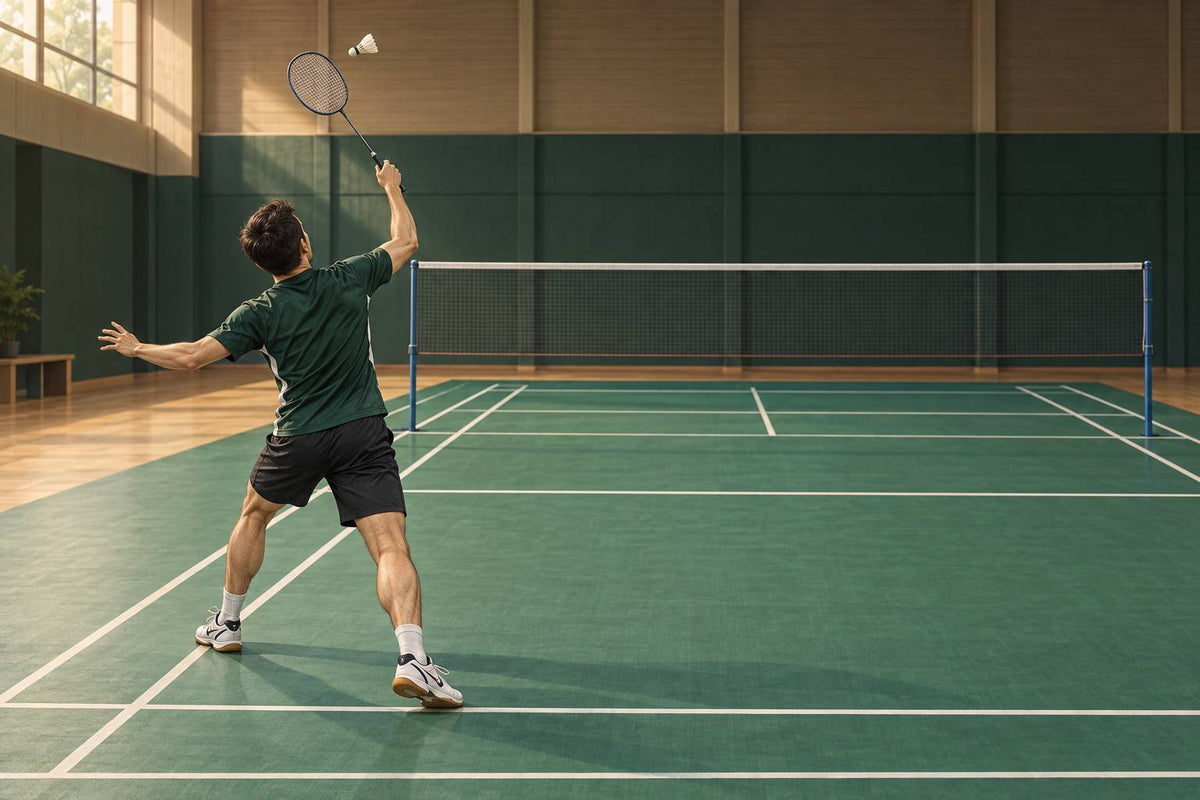
Use the round-the-head shot when you can still get around a shuttle over your backhand shoulder and strike it with a forehand before it travels too far behind you.
Default
Forehand round-the-head: best choice when you can side-step or jump out early, contact the shuttle high enough, and recover quickly back toward centre.
Reset
If you reach the corner late or off balance, choose a slow drop or deep clear instead of forcing a smash that exposes the open court.
Backhand
Use the backhand only when the shuttle has already gone too far past you to intercept with a forehand safely.
If your backhand rear corner keeps turning into a weak lift, a late backhand clear, or a panicked slice into the tramlines, the round-the-head shot is the escape route you need. In round the head shot badminton technique, you move around a shuttle that is dropping over your backhand shoulder and play it with a forehand swing instead — giving you more power, better court vision, and a faster path back forward than a backhand overhead.
The catch is that this shot only works when your feet, body shape, swing chain, and recovery all connect. Many Canadian club players learn the contact first, then wonder why they are falling out of court after the shot. This guide breaks the movement down in the order it actually happens: getting around the shuttle, leaning into the non-racket side, leading with the elbow, choosing the right attacking or reset shot, and recovering before the open court gets exposed.
Training this shot? Start with stable court footwear. The round-the-head corner demands a fast split-step, side-step, off-balance landing, and quick push back to centre. Browse badminton footwear in CAD, with free Canadian shipping.
In This Guide
- Why Use a Round-the-Head Shot?
- Preparation: Split, Side-Step, and Get Around the Shuttle
- What Body Shape and Contact Point Should You Use?
- The Swing Chain: Elbow, Forearm, Then Wrist
- Attack or Reset: Should You Smash, Cut, Drop, or Clear?
- Accuracy Mistakes That Give the Rally Away
- Recovery: The Step Most Players Miss
- Which Round-the-Head Option Should You Choose?
Why Use a Round-the-Head Shot?
A round-the-head shot is a forehand overhead played from the rear backhand corner: instead of letting the shuttle drop over your non-racket shoulder, you move around it and strike it with a forehand swing. That turns one of the weakest rear-court situations into a chance to attack, hold pressure, or at least reset the rally from a stronger body position.
In the rear court, a forehand gives you more power than a backhand overhead clear, keeps your vision better, and makes it easier to recover forward after contact. That matters in singles, where one weak lift can expose the whole court, and in doubles, where a soft rear backhand can immediately invite a net kill or steep counter-attack.
The goal is not to avoid every backhand. The goal is to recognize when you still have time to get around the shuttle and use your forehand before the backhand corner becomes a survival shot.
Think of it as an upgrade in options. From a late rear backhand position, many players can only lift or clear under pressure. From a round-the-head position, you can still play a smash, cut, fast drop, slow drop, or clear. Even when you do not win the rally outright, you are usually asking your opponent a harder question.
The fallback is the backhand clear. It is still an important skill, especially when the shuttle has already gone too far behind you or you cannot get your feet around in time. If that is the situation you are facing more often, work on the badminton backhand clear technique as a safety shot — but do not make it your first choice when a forehand round-the-head contact is available.
A useful cue: if the shuttle is dropping near your backhand shoulder but has not passed you yet, try to get around it. If it has already travelled behind your body, accept the backhand option and make the next rally better by preparing earlier.
Preparation: Split, Side-Step, and Get Around the Shuttle
The preparation for a round the head shot badminton players can trust starts before the shuttle reaches the rear court. Use a forehand grip early, react as soon as your opponent hits, then move around the shuttle so you can play it with your forehand instead of getting trapped into a late backhand.
Think of the first move as a setup step, not a panic sprint. If you are balanced in your base, use a split-step timing cue as the opponent contacts the shuttle. If you are already shading toward the rear backhand corner, start with a side-step so your body can travel sideways and slightly backward into the rear court.
- Set the forehand grip first. The round-the-head shot works because you are choosing a forehand overhead action on the backhand side. If the grip change happens late, the swing usually becomes cramped.
- Move on the opponent’s hit. Do not wait until the shuttle is already dropping over your non-racket shoulder. Read the lift or clear early and start your side-step or split-step setup right away.
- Create space beside the shuttle. Your goal is not to stand directly under it. You want enough room to lean toward your non-racket side while still contacting the shuttle in front of your body line.
- Intercept before it passes you. On a flatter lift or clear, the stronger option is often to jump out and meet the shuttle early rather than letting it travel too deep and forcing a defensive backhand.
A simple first-move cue
Use this rhythm in practice: split, push, side-step, get around. The split gives you a loaded base, the push sends you toward the rear backhand corner, and the side-step helps your torso stay organized instead of spinning away from the court.
If this movement feels rushed, rebuild the base patterns first. Our badminton footwork basics guide covers the split-step, chasse-style movement, and recovery habits that make the round-the-head corner feel less desperate.
Footwear matters in this corner. Because the shot starts with a fast split-step and often finishes off balance, use proper indoor court shoes with lateral support. Browse Canadian badminton footwear options before drilling this movement hard.
One final check: if your first step sends you straight backward, you will usually arrive late. If it sends you sideways and around the shuttle, you give yourself the space to choose a smash, cut, drop, or clear instead of simply surviving the rally.
What Body Shape and Contact Point Should You Use?

The round-the-head shot feels awkward at first because your body is not directly behind the shuttle. You are reaching over the backhand shoulder with a forehand swing, so the shape of the body matters as much as the racket swing.
The key shape is a controlled lean toward your non-racket side. For a right-handed player, that means the body leans left as you reach around the head; for a left-handed player, it leans right. This lean creates the space to swing with a forehand action instead of getting trapped into a weaker late backhand.
Simple body-shape checklist
- Lean to the non-racket side: this lets the racket arm come around the head without collapsing the swing.
- Keep the chest open: use the non-racket arm up and out to help balance the body and stop the shoulders from closing too early.
- Let the elbow lead: the elbow is the pivot that brings the forearm and wrist through after it.
- Adjust the back foot: if the shuttle is lower, draw the back foot farther back and sit into a deeper stance.
Use the non-racket arm to stay open
A common mistake is letting the non-racket arm disappear. When that arm drops, the chest tends to close and the swing becomes cramped. Instead, bring the non-racket arm up and out to the side. Its job is not to hit the shuttle; its job is to balance your lean and keep the chest open long enough for the forehand swing to come through cleanly.
You should feel wide and stable through the upper body, not twisted and falling away. If your chest closes too early, the shot often becomes a rushed swipe. If the chest stays open, the elbow has room to lead and the forearm can accelerate through the shuttle.
The elbow is the pivot
In a good round-the-head shot, the elbow leads the hitting action. Think of the elbow as the moving pivot: it comes through first, then the forearm follows, then the wrist finishes the strike. That order gives you a stronger, cleaner forehand action than trying to flick the shuttle with the wrist alone.
This is why round-the-head technique connects closely with forearm pronation. If you want a deeper breakdown of how the forearm contributes to overhead power, read Badminton Forearm Pronation: Smash Power Guide Canada. The same principle applies here: the wrist is part of the finish, but it is not the whole engine.
Match the stance depth to the shuttle height
The contact point changes the stance. If the shuttle is high enough, you can stay taller and attack it earlier. If the shuttle has already dropped, you need a deeper, lower base. That is where the back foot matters: the lower the shuttle, the farther back the rear foot has to draw so your body can get underneath the contact point without tipping over.
Do not solve a low shuttle by only bending from the waist. That makes the swing small and the recovery slow. Lower the whole stance instead: back foot farther back, knees bent, body leaning to the non-racket side, chest still open. This gives you a fighting chance to play a controlled shot instead of simply surviving the corner.
| Incoming shuttle | Body shape | Main risk |
|---|---|---|
| Higher over the backhand shoulder | Controlled lean, chest open, elbow leading through the shuttle. | Over-rotating and pulling the shot wide. |
| Lower and dropping | Back foot draws farther back; stance becomes deeper and lower. | Reaching with the arm only and losing balance after contact. |
The best cue is simple: get your body around the shuttle, not just your racket. If only the racket reaches, the shot becomes late and fragile. If the feet, lean, non-racket arm, and elbow all work together, you can hit straight, cross-court, or reset without giving away the rally immediately.
For the movement base that gets you into this shape, pair this section with Badminton Footwork Basics: 6 Moves for Canadian Beginners. The round-the-head shot is an overhead skill, but it only works when the footwork gives the body enough room to swing.
The Swing Chain: Elbow, Forearm, Then Wrist

The round the head shot badminton players struggle with is rarely solved by “more wrist.” The wrist matters, but it is the last link in the chain. If the feet, hips, chest, elbow, and forearm are late or disconnected, the wrist ends up forcing the shuttle instead of finishing a clean swing.
Think of the action as a compact throw from an off-balance position: push off, keep the hips square to the net, bring the elbow back, open the chest, throw the elbow forward, then let the forearm come through before the wrist finishes the shuttle. That sequence gives you power without needing a huge swing.
Key cue: lead with the elbow, not the racket head. If the racket head goes first, you usually slice too early, lose power, and pull the shot wide.
The order of the swing
| Link in the chain | What to feel | Common mistake |
|---|---|---|
| Push off | Drive out toward the backhand rear corner so you meet the shuttle before it drops too far behind you. | Waiting under the shuttle and turning it into a late backhand problem. |
| Hips and chest | Keep the hips square to the net and use the non-racket arm for balance while the chest opens. | Over-rotating the body when there is not enough time to make a full rear-court turn. |
| Elbow | Bring the elbow back, then throw it forward as the pivot of the stroke. | Swinging from the shoulder only, which often feels powerful but arrives late. |
| Forearm | Let the forearm rotate through after the elbow starts the throw. For a deeper look, see our forearm pronation guide. | Trying to hit only with the wrist and leaving the forearm passive. |
| Wrist and fingers | Finish with a short squeeze at contact, especially when you want a sharper angle or a sliced change of pace. | Tensing the grip too early, which slows the racket head and makes timing harder. |
Why the elbow matters so much
On a normal forehand overhead, you may have more time to turn, load, and swing. On a round-the-head contact, the shuttle is over the non-racket shoulder and your body is leaning that way. The elbow gives the stroke a clear pivot point, helping you redirect the shuttle straight or cross-court without making the swing too big.
If you want more power, do not simply snap harder. Build the throw in order. The elbow starts the acceleration, the forearm adds racket-head speed, and the wrist/finger squeeze finishes the hit. This is the same idea behind a good overhead power chain, covered in more detail in our badminton kinetic chain guide.
Keep the follow-through useful, not dramatic
A big follow-through can feel satisfying, but it can hurt this shot. If the racket keeps dragging your body across the court after contact, your timing and recovery both suffer. The finish should support the next movement, not pull you farther out of position.
A better finish is compact: hit, allow the racket to come through naturally, then organize the body for landing and recovery. This is especially important when you use the round-the-head action as an attacking jump-out shot, because the landing often starts on the non-racket leg before the racket leg comes down.
Two simple swing-chain drills
- Shadow throw, no shuttle: start in ready position, split, push out to the backhand rear corner, freeze with the elbow back and chest open, then throw elbow → forearm → wrist. Keep the finish short and recover toward centre.
- Half-speed feed: have a partner feed lifts toward your backhand rear corner. Do not smash at full pace. Aim for clean sequence and balance: elbow leads, forearm follows, wrist finishes, then recover. Once the chain feels smooth, add sharper drops, clears, or a controlled smash.
For the last part of the stroke, pair this section with the relax-then-squeeze grip pressure guide. If your round-the-head finish becomes a full attacking jump, the jump smash technique guide will help you connect the hit to a safer landing and faster recovery.
Attack or Reset: Should You Smash, Cut, Drop, or Clear?
The round-the-head shot is not one fixed stroke. It is a decision point. If the opponent’s lift or clear is flat enough that you can intercept it before it travels too far past your body, you can turn the backhand rear corner into an attacking forehand. If the shuttle is already behind you, the smarter play is often a deep clear or a controlled drop that buys time and protects the open court.
Use this simple branch as the shuttle comes over your non-racket shoulder:
- High contact, shuttle not past you: attack straight. A round-the-head straight smash works best when you can throw the elbow forward, bring the forearm through, and finish without a huge follow-through that delays recovery. For the full attacking pattern, see our badminton smash technique guide.
- Good contact, opponent leaning to defend power: cut or slice the shuttle. The same preparation can produce a sharper angle or slower downward shot, especially when a full smash would pull you too far off balance.
- Contact is slightly late or lower: play a slow drop. A stop drop can still pressure the opponent if it lands tight enough and lets you recover forward. For touch and landing-zone details, use our badminton drop shot guide.
- Shuttle has gone too far behind you: reset with a deep clear. Trying to force a smash from this position often gives away a loose mid-court reply or leaves the front court exposed.
| Your contact position | Best option | Why it works |
|---|---|---|
| Flat lift, early interception | Straight smash | You can use forehand power before the shuttle escapes behind the shoulder. |
| Early contact, defender set for power | Cut or sliced drop | The same round-the-head shape creates disguise while reducing the risk of over-rotating wide. |
| Lower contact, still balanced | Slow drop | It keeps the shuttle moving downward without forcing a low-percentage power shot. |
| Late contact, shuttle behind you | Deep clear | It resets the rally and gives you time to push back toward centre. |
Drill the decision, not just the swing. Have a feeder mix flat lifts, higher clears, and slightly late shuttles to your rear backhand corner. Your job is to choose smash, cut, drop, or clear from the same preparation so you do not become predictable.
One accuracy cue matters on the attacking branch: if your straight smash or slice keeps drifting wide, aim slightly inside the sideline. Your body rotation can pull the shuttle outward from this round-the-head position, so a safer target often wins more points than a perfect line.
Accuracy Mistakes That Give the Rally Away
A good round the head shot badminton pattern is not just about getting there early. It is about keeping the shuttle inside the lines while your body is leaning, rotating, and trying to recover from the rear backhand corner. Many players do the hard part well, then give the rally away with a smash that drifts wide, a slice that leaks past the sideline, or a recovery that leaves the straight counter open.
The main reason is body rotation. On straight slices and straight smashes, your body can pull the shuttle toward the sideline. Instead of aiming directly at the line, aim slightly inside the court so the shuttle has room to drift without landing out.
Simple court-control rule: if your round-the-head straight smash keeps missing wide, move your target one racket-width inside the sideline before trying to hit harder.
Mistake 1: Aiming at the line when your body is still pulling sideways
The round-the-head position naturally pulls you toward your non-racket side. If you contact the shuttle while drifting or rotating, a shot that feels “straight” off the strings can still travel toward the tramline. That is why the safer target is not the sideline itself. It is a slightly inside target that still pressures the opponent but gives you margin.
- For a straight smash: aim inside the singles sideline rather than trying to paint the line.
- For a straight slice: keep the racket path controlled and accept a safer landing zone.
- For doubles: a slightly inside body or hip target is often safer than a wide sideline target when you are late.
Mistake 2: Letting the swing fly open instead of finishing with control
A loose, oversized follow-through can make the shuttle spray and slow your recovery. A more stable option is a controlled, curling finish: the racket wraps through the shot without letting your whole body spin away from the court. That curling finish helps accuracy and improves stability in the air and on landing.
Think of the finish as a brake, not a pose. You still swing through the shuttle, but you do not let the racket drag your chest and hips so far around that you lose the next step.
Mistake 3: Hitting from the wrist before the elbow has set the direction
The elbow-led pivot matters because it gives the shot direction before the forearm and wrist add speed. When the elbow comes through first, you can redirect the shuttle straight or cross-court with better control. When the wrist takes over too early, the shot often becomes a flicky guess: sometimes sharp, sometimes wide, and hard to repeat under pressure.
Use the same basic chain from the earlier swing section: elbow, then forearm, then wrist. The elbow sets the lane. The forearm and wrist finish the strike. If you are working on pronation or smash mechanics, the same idea carries over from forearm pronation power and smash technique: power is useful only if the contact face is controlled.
| Miss | Likely cause | Court-control fix |
|---|---|---|
| Straight smash drifts wide | Body rotation pulls the shuttle toward the sideline | Aim slightly inside the court, then build power once the line is reliable |
| Slice floats out | Racket face opens while the body is leaning sideways | Use a cleaner elbow-led path and a controlled curling finish |
| Cross-court shot lands short | Contact is late or the wrist is trying to redirect without enough elbow support | Get around the shuttle earlier and let the elbow pivot create the angle |
| Smash is hard but easy to counter | The shot is predictable and recovery is delayed | Mix straight, cross, drop, and clear targets instead of forcing every shuttle downward |
Mistake 4: Choosing the hardest shot instead of the highest-control shot
The round-the-head corner feels like an invitation to smash, but court control often comes from shot selection. If you are balanced and early, the attacking smash or fast slice can be the right choice. If you are stretched, a controlled drop or deep clear may protect the rally better than a low-percentage winner attempt.
This is especially important in singles, where giving away the sideline also opens the next shot into the empty forecourt. For more on building point patterns instead of forcing winners, read badminton singles strategy and change-of-pace tactics.
Practice drill: inside-line targets
Set a visual target slightly inside the straight sideline. Feed or self-feed round-the-head shuttles and play three controlled straight shots before trying one cross-court option. Count only the shots that land in with a stable finish and a clean first recovery step. If the shuttle keeps drifting wide, do not swing harder; move the target farther inside until your contact and finish become repeatable.
Shop Badminton Footwear for Stable Recovery
Free shipping across Canada · 14-day returns
Recovery: The Step Most Players Miss

The round-the-head shot is not finished when the shuttle leaves your strings. Because your body is leaning and moving toward the non-racket side, the recovery is the make-or-break phase: if you admire the shot or let the follow-through pull you wide, the straight reply and open forecourt become easy targets.
Think of the recovery as part of the stroke, not a separate afterthought. Your goal is to land, absorb, and push back toward centre before your opponent makes contact.
Footwork gear matters here. A round-the-head recovery asks a lot from your shoes because you are landing off-balance and changing direction quickly. The Babolat Shadow Tour Men’s Badminton Shoes – Orange are a court-shoe option for this kind of fast split-step and recovery work.
The landing sequence
- Land first on the non-racket leg. Keep the knee slightly bent so the leg absorbs the landing instead of jamming the hip, knee, or ankle.
- Then bring the racket leg down. Again, land with a slight knee bend so you are ready to push, not stuck upright.
- Use one or two mini steps when needed. If you had to move fast over a longer distance, do not force one huge recovery step. Small adjustment steps can help you regain balance and return toward centre.
A common mistake is letting the racket follow-through get too big after contact. That long finish feels powerful, but it can delay the legs and make your next movement late. Keep the finish controlled enough that your feet can start working immediately.
A simple recovery drill
Have a partner feed repeatable shuttles to your rear backhand corner. Play the round-the-head shot, call out “land-push” as you land non-racket leg then racket leg, and recover toward centre before the next feed. Do the drill slowly first; clean footwork matters more than smashing hard.
For high-repetition practice, durable nylon shuttles are useful because the focus is timing, contact, and recovery rhythm. The Yonex Mavis 350 Nylon Shuttlecocks are a practical option for drilling repeatable round-the-head reps in Canadian club sessions.
The test is simple: after your round-the-head shot, could you still cover the next straight block, lift, or drive? If not, the recovery needs as much practice as the swing.
Which Round-the-Head Option Should You Choose?
The best round the head shot badminton choice depends on one question: are you early enough to attack, or are you using the forehand side mainly to stay alive and recover? Use this table as your on-court decision helper.
| Choose this | When it fits | Key cue | Main risk to manage |
|---|---|---|---|
| Jump-out smash | Your opponent has played a flat lift or clear and you do not have time to get fully behind the shuttle. | Intercept the shuttle before it travels too far past you; keep the hips square, bring the elbow back, then throw the elbow forward before the forearm and wrist follow. | Recovery. You land on the non-racket leg first, then the racket leg, both knees slightly bent to absorb the landing. |
| Straight smash or straight slice | You are early enough to attack down the line and want to pressure the open court. | Aim slightly inside the court, because body rotation can pull the shuttle toward the sideline. | Over-hitting wide. A controlled, curling finish can help accuracy, stability in the air, and the landing. |
| Slow or stop drop | The smash is available but not clearly winning, or your contact is lower and you need a safer attacking reset. | Use the same forehand preparation, then take pace off the shuttle so the opponent must move forward. | Leaving the drop loose. In singles, a well-played slow drop can apply pressure and limit the opponent’s replies. |
| Deep clear | You are stretched, lower, or not stable enough to attack without exposing the court. | Use the forehand swing to send the shuttle deep instead of forcing a weak backhand overhead clear. | Recovering too slowly after contact. If you moved a long distance at speed, you may need 1 or 2 mini steps to get back. |
| Do not force the round-the-head | The shuttle has already gone too far past your body and the forehand interception window is gone. | Choose the shot that lets you keep the rally alive, then rebuild your base position. | Trying to create power from only the wrist. The round-the-head action works best as a chain: elbow, forearm, then wrist. |
If this decision still feels rushed, pair it with footwork practice from Badminton Footwork Basics and the power sequence in Badminton Forearm Pronation. For repeatable feeding sessions, Yonex Mavis 350 Nylon Shuttlecocks work well for durable round-the-head practice reps.
Get 10% off your first order
Join the Badminton House list and we’ll email you a 10% welcome code — plus subscriber-only restock alerts, giveaways, and honest gear advice from players.
By subscribing, you agree to receive Badminton House emails and can unsubscribe anytime.
Round-the-head work is one of those skills that rewards patient reps: cleaner split-step timing, a calmer elbow-led swing, and a recovery habit that protects the open court. We play badminton ourselves, so if you are choosing shoes, shuttles, strings, or a racket setup for this style of movement, contact us and we will help you narrow it down for your level and playing style.
Free shipping across Canada · 14-day returns · Canadian badminton specialty shop

Leave a comment
This site is protected by hCaptcha and the hCaptcha Privacy Policy and Terms of Service apply.