
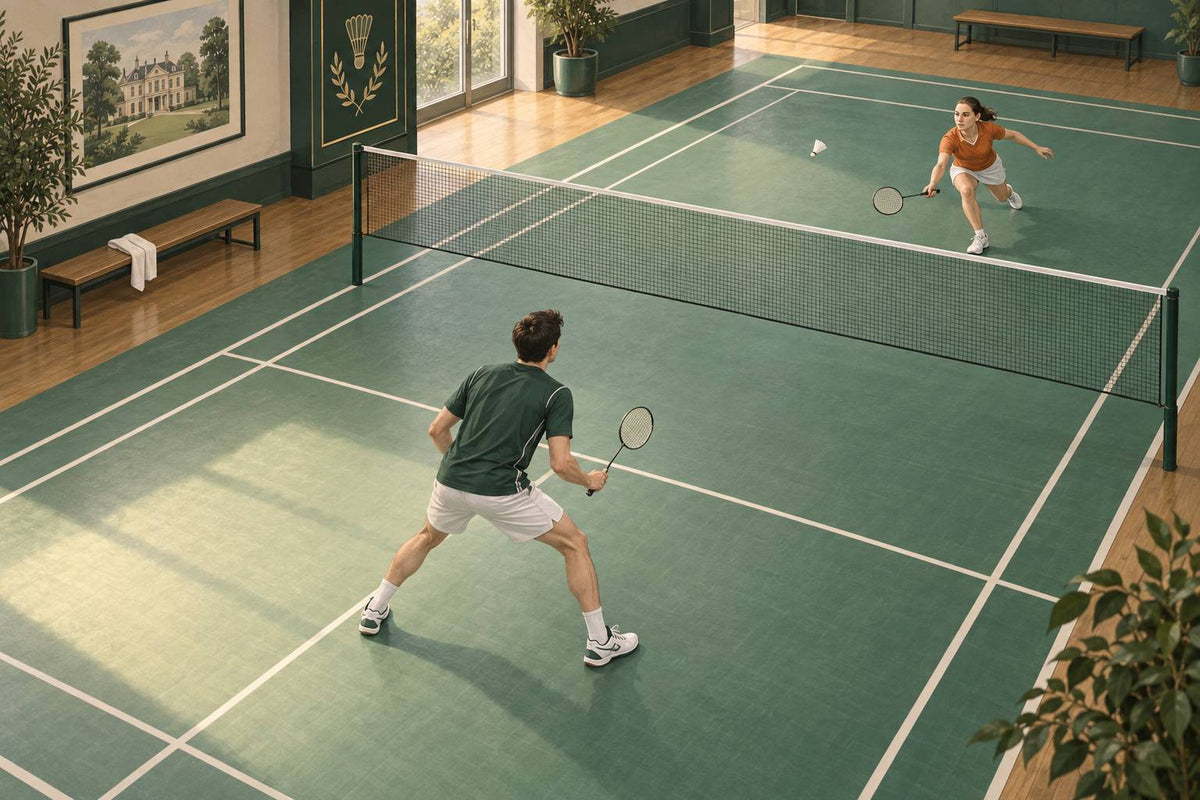
Last updated: July 2026 · Written by the team at Badminton House
Quick Answer: Badminton Opponent Scouting
Scout one repeatable pattern at a time, then test one safe sequence instead of guessing every shot.
Default
Use the four cues: lateral speed, forward recovery, serve return, and response under pressure; these are observable during normal club play and help you act on probabilities, not hunches.
Singles
Watch whether they recover to base after each shot, favour a specific corner, or repeat the same reply when late; then build one rally pattern that makes them move to that weakness again.
Doubles
Track serve-return habits, who is less comfortable under pressure, and whether the pair hesitates through the middle; those reads often matter again when you face the same opponents later.
If you keep losing to the same player at club night, do not try to “read their mind.” Pick one thing you can actually see: are they late recovering forward, slower to one rear corner, predictable on serve return, or rushed under pressure? Good badminton opponent scouting is simply noticing those repeatable moments during normal rallies, then choosing a safer shot sequence because of them.
That matters in club and league play because you often see familiar opponents across a season. A small note from one match can pay off the next time you share a court. The goal is not to stare, stall, or over-commit before contact; it is to build a useful picture while you keep playing: movement, recovery, serve-return habit, pressure response.
This guide shows you how to scout patterns, not every shot, and turn one recurring clue into one high-percentage plan you can actually use in singles or doubles. For acting on a pattern you spot once a match is already underway, see our guide to singles mid-match adjustments.
Move well enough to use what you read. Scouting only helps if your split step and first push are stable, so use proper indoor court footwear and check live availability in our badminton footwear collection when your shoes start sliding, rolling, or slowing your recovery.
In This Guide
- Scout Patterns, Not Every Shot
- The Four-Part In-Match Scouting Checklist
- Read Movement Without Over-Committing
- Spot Serve-Return Patterns in Singles and Doubles
- Turn One Pattern Into One High-Percentage Sequence
- Reassess If It Stops Working—and Stay Sporting
- Gear Note: Move Well Enough to Use What You Read
- Which Scouting Pattern Should You Choose First?
Scout Patterns, Not Every Shot
Badminton opponent scouting is not mind-reading. You are not trying to predict every clear, drop, drive, block, or lift before it happens. You are trying to notice repeatable situations: what your opponent tends to do when they are late, balanced, rushed, serving, receiving, or defending under pressure.
That distinction matters. In some rallies, the situation gives you a strong read: their body position, grip, recovery path, and previous choices all point toward one likely reply. In other rallies, it is closer to a guess, and moving too early just gives them an easy hold, slice, or change of direction. Good scouting improves your odds; it does not remove uncertainty.
Use the opening rallies as a calm observation window. Play your normal game, keep the shuttle in, and watch how they solve common problems. Are they comfortable moving laterally? Do they recover forward after playing to the net, or do they stay stranded? Do they have a favourite serve return? When rushed, do they lift, block, drive, or try something risky?
- Lateral speed: notice whether one side or one corner consistently costs them time.
- Forward recovery: notice whether they return toward a useful base after playing the shuttle, or leave a gap.
- Serve return: notice the first reply they prefer in singles or doubles, especially when the serve is tight.
- Response under pressure: notice their safe habit when they are late, stretched, or defending.
Keep this simple. You are looking for one useful pattern, not building a full scouting report in your head while the rally is happening. A pattern might be as plain as “when I push fast to the backhand rear court, they lift cross-court” or “when my doubles pair serves low to this receiver, they drive straight more often than they push cross.” That is enough to shape your next high-percentage choice.
The scouting should also stay sporting. Observe from normal play; do not pause the match to over-analyse, delay between rallies, or seek coaching outside the event’s permitted windows. If an official is present, follow their instructions. And if an opponent is clearly injured, do not turn “scouting” into targeting the injury. The goal is to read badminton habits, not exploit someone’s health.
Finally, scouting only works if your base position is stable enough to act on the read. If you guess from an upright stance, you will get wrong-footed. Start from a balanced ready position, time the split step, then let the pattern guide your first movement. For the footwork side of that idea, see our badminton defence ready position guide.
The Four-Part In-Match Scouting Checklist

Use this checklist as a quick note-taking habit in your head, not as a full match analysis. During normal rallies, pick one repeatable movement or decision pattern from the four categories below. If you try to track every clear, drop, drive, block, lift, and smash, you will stop playing the point in front of you.
The goal is simple: notice what keeps happening, then test one sensible response. This is especially useful because many matches are played against familiar styles: steady retrievers, fast front-court doubles players, hard smashers, or opponents who panic when moved forward.
| Checklist item | What to watch during normal play | Pattern question |
|---|---|---|
| Lateral speed | How they move side-to-side when pulled wide, especially after a drive, punch clear, or fast lift. | Do they arrive late on one side, reach instead of move, or give you the same loose reply when stretched? |
| Forward recovery | Whether they are ready again after playing from the net, or still recovering from the previous shot. | After they play tight at the net, do they recover to base quickly, or leave space behind or across their body? |
| Serve return | Their first decision after your serve: push, lift, net, drive, flick response, or hesitation. | Do they keep returning to the same area, avoid lifting, or rush the same return when pressured? |
| Response under pressure | Their choice when late, stretched, jammed, or forced to hit below net height. | When uncomfortable, do they repeat a lift, block straight, play the net, or try a low-percentage escape? |
A useful in-match routine is to ask yourself one question at the end of a rally: “What did they do again?” Not “what is their entire game plan?” Just one repeat. Maybe their backhand-side defence keeps blocking straight. Maybe their serve return in doubles keeps going flat through the middle. Maybe they are still recovering after a tight net exchange.
Keep the checklist playable
- One category at a time: if you are serving, watch the opponent’s return pattern; if you are in long rallies, watch recovery and pressure responses.
- One cue before contact: look for preparation clues such as whether they are ready or still recovering, their grip, and whether they are taking the shuttle early or late.
- One test sequence: once a pattern repeats, choose a high-percentage reply you can actually execute under match pressure.
- One reset point: if the opponent adapts, stop forcing the old read and go back to observing.
Keep it sporting: make these observations from normal play, without delaying rallies or relying on outside communication that is not allowed in your event. If officials are present, follow their instructions on intervals, coaching, and continuous play.
Read Movement Without Over-Committing

Good badminton opponent scouting is not a staring contest with the shuttle. Once you have played your shot, quickly check the opponent’s movement state: are they balanced and ready, still recovering, weaker moving laterally to one side, or slow getting back toward base?
That last part matters because court coverage is not just raw speed. In singles, the base point is the centre area you recover toward between shots; in doubles, it is the centre of the area you are responsible for. A player who looks “fast” is often simply recovering earlier, staying balanced, and reading the next situation sooner.
Movement read: what to watch between your shot and their contact
- Ready position: are they back on balance with the racket prepared, or are their feet still crossing and their body still rising?
- Lateral speed: do they cover both sidelines smoothly, or does one side regularly force a late contact?
- Forward recovery: after a net shot or short defence, do they move back into court, or do they stay too close to the tape?
- Preparation cues: before contact, notice grip, body position, racket face, shoulder position, and whether the shuttle is being taken early or late.
The trap is to turn a clue into a gamble. If your opponent is late to their deep backhand corner, that is useful information — but it does not mean you should sprint to the net before they hit. A hold, slice, or late change of direction can wrong-foot you if your body commits before their racket has made the shot clear.
Instead, let the read shape your readiness, not your whole movement. Shade your stance slightly toward the likely reply, keep your racket prepared, then time your split step so you can still push either way. For a deeper breakdown, see our guides to the badminton defence ready position and badminton split step timing.
| What you see | What it may suggest | High-percentage response |
|---|---|---|
| They recover slowly from the front court | Their base is late, so the rear court may open | Be ready to lift, push, or punch behind them if the shuttle quality allows |
| They are late moving to one sideline | One lateral direction may be less comfortable | Test that side again, but stay balanced for the straight or cross reply |
| They reach the shuttle late or low | Their shot options may become more limited | Move earlier after your split step, not before their contact |
| They are balanced, early, and deceptive | The situation is less certain | Hold your base, keep your racket up, and react through the split step |
A practical club-match habit is to watch the opponent’s first recovery step after your shot. If that step is sharp and balanced, do not assume an opening. If it is late, upright, or drifting away from base, you may have a pattern worth testing on the next rally.
The best read is still a percentage, not a promise. Use movement clues to arrive a fraction earlier while keeping enough balance to cover the alternative. That is the difference between anticipation and over-committing.
Spot Serve-Return Patterns in Singles and Doubles

The serve and return are the easiest places to scout because everyone starts from a fixed situation. You do not need to guess their whole game. Just ask: after this serve, what return do they repeat when they are comfortable, rushed, or under pressure?
Watch the first two shots after your serve and after your opponent’s serve. In club and league play across a season, you may see the same players often enough that these small habits become useful week after week.
When You Serve: Track the Receiver’s First Instinct
After you serve, your scouting job is not to admire the serve. It is to recover balanced, prepare for the next shot, and read the receiver’s first choice.
- Do they lift by default? If yes, you may be able to prepare earlier for an attacking setup or a controlled rear-court shot.
- Do they play net whenever the serve is tight? Be ready to move forward, but do not lunge before contact or a hold can wrong-foot you.
- Do they drive fast at your body or hip? Keep the racket up and expect a flatter rally immediately after the serve.
- Do they give a weak return when rushed? Note whether the weak reply goes to the tape, mid-court, or straight back to the server.
This is especially useful because serve-return habits often appear under pressure. Some receivers look comfortable until the score tightens, then choose the safest return again and again.
Singles: Expect More Conservative Serve Choices
In singles, the server has to cover the whole court after serving, so serving tactics are often more conservative. The goal is usually to avoid handing the receiver an easy attack.
That changes what you scout. Instead of looking only for a spectacular return, look for the return that gives your opponent comfort:
- Against a high or deeper serve: do they clear safely, drop straight, or try to attack early?
- Against a short serve: do they tumble at the net, push to the backhand side, or lift because they dislike taking the shuttle early?
- When late to the shuttle: do they still choose the same shot, or does the return become shorter and more attackable?
A good singles read is usually simple: when I serve short to this side, they lift cross-court, or when I serve deeper, they play a straight drop if they are late. One repeated cue is enough to guide your next rally plan.
Doubles: Low Serve, Fast Return, Partner Ready
In doubles, short low serves are common because they help stop the receiver from gaining the attack. After a low serve, the server normally covers reachable net and mid-court replies while the partner covers shots passing behind; both should be ready for a weak return.
Your scouting should include both the receiver and the receiver’s partner. A doubles return is not just a shot; it triggers a formation. If the return is lifted and your side can smash, your pair can move into an attacking front-back shape. If your side lifts and the opponents can smash, you should expect to defend side-by-side.
For a deeper breakdown of the receiving side, read our Badminton Doubles Return of Serve Guide. For scouting, keep the question narrower: what do they actually do most often against your serve?
| Return pattern you see | What it may give you | Practical response |
|---|---|---|
| Receiver lifts often | A chance to start the attack if the lift is not deep enough | Serve, recover, then prepare your rear player for a controlled smash, drop, or placement shot. |
| Receiver plays tight net returns | A front-court contest where timing matters | Keep your racket up and move after the receiver commits. Your partner should be ready behind you if the net exchange is lifted. |
| Receiver drives fast | A flat rally where the first prepared racket often wins | Stay compact, protect the body line, and consider whether serving slightly tighter or varying placement reduces the drive. |
| Receiver gives weak mid-court returns | A pouncing opportunity for the front player | Front player holds an alert racket position and looks to kill, push, or force the next lift without over-swinging. |
When Your Opponent Serves: Scout Their Serve Plus Their Recovery
You can also scout while receiving. After your return, notice how the server recovers. Do they stay stuck at the service line? Do they retreat too early? Do they lean one way because they expect your usual return?
This matters because anticipation works both ways. If the server expects you to lift, a sudden net return may expose their forward recovery. If they expect a net return, a flatter push or drive may catch their racket preparation late.
- Server slow forward: test a tighter net return when the serve allows it.
- Server over-leaning forward: consider a push or lift that makes them turn and recover.
- Server’s partner over-eager in doubles: avoid feeding the obvious pounce; use placement that makes the pair communicate.
- One doubles opponent less comfortable: when the rally opens, place more returns and follow-up shots toward that player if the situation allows.
Simple serve-return scouting phrase
Use this between rallies in your own head: serve type → return habit → recovery gap. Example: low serve to backhand → straight lift → front player can close the middle.
Turn One Pattern Into One High-Percentage Sequence
Once you notice a pattern, do not redesign your whole game. Pick one recurring clue, choose one sensible sequence, then test it for a few rallies while keeping your normal base, split step, and recovery.
That is the main decision step in badminton opponent scouting: turn observation into a simple plan you can actually execute under pressure. If you change your serve, return, pace, placement, and formation all at once, you will not know which change helped—or whether the opponent simply made an error.
The one-pattern rule
- Observe: identify one repeatable problem, such as slow forward recovery, weak smash defence, trouble with drops, or hesitation between doubles partners.
- Choose: build one high-percentage sequence that targets that problem without forcing a miracle shot.
- Test: run it enough times to see the opponent’s real response, not just one lucky rally.
- Reassess: if they adapt, change one part of the sequence instead of panicking.
Example 1: They struggle with drops
If an opponent repeatedly arrives late to the front court or lifts short after a drop, your sequence might be:
- Play a clear or lift that pushes them back.
- Use a controlled drop, not necessarily the tightest winner attempt.
- Move forward ready for the predictable loose net reply or short lift.
- Finish with a net kill, push, or controlled attack depending on the height of the reply.
The point is not “drop every time.” The point is to create a situation where their known weakness is likely to appear, then position yourself early enough to use it. For a technical refresher, see our guide to the badminton drop shot.
Example 2: They struggle with smashes
If their smash defence often pops up, breaks down on one side, or leaves them late to recover, build the rally so the smash is earned:
- Move them with a clear, push, or lift that gives you time to get balanced.
- Attack the weaker defensive lane or body area you have already observed.
- Recover forward if the reply tends to be short, or stay ready for the block if they defend soft.
- Repeat only when the setup is good; forcing a smash from a poor position usually gives the pattern back to them.
This works best when the smash is part of a sequence, not a standalone gamble. If you need the mechanics piece, start with how to improve your badminton smash and connect it to your scouting plan.
Example 3: In doubles, they hesitate in the middle
Many doubles points turn on hesitation. If both opponents pause when the shuttle goes between them, use a simple centre-channel sequence:
- Keep your attack formation when your side has the chance to hit down.
- Aim a drive or smash through the centre, especially between the racket hips or shoulders of the pair.
- Have the front player ready for a loose block or half-lift.
- If they start calling clearly and covering the middle, move the next attack wider rather than repeating the same line blindly.
If you see the same pairs across a season, this kind of pattern can pay off more than once. Just be careful: once your sequence becomes predictable, a good pair can anticipate it, counter-drive, or bait you into hitting the middle when they are waiting for it. For a deeper doubles framework, read badminton doubles shot placement or doubles positioning and rotation.
Keep it high-percentage. The best scouting adjustment is usually a slightly better version of a shot you already trust—not a new trick shot you have never used in a match.
What to avoid
- Do not chase every clue. If you saw one weak backhand, one slow recovery, and one poor serve return, choose the most repeatable pattern first.
- Do not over-commit before contact. Use the read to prepare, then time your split step so you can still respond if they hold, slice, or change direction.
- Do not become the predictable player. If your opponent knows the drop, smash, or centre drive is coming every time, your advantage disappears.
- Do not confuse scouting with stalling. Keep play moving and make your adjustments within normal match rhythm and the event’s rules.
A useful test is this: can you explain your adjustment in one sentence? For example, “When I push them deep, they are late to the front, so I will use a controlled drop and cover the short reply.” If the plan takes ten sentences, it is probably too complicated for match play.
Reassess If It Stops Working—and Stay Sporting
A scouting read is only useful while it stays true. If your opponent notices your pattern-hunt and adjusts, do not keep forcing the same tactic just because it worked for three rallies earlier. Treat it as new information.
For example, maybe you were winning points by pushing into a slower rear forehand corner, but now the opponent starts recovering earlier. Or maybe you were attacking the middle in doubles, but the pair begins calling clearly and covering it together. That does not mean the original read was wrong; it means the match has moved on.
When a pattern stops paying off, ask three quick questions
- Did they adapt? If their recovery, serve return, or pressure response has changed, switch to the next sensible option.
- Did you overuse it? A good pattern becomes predictable if you play it every time.
- Are you still balanced? If you are leaning early and getting wrong-footed, return to a neutral split step and rebuild the read.
The best adjustment is usually small. Change the height, pace, or placement enough to make the opponent prove the new pattern. If they handled your fast push, test a softer drop. If they started sitting on your drop, play deeper first. If a doubles pair cleaned up the middle, move the attack toward the less comfortable defender or force a lift before going back through the centre.
This is also where discipline matters. Scouting is not an excuse to pause the match, hold up the server, or turn every rally into a sideline meeting. Under the Laws of Badminton, play is continuous from the first service until the match ends, except for permitted intervals, and officials can act on deliberate delay. Coaching or between-rally communication must follow the event rules and the umpire’s instructions.
Keep the read inside normal play. Observe footwork, preparation, serve returns, and pressure habits while you are playing the point. If an official gives an instruction, follow it immediately; your tactical edge should never come from delaying or distracting the opponent.
Gear Note: Move Well Enough to Use What You Read
Opponent scouting only turns into points if your body can act on the read. You still need a timed split step, a clean recovery toward base, and enough court grip to change direction without guessing too early.
For club players who see the same opponents through drop-ins, ladders, and leagues, that movement base matters. If you notice a pattern but arrive late, the issue may not be the read — it may be the setup under your feet.
Need court shoes for sharper movement? Browse badminton footwear, or check live availability for the Yonex SHB65Z4M Men's Badminton Shoes – White. If you are unsure what fits your foot shape or playing level, contact Badminton House and we will help you choose without overbuying.
Gear will not replace reading the game, but the right indoor court setup can make your scouting usable: see the cue, split at the right time, recover, and test the next rally with confidence.
Which Scouting Pattern Should You Choose First?
Do not try to scout everything at once. Choose the first pattern you can actually observe during normal rallies, then test it with one sensible sequence. If the read is only a 50/50 guess, stay balanced, time your split step, and wait for better evidence.
| Choose this focus if you notice... | Scouting category | High-percentage test | Do not choose it when... |
|---|---|---|---|
| Your opponent looks less agile on one side, or repeatedly struggles with a specific shot type such as smashes or drops. | Lateral speed | Move them toward the side or shot type that has caused problems, then recover to base so you can cover the next reply instead of admiring the first shot. | They are reaching the shuttle comfortably and changing direction without obvious delay. In that case, keep observing footwork and response times before committing. |
| They are still recovering from the last shot, are not back in a ready position, or stay put after returning the shuttle. | Forward recovery | Use the opening created by slow recovery, then return to your own base point: centre in singles, or the centre of the area you cover in doubles. | You are late to your own base after the shot. A recovery pattern only helps if you can still cover the court after testing it. |
| Their serve return becomes predictable: in singles, they give you a repeated reply after a conservative serve; in doubles, they struggle to create attack against a tight low serve. | Serve return | In singles, note the reply they prefer after your serve. In doubles, keep the low serve tight, let the server cover reachable front-court replies, and have the partner ready behind. | The return is changing each time, or your serve quality is giving away easy attack opportunities. Fix the serve before blaming the read. |
| Under pressure, they repeat the same shot, prefer a net shot over a lift, or show clear preparation cues in grip, body position, racket position, or swing start. | Response under pressure | Re-create the pressure situation once, prepare for the likely reply, and use your split step so anticipation becomes movement rather than a full-body guess. | You are moving before contact so hard that a hold, slice, or change of direction wrong-foots you. Read the cue, but do not abandon timing. |
Simple decision rule: pick the row with the clearest repeated evidence, not the row that would be most satisfying to attack. If it stops working, assume the opponent has adapted and switch to another observable category.
For the footwork side of this decision, the useful gear category is court footwear, not a new tactical idea. If your read is correct but your first step or lateral recovery is the limiting factor, you can check live availability in badminton footwear; for timing and stance details, review the badminton defence ready position guide.
Keep it legal and sporting. Make these observations from normal play. In officiated matches, play must be continuous except during permitted intervals, and coaching or between-rally communication should follow the event rules and the umpire’s instructions.
Get 10% off your first order
Join the Badminton House list and we’ll email you a 10% welcome code — plus subscriber-only restock alerts, giveaways, and honest gear advice from players.
By subscribing, you agree to receive Badminton House emails and can unsubscribe anytime.
Good scouting is a club-player skill you build rally by rally: notice one repeatable pattern, test it with good footwork, then adjust if your opponent adapts. We play badminton too, so if you want help matching your movement, court shoes, racket setup, or practice goals to the way you actually play, contact Badminton House and we’ll point you in the right direction.
Move well enough to use what you read.
Badminton opponent scouting only helps if your shoes let you split-step, recover, and change direction with confidence. Check live availability on court footwear for Canadian club play.
Shop Badminton Footwear10% off first order · Free shipping on $200+ · 14-day returns · Canadian badminton specialty shop


Leave a comment
This site is protected by hCaptcha and the hCaptcha Privacy Policy and Terms of Service apply.