

Last updated: July 2026 · Written by the team at Badminton House
Quick Answer: Mixed Doubles Badminton Tactics
Use front-and-back when you are attacking, switch to side-by-side when you lift or lose the downward pressure, and rotate based on where the shuttle is going rather than standing in fixed spots.
Default
Attack front-and-back: the front player controls the net and looks to finish, while the rear player builds pressure with drops, smashes, and steep shots from the back court.
Defence
If you lift, serve high, or the opponent contacts the shuttle above net height, recover into side-by-side defence so both players can cover smashes, drives, and pushes.
Flexible
The common mixed setup puts the woman at the net and the man in the mid/back court, but pairs can reverse or level the roles if that better matches speed, power, and comfort.
Mixed doubles badminton tactics can feel messy fast: one player wants to hold the net, the other is trying to cover the rear court, and the shuttle keeps forcing both of you through the same middle lane. If you have ever hesitated after a serve, left a soft block untouched, or nearly clipped rackets with your partner, the problem usually is not effort — it is unclear rotation.
The default attacking shape in mixed doubles is front-and-back: the front player controls the net and creates downward chances, while the back player builds pressure from the mid and rear court. But that shape is not a fixed rule for every pair. Strong mixed teams rotate from serve, return, attack, and defence based on who can take the next shuttle earliest, who is better positioned, and what space needs protecting.
This guide breaks mixed doubles rotation into simple court jobs: how the serve sets your shape, why the first four shots matter so much, when the front player should stay forward, when the rear player should rotate in, and how Canadian club players can avoid the most common confusion points in drop-in, league, and tournament play.
Rotating well starts with stable footwork. If your shoes slide, twist, or lack lateral support, mixed doubles movement gets harder than it needs to be. Browse badminton footwear — Badminton House ships across Canada.
In This Guide
- How Does Mixed Doubles Positioning Differ From Level Doubles?
- Serve Shape: Why Do the First Four Shots Decide So Much?
- Attacking Roles: Front Player Creates, Back Player Builds
- Defensive Roles: Who Covers the Net, Mid-Court, and Deep Court?
- Rotation Triggers: When to Switch and Which Way to Move
- Avoiding Collisions: Simple Calls and Gear That Supports Rotation
- Which Mixed Doubles Rotation Should You Choose?
How Does Mixed Doubles Positioning Differ From Level Doubles?

Mixed doubles badminton tactics still start with the same basic doubles logic: when your side is attacking, you want a front-and-back shape; when your side is defending, you usually move into a side-by-side shape. In front-and-back attack, the front player owns the zone from the net to roughly the short service line (1.98 m back), while the rear player covers everything behind it; in side-by-side defence, each player covers one half of the 6.1 m-wide doubles court. If you already understand standard doubles rotation, mixed is not a completely different sport — it is a more role-specific version of the same idea.
The big difference is that mixed doubles usually gives the two partners more distinct jobs. In attack, the front player controls the net, looks for interceptions, and tries to create or finish downward chances. The back player builds pressure from the mid and rear court with smashes, drops, and steep attacking shots. For a broader foundation on front-and-back versus side-by-side movement, start with our badminton doubles positioning and rotation guide.
Simple mixed doubles shape
- Attacking: front player near the net, back player covering the mid and deep court.
- Defending: both players spread more side-by-side to handle smashes, drives, and pushes.
- Transitioning: the pair rotates depending on whether the shuttle is lifted, driven flat, blocked short, or taken early at the net.
In many traditional mixed pairs, the woman is described as the front-court player and the man as the mid/rear-court player. That is the common teaching model because it creates a clear attacking structure: one partner fights for net position while the other applies pressure from behind. But it should not become a rigid rule for every Canadian club pair. If one partner is faster around the front court, stronger from the rear court, or simply more comfortable under pressure in a specific role, build your shape around those strengths.
A practical way to think about it is this: level doubles asks both partners to share front, middle, and rear responsibilities more evenly. Mixed doubles asks the pair to protect the same court, but with clearer ownership of zones. The front player should be ready for net kills, tight net replies, and mid-court interceptions. The back player should be ready to cover straight replies, rear-court lifts, and the space behind the front player.
"Mixed doubles is not about standing still in fixed gender positions — it is about using clearer front-court and rear-court roles so the pair can attack and defend as one unit."
Serve Shape: Why Do the First Four Shots Decide So Much?
Mixed doubles badminton tactics start earlier than most club players think. The serve does not just begin the rally; it decides whether your pair can start in front-and-back attack or whether you must immediately drop into side-by-side defence.
The first four shots are especially important: serve, return, third shot, fourth shot. In doubles, 30–40% of professional rallies and 40–50% of intermediate rallies end within those first four shots. That is why serve shape and return shape deserve more practice than a lot of Canadian club pairs give them.
Serve with a plan, not just a target. If you want the technical base first, review our guides to the doubles low and flick serve, doubles return of serve, and how to serve in badminton.
The simple rule: low serve attacks, high serve defends
After a good low or short serve, the server can step forward and cover the front court while the partner holds the rear court. That gives your pair the preferred mixed attacking shape: one player threatening the net, the other ready to build pressure from the back.
After a high serve, loose flick, or lift, assume the opponents can hit down. Your pair should move into side-by-side defence right away. Do not leave one player stranded at the net while the other player tries to cover the full rear court alone.
| Serve outcome | Immediate shape | Practical cue |
|---|---|---|
| Tight low or short serve | Front-and-back attack | Server moves forward, racket up; partner holds the rear and prepares for the third shot. |
| Good flick that forces a late reply | Ready to attack, but balanced | Front player shades cross-court, rear player covers the straight reply and watches for a lift or block. |
| High serve, lift, or loose flick | Side-by-side defence | Both players split the court and prepare for smashes, drives, and fast pushes. |
| Serve return is pushed flat into mid-court | Depends on who reaches it first | Call early. If the front player can intercept, stay attacking; if not, recover into defence. |
What the server should think on shot three
In mixed, the server often has the first chance to protect the attack. A low serve that forces a net reply is your invitation to pounce: keep the racket up around net height, take the shuttle early, and play down or flat whenever possible.
If the return is lifted, the server should usually stay forward and let the partner attack from the rear. If the return is driven flat past the server, the pair must decide quickly whether the rear player can take it aggressively or whether both players should settle into side-by-side defence.
"The serve is not finished when the shuttle leaves your racket; it is finished when your pair has claimed the right shape for shot three."
What the receiver is trying to break
The receiver’s job is to stop the serving pair from settling into that clean front-and-back shape. A tight net return can pull the server forward under pressure. A fast push into the mid-court can expose the gap between the front player and rear player. A lift gives away the attack, but it may be the right choice if the serve was too tight to attack safely.
For the serving pair, this means your front player cannot stand passively after serving. The front player must look ready to cover net replies and mid-court interceptions, while the rear player stays alert for the deep lift, flat drive, or straight reply.
A practical first-four-shot pattern to train
- Shot 1: Low serve. Serve tight enough that the receiver cannot comfortably attack downward.
- Shot 2: Receiver returns net or pushes flat. The serving pair reads whether the shuttle is below or above hitting height.
- Shot 3: Server or partner claims the attacking shot. If the server can intercept, stay forward; if the partner takes it from the rear, the server holds the net.
- Shot 4: Pair confirms the shape. If you are hitting down, stay front-and-back. If you have lifted or lost height, rotate into side-by-side defence.
This is also where equipment matters in a quiet, practical way. Fast first steps, split-step recovery, and sideways defence all punish slippery or unstable footwear. If your shoes are holding back your first-four-shot movement, browse our badminton footwear collection. Badminton House ships across Canada.
For racket choice, mixed doubles players usually want a setup that supports their role without slowing rotation: the front player needs quick handling, while the rear player often values a racket that helps build pressure. You can browse current options in our badminton rackets collection, and if you are unsure, choose based on your actual role in the pair rather than copying a pro’s setup.
Attacking Roles: Front Player Creates, Back Player Builds
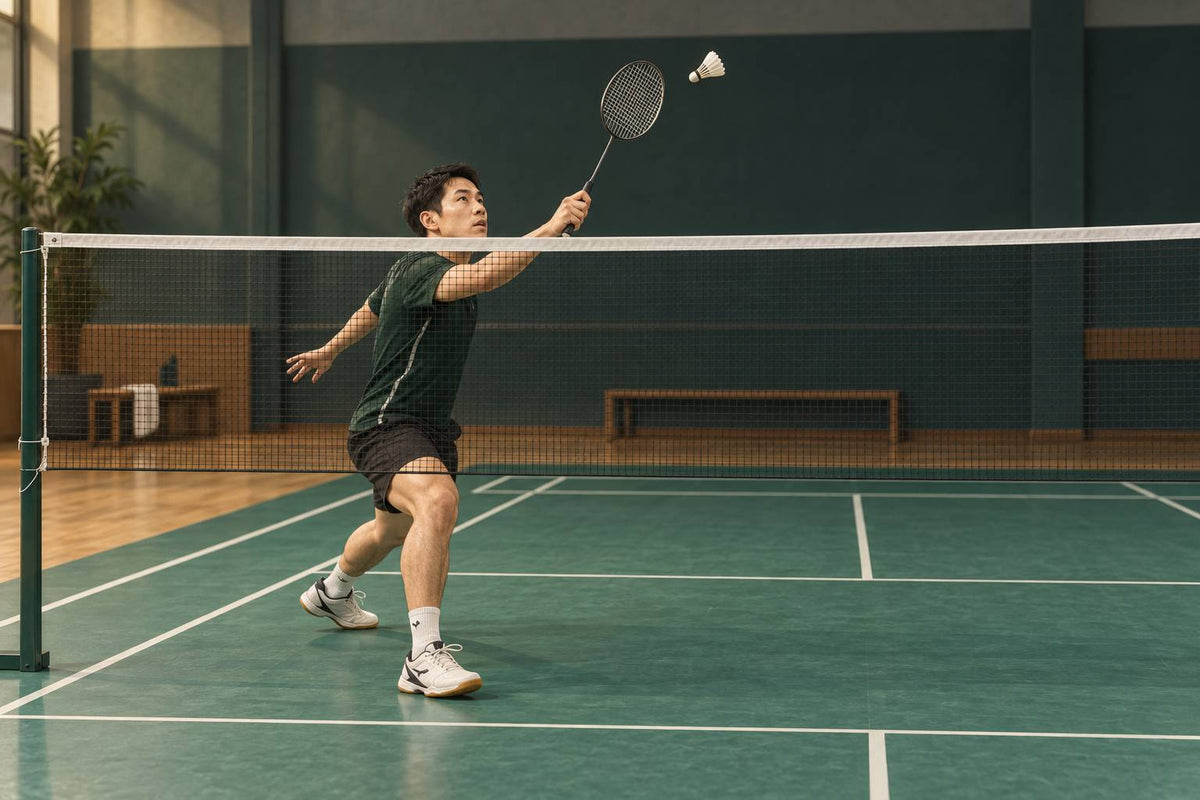
When your pair has the attack in mixed doubles, the default shape is front-and-back. The front player controls the net area, stays racket-up around net height, and looks to create or finish chances. The back player works from the mid and rear court, building pressure with drops and smashes until the front player can intercept.

In traditional mixed positioning, the female player is commonly the front-court player while the male player covers the mid and back courts. Treat that as a tactical starting point, not a rule. If your strongest rear-court attacker or quickest back-court mover is the woman, your pair can flip the roles and still use the same front-back attacking logic.
The net position is the lever. The front player is not just waiting for a winner; by holding the net, showing a threatening racket, and covering loose replies early, they create the downward opportunities that let the rear player keep attacking.
Front player: control the net and make the next shot uncomfortable
The front player’s first job is to make opponents feel that the net is closed. That means being balanced, racket up, and close enough to pressure net replies without drifting so far forward that the important mid-court space opens behind you.
- Own the tape area: look for loose blocks, weak net shots, and flat replies that can be tapped, brushed, pushed, or killed.
- Create the rear-court attack: a good front player forces lifts or half-lifts, giving the back player the chance to smash or drop from above the shuttle.
- Stay racket-up around net height: this lets you be early on the third shot after serve and keeps you looking threatening from the start of the rally.
- Protect the mid-court lane: mixed doubles has a strategically important mid-court area, so the front player should be ready for flat replies that are too high to ignore but too short for the rear player to attack comfortably.
Back player: build pressure, don’t just hit hard
The back player’s role is to keep the rally under pressure from the rear court. Smashes matter, but the back player also needs drops and placement so the front player can hunt. A smash that produces a loose block is often more useful than a full-power smash that gives the opponents an easy counter.
- Use drops and smashes together: the rear player often builds the rally with both shots, while the front player looks to finish.
- Cover the mid and back courts: in the basic mixed attacking formation, the rear player is responsible for the space behind the net player, including the deeper court.
- Attack with the front player in mind: aim to create a predictable weak reply into the net player’s racket zone, not just to win the rally from the back every time.
Practice diagram: draw your attack as zones, not positions
Use a simple court sketch like this when coaching or reviewing video: front player, back player, net zone, rear-court pressure zone, and the mid-court space that both players must respect.
Not to scale — use it as a rotation cue, not a foot-placement rule.
How this connects to the rest of your doubles game
If you are coming from level doubles, the attacking principle is familiar: attack in front-and-back, defend in sides. The difference in mixed doubles is that the role assignment is more deliberate, especially around the net player’s job and the rear player’s pressure-building role. For the broader rotation framework, see our badminton doubles positioning and rotation guide.
The serve and return decide how often you actually get into this attacking shape. For serve patterns, compare the low and flick options in our badminton doubles serve guide and the fundamentals in How to Serve in Badminton. For the receiving side, our doubles return-of-serve guide explains the choices that either keep the net player involved or force a quick defensive reset.
Gear will not fix poor rotation, but it can support the movement. Mixed doubles attack asks for sharp starts, lateral recovery, and repeated net-to-rear adjustments, so indoor court shoes with grip and lateral support matter; browse the options in badminton footwear. If your role is often the rear-court attacker, browse the badminton rackets collection to match a frame to that job.
Defensive Roles: Who Covers the Net, Mid-Court, and Deep Court?
Once your pair lifts, stop thinking like you are still in front-and-back attack. The immediate job is to rotate into side-by-side defence, lower your centre of gravity, and make the attacking pair hit one more shot. This defensive shape is not passive; it is a waiting room for the next counter-attack.
The key is patience. Against a smash, your first goal is usually to survive with quality: block the shuttle short to the net when there is space, drive flat when the attacker is leaning forward, or push into the mid-court/deeper court to change the pace. Good defence is not just “getting it back”; it is choosing a reply that makes the opponents lift, reach, or hesitate.
Defensive reminder. If you are still unsure about your base stance, review our badminton defence ready position guide before drilling mixed rotation.
The side-by-side shape after a lift
After a lift, both players should recover into a side-by-side shape. But “side-by-side” does not mean both players split the court perfectly in half and hope for the best. Your responsibilities shift based on where the attack is coming from and which player is better positioned to deal with the next ball.
- Cross-court defender: guards the cross-court net area and looks for soft blocks that can turn defence into attack.
- Mid-court defender: is ready for flat kills, body smashes, and fast pushes through the middle channel.
- Straight-side defender: takes the hardest straight smash line and must be ready to block, drive, or lift under pressure.
- Rear/deeper-court cover: protects the deeper court if the attack becomes a punch clear, steep half-smash, or pushed recovery shot.
In the mixed pattern described in the previous sections, the front player is still especially important even when the pair is defending: that player guards the cross-court net area and mid-court flat kills. The back player covers straight smashes and the deeper court. This is why mixed defence feels different from level doubles — the court is shared by role and angle, not just by left and right side.
Diagram note: simple mixed defence map
Cross-court net
Front player shades across the shuttle angle and looks for a soft block or net interception.
Straight smash
Back player braces for the direct power lane and keeps the racket in front of the body.
Deeper court
Back player also protects the deeper recovery space if the opponent changes from smash to push or clear.
How to defend without giving away the attack
The mistake many club pairs make is lifting again too early. A lift is sometimes necessary, but if every smash return goes high, the opponents can stay in front-and-back attack for the whole rally. Instead, build a defensive menu:
- Block off the smash: use a short block when the attacker is committed forward or when the net player has drifted too far to one side.
- Drive through the body: use a flat drive when the smash is not too steep and you can meet the shuttle in front.
- Push into space: push past the front player to force the rear attacker to move and hit from a less comfortable position.
- Lift only when needed: if you are late, off balance, or jammed at the body, a high lift can reset the rally better than a loose block.
This connects closely with change-of-pace defence. A soft block, a flat counter-drive, and a deeper push all ask different questions of the attacking pair. If you want more examples of this idea outside mixed doubles, see our badminton change of pace tactics guide and smash defence guide.
A simple rule for deciding who takes what
When the shuttle is hit hard and downward, the straight-side defender should expect the first contact. The cross-court player should not drift too far back or too wide; their value is in covering the net block area and the mid-court interception that comes after the first defensive touch.
Use this rule in practice: if the smash is coming straight at your partner, do not crowd them. Hold your cross-court and mid-court space. If your partner blocks short, then you are already close enough to move forward and contest the next net shot. If your partner drives, you are balanced enough to cover the reply through the middle.
For the bigger doubles framework behind this, our badminton doubles positioning and rotation guide explains how attack and defence shapes connect. If the rally begins from serve pressure, pair this section with our doubles low and flick serve guide and doubles return of serve guide.
Gear note for mixed defence. Fast side-to-side recovery depends on court grip and lateral support. Browse badminton footwear for indoor court shoes — the Babolat Shadow Tour is a non-marking option with lateral midfoot support worth a look — and check badminton rackets when you are matching your defensive countering style to your racket setup.
Rotation Triggers: When to Switch and Which Way to Move

The easiest way to understand mixed doubles rotation is this: move with the shuttle, relative to your partner. If the shuttle is hit high down one side, that side usually pulls a player backward. If the shuttle is played low near the net, that area pulls a player forward. Your partner fills the space you leave.
Quick Rotation Rule
Read the opponent’s contact point before you decide whether to attack, defend, or rotate.
Below net height
Move toward attack: expect a lift, weak push, or rising shot you can pressure. One player moves forward; the other prepares behind.
Above net height
Be ready for defence: a higher contact point gives the opponent attacking options, so prepare to split side-by-side or cover the straight and cross-court threats.
Trigger 1: Your Front Player Touches the Net Shot
A simple mixed doubles sequence looks like this:
- You serve or return short. The front player is already close enough to threaten the tape.
- The opponent plays a low net reply. Because the shuttle is low and near the net, the front player moves forward to take it early.
- The front player plays a tight net touch. They stay forward because they are still the closest player to the next net ball.
- The partner drops back. If the opponent lifts, the rear player is already available to attack from the back court.
This is the cleanest example of mixed doubles rotation: the shuttle pulls the front player forward, so the partner naturally moves behind. You do not need a dramatic switch. You just keep the front-back attacking shape because the front player has earned net position.
Trigger 2: Straight Smash, Net Block, Follow In
The most common rear-to-front switch happens after a straight attack:
- Rear player smashes straight. The attack goes down the line, so the defender’s easiest soft reply is often a straight block to the net.
- The attacker follows the smash forward. Because the shuttle is likely to land in front of them, they move in behind their shot instead of admiring it from the rear court.
- The opponent blocks to the net. The smasher is now the closest player and can take the next shot early.
- The partner rotates to the rear. As the attacker moves in, the original front player gives space and becomes the back-court cover.
This is where many club pairs hesitate. The rear player thinks, “I’m the back player,” and stays back. The front player thinks, “I’m the net player,” and also steps in. Now both players are in the same lane. The better habit is: if you smash straight and the block comes straight, follow your attack forward. Your partner rotates behind you.
Trigger 3: You Lift or Lose the Downward Attack
If your pair lifts, clears, or gives the opponents a high contact point, stop thinking attack rotation. Your first job is to survive the next shot. Move into a more side-by-side defensive shape, with each player ready to cover their half, then look for a block, drive, or push that lets you regain the front-back attack.
This connects directly to the broader doubles rule: attack is usually front-back, defence is usually side-by-side. For a deeper foundation, see our badminton doubles positioning and rotation guide.
Which Way Do You Rotate: Clockwise or Counter-Clockwise?
There are two possible rotation directions: clockwise and counter-clockwise. The right one is usually the one that follows the shuttle path while avoiding your partner’s lane.
| Situation | First movement | Partner movement |
|---|---|---|
| Low net reply in front of the front player | Front player moves in and stays forward | Partner drops back to prepare for the lift |
| Straight smash followed by straight net block | Smasher follows forward into the net | Partner rotates out and back to cover the rear court |
| Opponent contacts above net height | Prepare to defend the fast or downward shot | Open into side-by-side coverage instead of forcing a front-back shape |
| Opponent contacts below net height | Step forward and look to take the attack | Fill behind the forward-moving player |
If you are unsure, use short calls: “stay,” “switch,” “mine,” or “yours.” The goal is not to sound professional; the goal is to remove hesitation. Rotation breaks down when both players move to the shuttle or both players wait for the other person.
Gear note for fast rotation. Mixed doubles involves hard lateral pushes, split steps, and net-to-rear recovery. Browse badminton footwear for court-specific grip and support. If you are also tuning your rear-court attack, see our badminton rackets collection. Badminton House ships across Canada.
Rotation also starts from the first two shots. If your serve or return creates a low contact point, your pair can move toward attack immediately. If it gives the opponent a higher contact point, expect to defend first. For more detail, read our doubles return-of-serve guide, low and flick serve guide, and serve technique guide.
Avoiding Collisions: Simple Calls and Gear That Supports Rotation
The most common mixed doubles collision at club night is not caused by slow feet. It is caused by hesitation: both partners see the shuttle, both half-move, and neither is fully sure who owns the next shot.
Keep the solution simple. Use clear calls like “Mine” or “Yours”, then back those calls up with formation rules. If you are the front player, take the net shots and leave the rear-court shuttle to the back player. If you are the back player, build the rally from mid and deep court instead of drifting forward into your partner’s lane.
Club-night rule: call early, move decisively, and trust the shape. Most clashes happen when both players abandon their job at the same time.
Use calls for ownership, not commentary
A good call should answer one question: who is taking this shuttle? It does not need to explain the tactic. In a fast mixed rally, “Mine” and “Yours” are better than long instructions because they are short enough to say before the shuttle arrives.
- “Mine” means you are committed to the shot and your partner should clear space.
- “Yours” means you are releasing the shuttle and your partner should take it.
- “Leave” can be useful when the shuttle is clearly going out, but only use it if your partner trusts the call.
The call matters most in the grey zones: flat drives through the middle, lifts that land between rear player and front player, and net tumblers that sit just high enough to tempt both partners. For more on how doubles shape changes through the rally, see our badminton doubles positioning and rotation guide.
Let formation rules remove the guesswork
Mixed doubles becomes calmer when each partner knows the default responsibility before the rally speeds up. In the attacking front-and-back shape, the front player is responsible for the net area and the back player handles the mid and rear court. In defence, the pair should be ready to spread into a side-by-side shape rather than both staying narrow in the middle.
| Situation | Default owner | Collision risk |
|---|---|---|
| Tight net reply | Front player | Back player lunges in and crowds the net player. |
| Clear or lift over the front player | Back player | Front player backpedals instead of releasing the rear court. |
| Flat shuttle through the middle | Closest balanced player | Both partners swing because no one calls early. |
| Opponent attacks above net height | Pair shifts toward defence | One player stays forward while the other expects side-by-side coverage. |
If serve and return situations are where your pair gets tangled, review the basics in our doubles low and flick serve guide, doubles return-of-serve guide, and serve technique guide.
Gear that supports fast rotation
Mixed doubles asks for quick net-to-rear movement, sudden lateral changes, and hard braking when the shuttle changes direction. That makes court grip and support important, especially on indoor gym floors where you need to push off without sliding into your partner’s path.
Footwork support for mixed doubles rotation
If your current shoes feel unstable on split steps, side lunges, or recovery steps, start with badminton-specific court footwear. The Babolat Shadow Tour Men’s Badminton Shoes – Orange is a non-marking indoor court shoe with lateral midfoot support, and you can also browse the full badminton footwear collection. Badminton House ships across Canada.
For rear-court players thinking about smash pressure and deep-court coverage, browse the live badminton rackets collection rather than guessing from generic rackets that may not suit your role.
Which Mixed Doubles Rotation Should You Choose?
Use this as your on-court decision helper. Mixed doubles badminton tactics are not about memorizing one fixed pattern; they are about reading serve quality, shuttle height, who is strongest in each role, and whether your pair is attacking or defending.
| Situation | Choose this shape | Who moves | Why it works |
|---|---|---|---|
| You serve low and short well | Front-and-back attack | Server takes the front; partner holds the rear court. | A good short serve lets the serving pair adopt an attacking shape immediately, with the front player threatening the third shot and the rear player ready to build pressure. |
| You serve high or lift | Side-by-side defence | Both players split across the court. | A high serve or lift gives the opponents the first attacking chance, so your pair should protect both sides instead of leaving one player stranded at the net. |
| Opponent contacts below net height | Look to attack | One player moves forward; the partner takes the back. | A low contact usually limits the opponent’s downward options, giving your pair a chance to rotate into front-and-back pressure. |
| Opponent contacts above net height | Prepare to defend | Both players recover toward side-by-side coverage. | A higher contact point gives the opponent more chance to hit down, so patience, blocks, drives, and pushes become the safer defensive tools. |
| Your front player wins net position | Stay front-and-back | Front player keeps the net; rear player uses drops and smashes to build pressure. | The net player creates and finishes chances, while the rear player keeps the rally going downward or forces a weak reply. |
| The man flick serves | Diagonal net support | The partner moves cross-court from the shuttle; the server covers the straight reply. | The diagonal move gives the net player more time to read the shuttle while still staying close enough to threaten the front court. |
| Returner plays a net shot | Choose based on strengths | Returner can stay forward while the partner takes the rear, or move back and let the partner take the net. | There is no single correct answer if your pair has different strengths. If the woman is stronger from the rear or the man is not faster or more powerful at the back, a more level-doubles-style setup can make sense. |
| Both players hesitate | Call and simplify | Use clear calls like “Mine” or “Yours,” then follow your formation rules. | Most clashes happen when both players are unsure who owns the shot. If you are in front, take the net shots; if you are behind, take the deeper shots. |
Default choice for most club pairs: start with front-and-back when you are attacking and side-by-side when you are defending, then adjust the front/back roles to the players’ actual speed, power, net control, and comfort.
If you want the bigger doubles framework behind this table, pair this guide with Badminton Doubles Positioning: Rotation Guide for Canada. For the first-four-shots part of mixed, read Badminton Doubles Return of Serve Guide for Canada and Badminton Doubles Serve Guide for Canada: Low & Flick. If you are still building your serve base, How to Serve in Badminton is the better starting point.
Gear will not fix unclear movement, but it can support it. For mixed doubles rotation, prioritize reliable court grip and lateral support because the game asks for fast split steps, diagonal recoveries, and net-to-rear movement. See current options in badminton footwear; if you are comparing rackets for the rear-court role, browse the live badminton rackets collection for current availability.
Get new badminton guides by email
Join the Badminton House list for occasional emails with new guides, technique tips and news from our club in Moncton.
By subscribing, you agree to receive Badminton House emails and can unsubscribe anytime.
Mixed doubles rotation feels fast at first, but it becomes much simpler when both partners understand the same cues: who owns the net, who owns the rear court, and when the rally has changed from attack to defence. We play badminton ourselves, so if you want help choosing gear that supports faster movement, safer cuts, or a doubles-friendly setup, contact Badminton House and tell us how you play.
Ships across Canada · 14-day returns · Canadian badminton specialty shop


Leave a comment
This site is protected by hCaptcha and the hCaptcha Privacy Policy and Terms of Service apply.