
Last updated: July 2026 · Written by the team at Badminton House
Quick Answer: Badminton Home Gym Workout
Use this as a minimal-equipment strength session when you have bands, one pair of dumbbells, and want better support for badminton lunges, jumps, direction changes, and shoulder control without turning it into a skills workout.
Default
Best choice: do the full 30–40 minute band-and-dumbbell session: band lateral walk, rear-foot-elevated split squat, band external rotation, band Pallof press, and loaded single-leg calf raise.
Lower body
Prioritize the lateral walk, rear-foot-elevated split squat, and single-leg calf raise if your main goal is stronger single-leg control for lunges, landings, and push-off.
Band only
If you only have resistance bands, keep the lateral walk, external rotation, and Pallof press; for no-court skills and footwork instead, use our badminton drills at home guide.
Your Training Week — Quick Start
Short on time? This band-and-bodyweight session is the home version of the gym days, no rack required. Tap any exercise to jump straight to its how-to, sets, reps, and load.
| Day | Focus | Do this |
|---|---|---|
| Mon | Full-body home day (this session) | Band lateral walk 2–3×10–12/side · Rear-foot-elevated split squat 3×8–10/leg · Band external rotation 2–3×12–15 · Band Pallof press 2–3×8–12/side · Single-leg calf raise 3×10–12/leg |
| Tue | Court: drills + footwork | Shadow footwork + multi-shuttle drills |
| Wed | Upper body + prehab | Upper-body session + prehab |
| Thu | Power + fast hands | Power / plyometrics + reflex work |
| Fri | Light skills / recovery | Easy touch session or rest. Keep it light. |
| Sat | Match play | Warm up, then club matches or games. |
| Sun | Recovery / mobility | Rest, easy mobility, or an optional light session. |
A 3-gym-day template (Mon/Wed/Thu). Training twice a week? Keep Mon + Wed. See the full badminton gym program and weekly training plan for 2–4-day options.
This home gym workout needs just a band and one or two dumbbells, and builds single-leg strength, hip control, shoulder stability, anti-rotation core, and calf stiffness for push-offs. Repeated lunges, jumps and direction changes make single-leg strength and control useful training priorities. It's strength work, not skills; for footwork, see our badminton drills at home guide.
Home strength first, court gear second. Badminton House does not sell resistance bands, dumbbells, or gym equipment. When it's time to transfer the work, check live availability on badminton footwear.
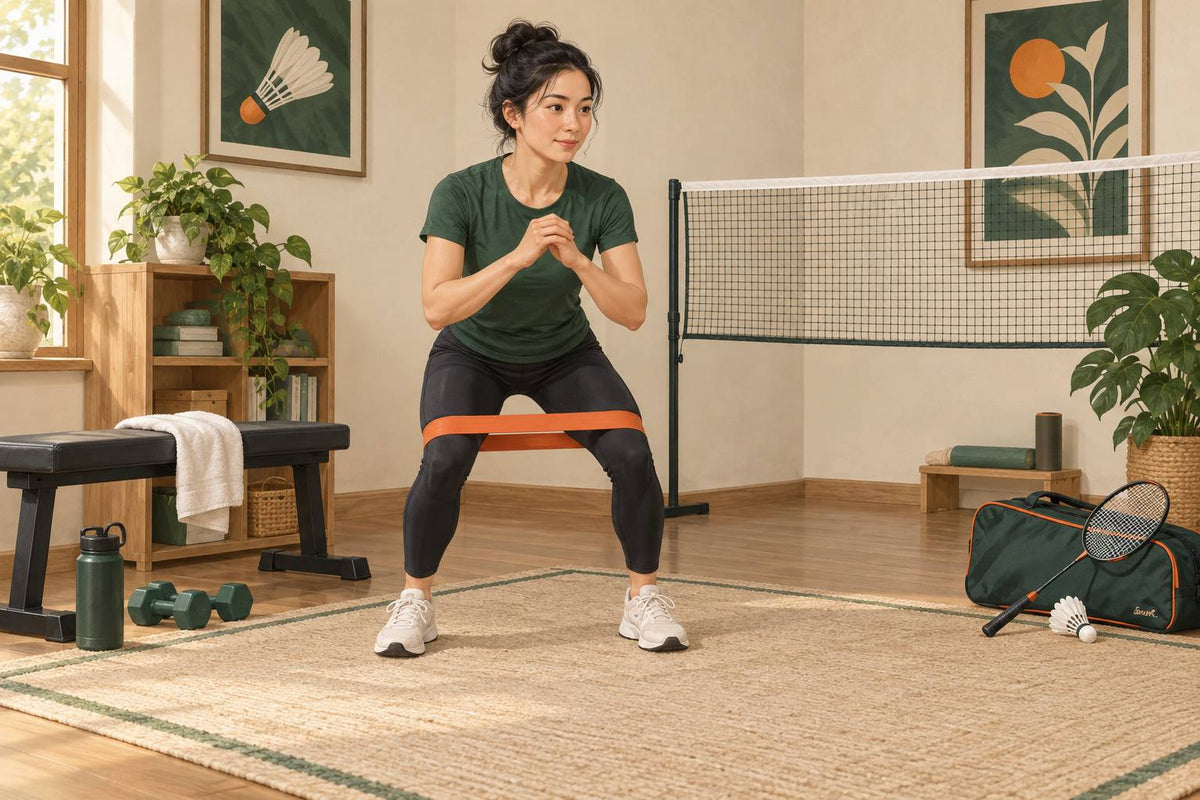
Band Lateral Walk


Why it matters: Banded lateral walks target the hip abductors and glute medius, which keep your pelvis level when one foot is off the ground, the base for sharp direction changes.
- Half-squat, toes forward, band above the knees (ankles for harder); step sideways under constant tension. Don't let the knees cave in or stand up out of the squat. That reduces control and changes the exercise.
Load & Progression: Band Lateral Walk
Start
2–3 sets of 10–12 per side. Use a band tension you can hold in a steady half-squat for all 12 steps with about 2 in reserve, keeping constant tension and the knees tracking out.
Progress
Add reps to the top of the range first, then step to a heavier band or move the band from above the knees toward the ankles, only once the knees stop caving.
Why
It fires the hip stabilisers that keep the knee tracking during badminton's constant side-to-side movement.
Rear-Foot-Elevated Split Squat


The main loaded single-leg move: it builds front-leg strength for deep lunges, recovery steps, and single-leg landings with only dumbbells. The front leg does most of the work, with the balance of load depending on your setup. No-equipment version: our badminton leg strength training guide.
- Rear foot on a stable 12–18 inch surface, front foot flat and knee tracking with the toes; hold one dumbbell at the chest (goblet) or two at your sides (suitcase).
- Brace, lower under control until the front thigh works hard, then drive through the whole front foot — no bounce. Feel it in the rear leg? Shift weight to the front foot.
Load & Progression: Rear-Foot-Elevated Split Squat
Start
3 sets of 8–10 per leg. Start with a bodyweight tempo you can control for 10 clean reps on your weaker leg with about 2 in reserve, keeping the front foot planted.
Progress
Add reps to the top of the range first, then slow the descent, then hold a loaded backpack or dumbbell. Always let the weaker leg set the load.
Why
It gives you heavy-feeling single-leg strength for badminton lunges and landings with just a bench and bodyweight.
Band External Rotation


Band external rotation strengthens the rotator cuff's external rotators (the infraspinatus and teres minor) for shoulder stability under overhead hitting. Treat it as strength work: slower and heavier than a warm-up. For the lighter shoulder-prep version, see our shoulder pain prevention guide.
- Anchor the band at elbow height, stand side-on with the working arm farthest away; bend the elbow 90°, pin the upper arm to your side, and rotate the forearm outward.
- Ribs, hips, and head stay still; twisting or elbow drift means the band's too heavy. Step closer and reset.
- Progress by moving farther from the anchor or slowing the return, never by twisting. Train both sides evenly.
Load & Progression: Band External Rotation
Start
2–3 sets of 12–15. Use a band tension you can rotate outward slowly and strictly for all 15 reps with about 2 in reserve, upper arm pinned to your side.
Progress
Add reps to the top of the range first, then slow the return or step to a heavier band. Never let a shrug or a torso twist creep in to move it.
Why
It strengthens the external rotators used to control repeated overhead strokes.
Band Pallof Press


The band Pallof press is anti-rotation core work: anchor a band at chest height, stand sideways, press it straight out, pause, then return, without letting your torso rotate. It keeps your spine steady while the legs push, stop, and redirect.
- Keep sternum, ribs, and hips square. Don't let the band twist you or drag the near hip back. Use enough tension that staying upright is genuinely hard, without leaning; progress by stepping farther out. Train both sides.
Load & Progression: Band Pallof Press
Start
2–3 sets of 8–12 per side. Choose a band tension you can press out and hold without twisting for all reps with about 2 in reserve, hips and ribs square.
Progress
Add reps to the top of the range first, then add a longer pause at full extension or step to a heavier band. Stop before you have to lean to hold position.
Why
It builds the anti-rotation core strength that keeps your trunk stable while the legs push and redirect, using just a band.
Single-Leg Calf Raise


Hold one dumbbell, stand on a step's edge with one foot, lower the heel under control, then drive up strongly. The goal isn't bigger calves. It's push-off power, ankle stability, and even left-to-right force, loading the gastrocnemius and soleus through full range.
- Ball of the foot on the step edge, heel free to drop below it; dumbbell on whichever side keeps you balanced, wall for balance only.
- Drive up through the big toe to a high position. Don't let the ankle roll out. Straight-knee reps bias the calf; a slight knee bend hits the soleus. Cut load before range.
Load & Progression: Single-Leg Calf Raise
Start
3 sets of 10–12 per leg. Start with a bodyweight tempo you can control through a full heel drop and strong rise for 12 reps with about 2 in reserve.
Progress
Add reps to the top of the range first, then slow the lowering, then hold a loaded backpack or dumbbell. Keep the range full before adding any load.
Why
It builds the calf and Achilles resilience you rely on for jumping and push-off on court.
FAQ
How long does this take?
About 30–40 minutes. Keep it lighter before court time; go full when it's your main strength session.
Are bands and one pair of dumbbells enough?
Yes. The goal isn't a full gym — it's single-leg strength, hip stability, shoulder rotation, anti-rotation core, and calf strength. Add band tension, slow the tempo, or go heavier as reps get easy.
How is this different from at-home badminton drills?
This is the strength session. For no-court skills (shadow footwork, wall drives, reaction drills), use our badminton drills at home guide.
Build the Strength, Then Bring It Back to Court
A focused 30–40 minute session covering hips, single legs, shoulder, anti-rotation core, and calves. Progress gradually, and pair it with badminton drills at home for skills, or go deeper with our leg strength, shoulder prevention, and stamina and fitness guides.
Which Should You Choose?
Can't fit the full session? Pick the movement that matches your biggest limitation.
| If your priority is... | Choose this | Why |
|---|---|---|
| Weaker/less stable lunge side | Rear-foot-elevated split squat | Emphasizes the working front leg. |
| Knees cave, pelvis drops laterally | Band lateral walk | Trains the glutes that keep the pelvis level. |
| Want shoulder strength, not just warm-up | Band external rotation | Builds rotator-cuff strength for overhead stability. |
| Twist or lose balance changing direction | Band Pallof press | Anti-rotation core work (resists the twist). |
| Weak push-off / landing power | Single-leg calf raise | Loads the calf through full range, one leg at a time. |
Not looking for loaded strength? See Badminton Drills at Home, Badminton Leg Strength Training, or Badminton Shoulder Pain Prevention.
Get new badminton guides by email
Join the Badminton House list for occasional emails with new guides, technique tips and news from our club in Moncton.
By subscribing, you agree to receive Badminton House emails and can unsubscribe anytime.
Not sure how this fits your level? Contact us. We play too.
Canadian specialty shop · Free shipping within Canada on orders over $200

Leave a comment
This site is protected by hCaptcha and the hCaptcha Privacy Policy and Terms of Service apply.