
Last updated: July 2026 · Written by the team at Badminton House
Quick Answer: Badminton Weight Training Legs
Add loaded leg work only after your bodyweight patterns are controlled: build strength with a squat, hinge, single-leg, hamstring-eccentric, and calf pattern, then bring that strength back to lunges, jumps, and recovery steps on court.
Default
Best choice: if your bodyweight squat, split squat, lunge, and calf raise already track cleanly, use this loaded guide to progress the back squat, Bulgarian split squat, Romanian deadlift, Nordic curl, and loaded calf raise without turning gym strength into sloppy court movement.
Start Here
If your knee caves in, balance wobbles, or landings feel heavy, start with the bodyweight foundation in Badminton Leg Strength Training before adding barbells or dumbbells.
No Gym Kit
Badminton House doesn't sell gym equipment. This guide assumes access to a gym or club strength facility. When you are ready to put that strength to work on court, check badminton footwear.
Your Training Week — Quick Start
Short on time? Here is where this lower-body gym session sits in a badminton week. Tap any exercise to jump straight to its how-to, sets, reps, and load.
| Day | Focus | Do this |
|---|---|---|
| Mon | Lower body + core (this session) | Back squat 3–4×5–8 · Bulgarian split squat 3×8–10/leg · Romanian deadlift 3×6–8 · Nordic curl 3×4–6 · Loaded calf raise 3×10–12, then core & rotation |
| Tue | Court: drills + footwork | Shadow footwork + multi-shuttle drills |
| Wed | Upper body + prehab | Upper-body session + prehab |
| Thu | Power + fast hands | Power / plyometrics + reflex work |
| Fri | Light skills / recovery | Easy touch session or rest (keep it light). |
| Sat | Match play | Warm up, then club matches or games. |
| Sun | Recovery / mobility | Rest, easy mobility, or an optional light session. |
A 3-gym-day template (Mon/Wed/Thu). Training twice a week? Keep Mon + Wed. See the full badminton gym program and weekly training plan for 2–4-day options.
Leg strength work should support court movement: braking into lunges, pushing off corners, and landing from jumps without your knees or Achilles feeling cooked. Lunging makes up about 15% of movements in competitive singles, which is why this guide builds the back squat, Bulgarian split squat, Romanian deadlift, Nordic curl, and loaded calf raise into stronger “shock absorbers” for jumps and direction changes. Still shaky on the bodyweight versions? Start with Badminton Leg Strength Training first.
Back Squat


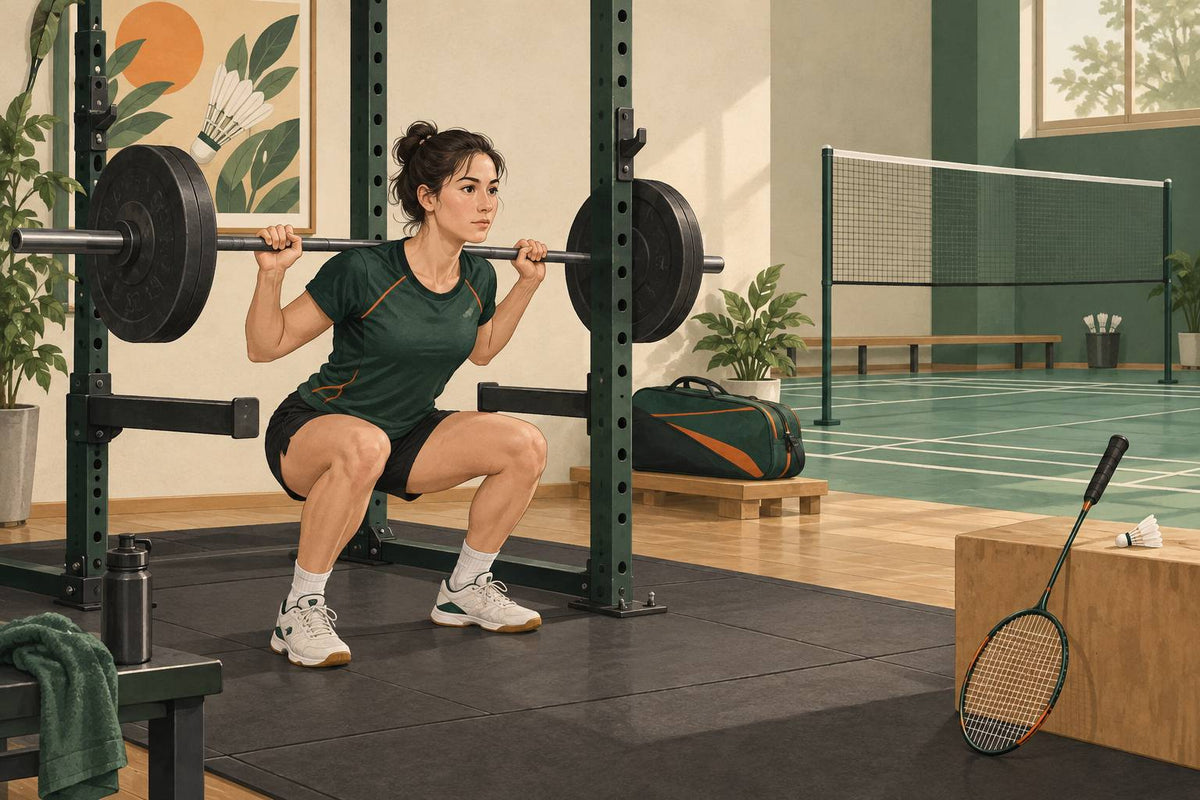
The back squat is the loaded progression, not the starting point. Build the bodyweight version first in Badminton Leg Strength Training. It matters because squat strength tracks with jump power: Stone et al. (2003) found 1RM back squat strongly correlated (r = 0.77–0.94) with jump power up to 90% of 1RM, and a study of 15 national athletes including five badminton players found squat loading raised jump height acutely. Treat 2 sets of 10 reps at 70–80% 1RM from one jump study as a trained-lifter benchmark, not a first session. It creates real fatigue. Don't max out for ego, and back off if your split step starts feeling heavy.
Load & Progression: Back Squat
Start
3–4 sets of 5–8. Choose a load you can squat to solid depth for 8 clean reps with about 2 left in the tank: for many club players that is the empty barbell while you groove depth and bracing.
Progress
When all sets reach the top of the range at good depth, add about 2.5 kg (double progression): earn the reps first, then add the load.
Why
Small, steady overload with reps in reserve builds strength without cooking your legs for court. Grinding heavy singles buys soreness, not faster footwork.
Bulgarian Split Squat


The Bulgarian split squat is this plan's single-leg lift. It builds strength on each leg independently and exposes left-right asymmetries that show up as uneven lunges and jump take-offs. Work 3–5 sets of 5–8 reps per leg at a moderate-to-heavy load, rear foot on a support behind you, weight centred over the front leg, descending until the front thigh is roughly parallel to the floor. Keep the chest upright and drive up through the front leg, not the rear foot; if you're not ready to load it, use the bodyweight version in Badminton Leg Strength Training first.
Load & Progression: Bulgarian Split Squat
Start
3 sets of 8–10 per leg. Start with bodyweight, or light dumbbells you can control for 10 reps on your weaker leg with about 2 in reserve.
Progress
Build to 10 clean reps per leg on both sides, then add a light dumbbell in each hand. Always let the weaker leg set the load.
Why
Badminton is played one leg at a time; single-leg strength matches the lunge-and-recover demand, and loading the pattern before your balance is solid just makes the wobble heavier.
Romanian Deadlift


The Romanian deadlift is the loaded hinge, a hip-dominant lift that trains the hamstrings and glutes through a controlled lowering while holding a neutral spine. It builds the posterior-chain strength behind take-offs, braking, and repeated lunges. Start standing with the bar close to your thighs, hips pushed back, knees soft, and lower until you feel a strong hamstring stretch around mid-shin, then drive the hips forward to finish tall. Work 3–5 sets of 6–12 reps with a 3-second lowering. If you have to bounce or round your back to finish a rep, the load is too heavy. Watch for the bar drifting away from your legs, which shifts stress to the lower back.
Load & Progression: Romanian Deadlift
Start
3 sets of 6–8. Use a load light enough to keep a flat back and actually feel the hamstrings lengthen (often an empty or lightly loaded bar).
Progress
Add 2.5–5 kg once every set keeps clean form and a full hip hinge; chase hamstring tension through range, not the number on the bar.
Why
Hamstring strength supports controlled braking in lunges; use a load and range you can manage.
Nordic Curl


The Nordic curl is the hamstring-eccentric piece most leg programs miss. It asks your hamstrings to resist your body weight as you lower toward the floor. The case is strong: two systematic reviews and meta-analyses reported fewer hamstring strains in programs that included Nordic exercises; the often-cited reduction of about half is a pooled sports finding, not a guaranteed badminton outcome. Secure your ankles under a partner or stable anchor, then lower slowly, letting your hamstrings resist gravity. Only go as far as you can control smoothly, using bands or partner assistance until you can handle full bodyweight. Progress from band-assisted, to eccentric-only, to full bodyweight; smooth control beats aggressive range you can't hold.
Load & Progression: Nordic Curl
Start
3 sets of 4–6. Begin at bodyweight through the range you can control, hands ready to catch yourself near the bottom.
Progress
Lower more slowly and through a longer range before adding reps; only advanced players add external load. Range and control come first.
Why
Eccentric hamstring strength is the aim; preserve controlled lowering before adding repetitions.
Loaded Calf Raise


Calf work matters because badminton demands constant pushing, braking, hopping, and split-stepping. Straight-knee raises bias the gastrocnemius for explosive push-offs and direction changes; bent-knee raises bias the soleus, which also contributes to force production and control during landings and lunges. Train both. Use a full range without bouncing at the bottom, and test single-leg strength periodically: compare sides and investigate a persistent loss of strength or control rather than treating one percentage as a universal injury threshold. Keep heavy calf work away from a hard court night, and build the bodyweight version first in Badminton Leg Strength Training if balance or ankle control isn't solid yet.
Load & Progression: Loaded Calf Raise
Start
3 sets of 10–12. Pick a load you can raise to full height and pause at the top for a beat, keeping about 2 reps in reserve.
Progress
Build to 12 reps, then add about 2.5 kg; keep every rep full-range with a brief pause at the top.
Why
Your calves and Achilles absorb every jump and push-off, so full-range loading builds the tendon tolerance that repeated smashes and lunges demand.
FAQ
Should I start with loaded leg training or bodyweight work?
Only if your bodyweight squat, split squat, and balance are already solid. See Badminton Leg Strength Training first otherwise.
Can this help if I get knee pain from badminton?
Strength work may help when it matches the cause and irritability of knee pain, but this general session is not a treatment plan. Seek assessment for persistent or worsening pain, and read Badminton Knee Pain: Causes, Fixes & Gear.
Put the Strength Back on Court
Apply leg strength to court movement: arriving faster, braking cleaner, and recovering sooner from the lunges, jumps, and direction changes that decide rallies. Pair it with Badminton Explosive Power Training, or manage active knee pain with Badminton Knee Pain: Causes, Fixes & Gear.
Which Loaded Leg Exercise Should You Choose?
Match the lift to what's limiting you on court:
| Your on-court need | Choose this | Why it fits |
|---|---|---|
| One leg feels weaker or less stable in lunges. | Bulgarian split squat | Rear-foot support lets you load the front leg heavily while building side-to-side symmetry. |
| Your first step, push-off, or calf/Achilles balance is the limiter. | Loaded calf raise | Straight-knee raises train explosive push-offs; bent-knee raises train shock absorption. |
Get new badminton guides by email
Join the Badminton House list for occasional emails with new guides, technique tips and news from our club in Moncton.
By subscribing, you agree to receive Badminton House emails and can unsubscribe anytime.
Building a loaded leg program? Keep the gym work honest and bring it back to sharper lunges and pushes. Unsure how it connects to your shoes or footwork? Contact us and we'll help you think it through.
When the leg strength is built, the payoff happens on court: stable landings, cleaner pushes, and shoes that are made for badminton movement.
Check Live Footwear AvailabilityBadminton footwear for Canadian players · Put your new strength to work on court


Leave a comment
This site is protected by hCaptcha and the hCaptcha Privacy Policy and Terms of Service apply.