
Last updated: July 2026 · Written by the team at Badminton House
Quick Answer: Badminton Dumbbell Workout
Use one controllable pair of dumbbells for a full-body session 2–3 times per week, prioritizing knee alignment, hip control and trunk stability over heavier weight.
Default
Best choice: run the five-move dumbbell session (goblet squat, reverse lunge, push press, renegade row and DB RDL) when you want one compact workout for lunge strength, hip drive, anti-rotation core and upper-body power.
Control
Choose lighter dumbbells, fewer reps or bodyweight first if your knee collapses in a lunge, your hips rotate in a row or your back rounds during the hinge.
Travel
Use this as your machine-free or barbell-free option when you are training at home, in a small condo gym or anywhere you only have a single dumbbell pair.
Your Training Week — Quick Start
Short on time? This full-body dumbbell session is the no-barbell version of the gym days. Run it once or twice a week (e.g. Mon/Wed). Tap any exercise to jump straight to its how-to, sets, reps, and load.
| Day | Focus | Do this |
|---|---|---|
| Mon | Full-body dumbbell day (this session) | Goblet squat 3×8–10 · DB reverse lunge 3×8–10/leg · DB push press 3×6–8 · Renegade row 3×8–10/side · DB RDL 3×8–10 |
| Tue | Court: drills + footwork | Shadow footwork + multi-shuttle drills |
| Wed | Upper body + prehab | Upper-body session + prehab |
| Thu | Power + fast hands | Power / plyometrics + reflex work |
| Fri | Light skills / recovery | Easy touch session or rest. Keep it light. |
| Sat | Match play | Warm up, then club matches or games. |
| Sun | Recovery / mobility | Rest, easy mobility, or an optional light session. |
A 3-gym-day template (Mon/Wed/Thu). Training twice a week? Keep Mon + Wed. See the full badminton gym program and weekly training plan for 2–4-day options.
Build this one-pair session around badminton-like movements: squat for a stronger base, reverse lunge for court recovery, push press for leg-to-racket power, row for anti-rotation, and RDL for the hamstrings that brake and re-accelerate you. Repeated lunges make knee and trunk control relevant alongside strength. Because each dumbbell pulls its own weight, this format exposes side-to-side imbalances a barbell can hide.
Use it as a complete session when machines or barbells aren't available. Keep loads controlled, stop any rep that breaks form, and judge success by movement on court.
Training first, gear second. Badminton House does not sell gym equipment, so use a safe dumbbell pair you already have access to. When you bring this strength back to court, supportive indoor footwear helps you handle the same lunge and change-of-direction loads: check live availability in our badminton footwear collection.
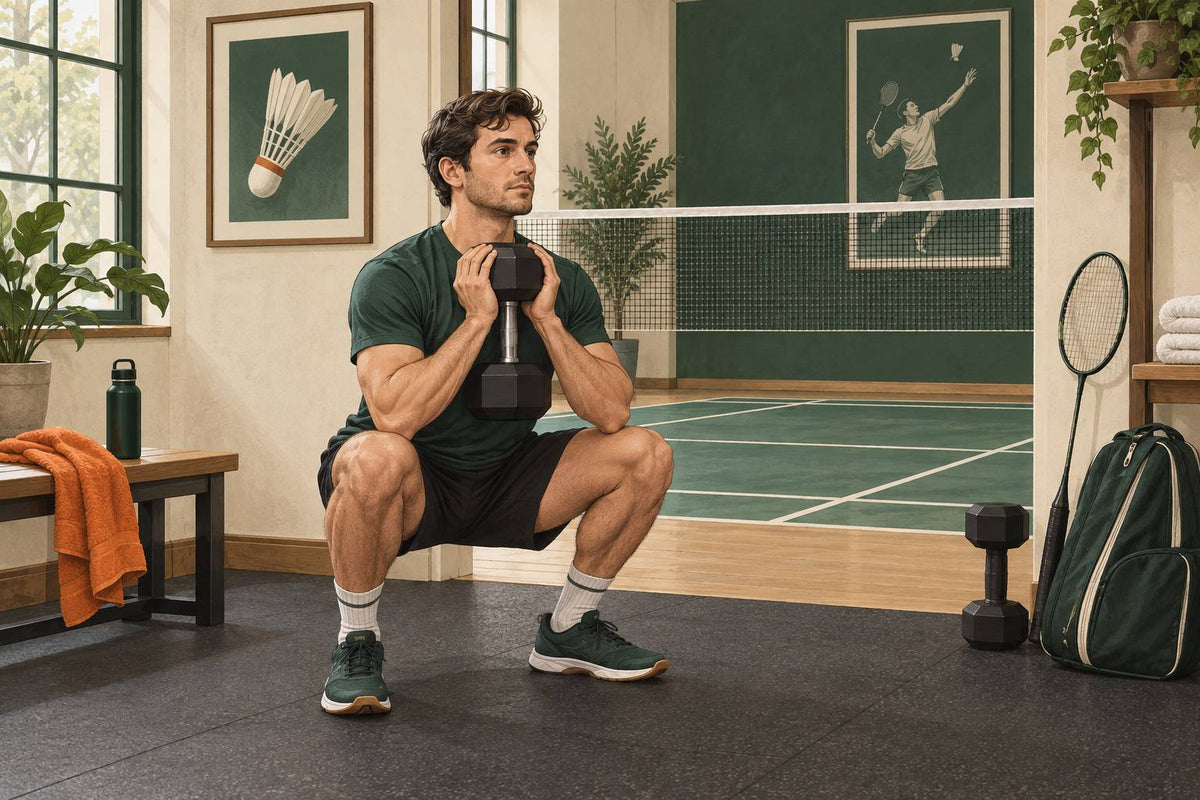
Goblet Squat


Goblet squats train the quads, glutes, and hamstrings: a stronger base before lunge and recovery work. Hold the dumbbell at chest height, elbows tucked in, feet hip- to shoulder-width apart, and squat with a tall chest, using the weight as a counterbalance. Start with 2–3 sets of 6–10 reps; not ready to load, build the bodyweight base first with Badminton Leg Strength Training. Common mistakes: rounding the back, knees caving in, and getting pulled onto the toes.
Load & Progression: Goblet Squat
Start
3 sets of 8–10. Hold one dumbbell at your chest that you can control for 10 clean reps to solid depth with about 2 in reserve.
Progress
When all 3 sets hit 10 reps with an upright torso and no forward collapse, move to the next dumbbell up and rebuild from 8 reps — earn the reps first, then the load.
Why
A joint-friendly loaded squat that builds leg drive for jumps and recovery without needing a rack.
DB Reverse Lunge


Bodyweight first if your lunge is still unstable. Build the pattern with Badminton Leg Strength Training, then load it once you control your front knee and trunk.
The reverse lunge trains leg strength without a barbell. Hold the dumbbells at your sides, step backward, and track the front knee over the front foot. Brace before you descend, then drive up with intent. Let the weaker leg set the load, and watch for the knee collapsing inward or the weights swinging.
Load & Progression: DB Reverse Lunge
Start
3 sets of 8–10 per leg. Hold a dumbbell in each hand you can control for 10 reps on your weaker leg with about 2 in reserve, front knee tracking over the foot.
Progress
Build to 10 clean reps per leg on both sides, then step up to the next dumbbell and rebuild from 8. Always let the weaker leg set the load.
Why
Single-leg strength that mirrors the lunge-and-recover you do every rally, so each leg can brake and push on its own.
DB Push Press


The dumbbell push press is this session's upper-body power move (a shallow leg dip and fast hip drive into an overhead press, legs first, core tight, arms last). Rack the dumbbells at shoulder level, dip shallowly, then drive up fast before pressing to lockout. Common faults: muted hips, pressing too early, and a soft core at lockout that lets the back take over.
Load & Progression: DB Push Press
Start
3 sets of 6–8. Rack dumbbells you can drive overhead for 8 fast, coordinated reps with about 2 in reserve (legs first, arms last).
Progress
Once every rep still looks fast at 8, move to the next dumbbell up and rebuild from 6 reps. Keep the reps crisp rather than grinding slow ones.
Why
Overhead power built from leg drive is the same chain you use to launch into a smash.
Renegade Row


The renegade row combines a single-arm dumbbell row with a push-up plank: your upper back pulls while your core resists rotation. Grip hexagonal dumbbells, feet wider than shoulder-width, brace, then pull one dumbbell to your ribs while pressing the other into the floor. Keep both hips square to the floor, or you lose the anti-rotation benefit and the lower back takes over.
Beginners should choose a load they can control; use an easier supported row if the plank position is not yet stable. See our core and rotational power training guide for more trunk work.
Load & Progression: Renegade Row
Start
3 sets of 8–10 per side. Use dumbbells light enough to row for 10 reps while both hips stay square to the floor, with about 2 in reserve.
Progress
Once both sides hit 10 reps with no hip twist, move to the next dumbbell up and rebuild from 8 — hips staying square is the pass/fail, not the weight.
Why
Pulling strength plus anti-rotation core in one move, matching how your trunk must resist twist on one-sided shots.
DB RDL


The dumbbell Romanian deadlift is your hip-hinge pattern (hamstrings, glutes, and lower back), knees softly bent but fixed, so the movement comes from the hips, not a squat.
How to do it: push your hips back (like closing a car door), letting the dumbbells travel down close to your legs with a neutral spine, until you feel a hamstring stretch around mid-shin, then drive the hips forward to stand tall.
Key cues: hips back first, dumbbells close to the legs, spine neutral throughout. Common mistakes: rounding the back, turning it into a squat, or chasing depth over hamstring tension. Own the hinge here to load and recover from deep lunges on court.
Load & Progression: DB RDL
Start
3 sets of 8–10. Hold dumbbells light enough to keep a flat back and feel the hamstrings lengthen for 10 reps with about 2 in reserve.
Progress
Build to 10 clean reps with a full hip hinge, then step up to the next dumbbell and rebuild from 8. Chase hamstring tension through range, not the number.
Why
Hamstring and hip strength supports braking and recovery from lunges.
Badminton Dumbbell Workout FAQ
How often should I do this session?
Two or three sessions a week is the sweet spot. Start with two if you already play hard badminton sessions, and keep it controlled, not max-effort.
Is one pair of dumbbells really enough?
One pair can cover a basic session if it is controllable in every exercise, but the ideal load differs between movements; use bodyweight, adjust repetitions or choose different weights when needed.
Take the Strength Back to the Court
This session is about making lunges, recoveries, and direction changes feel stable under fatigue, not chasing gym numbers. Badminton loads the knees, ankles, hips, and lower back constantly.
Bring the strength work onto the court. If your shoes are worn or not built for indoor badminton, check live availability in badminton footwear. Need help with your level or injury history? Contact the Badminton House team.
Which Dumbbell Exercise Should You Prioritize?
Do all five if you have time. Short on time, pick the exercise matching your biggest on-court limitation, often lower-body control for repeated lunges and recoveries.
| Choose this first if... | Best pick | Why it fits badminton | Use extra caution if... |
|---|---|---|---|
| New to loaded strength work. | Goblet squat | Builds quads, glutes and hamstrings. | Knees cave in or back rounds. |
| Lunges feel unstable in the front court. | DB reverse lunge | Strengthens the lunge pattern and front-knee alignment. | Front knee collapses inward. |
| Want one exercise for legs, hips, core and arms. | DB push press | Coordinates leg drive with an overhead press. | Pressing too early or torso falling forward. |
| Planks feel solid; you want more anti-rotation. | Renegade row | Combines a row with an anti-rotation plank. | Hips rotate toward the ceiling. |
| Hamstrings, glutes or hip hinge feel like your weak link. | DB RDL | Targets hamstrings, glutes and lower back. | Rounding the back or bending the knees too much. |
Priority order for most club players: lower-body control, hinge strength, upper-body power, then anti-rotation work. This session can sit alongside your court sessions two or three times a week.
Get new badminton guides by email
Join the Badminton House list for occasional emails with new guides, technique tips and news from our club in Moncton.
By subscribing, you agree to receive Badminton House emails and can unsubscribe anytime.
We play badminton ourselves, so our goal with this plan is simple: build strength that shows up in your lunges, recovery steps, and match durability. Need help choosing footwear for repeated lunges and stops? Contact us.
Train strong, then protect that strength on court.
Check live availability on badminton footwear built for indoor court movement, lunges, and quick changes of direction.
Shop Badminton FootwearCanadian badminton specialty shop · Player-focused advice · Gear for your next session


Leave a comment
This site is protected by hCaptcha and the hCaptcha Privacy Policy and Terms of Service apply.