
Last updated: July 2026 · Written by the team at Badminton House
Quick Answer: Playing Against a Left-Handed Badminton Player
Stop aiming on right-handed autopilot: use straight shots and the flat middle first, then adjust once you see the lefty’s actual strengths.
Default
Best choice: make straight clears, straight drops, straight smashes, and flat body/middle shots your safe pattern so your usual cross-court habit does not feed the lefty’s forehand.
Singles
Change your serve and return targets so the shuttle does not drift into the lefty’s forehand, then test their real backhand side instead of assuming every left-hander reacts the same.
Doubles
Against a left-right pair, attack the centre seam and body with drives and pushes because both outside tramlines can be covered by forehands.
If your usual “pressure the backhand” pattern suddenly gets punished, you are probably aiming at the wrong side. Against a left-handed badminton player, the court looks familiar but the danger is flipped: the diagonal you normally use to find a right-hander’s backhand can land straight on a lefty’s forehand, and the serve target you use on autopilot can invite a fast first attack. The fix is not to assume every lefty has the same weakness; it is to rebuild your default map.
Think of this as a geometry problem first and a matchup problem second. A left-hander is a mirror image: forehand and backhand corners reverse, net spin feels unfamiliar, and in doubles the middle seam changes how both players decide who takes the shuttle. Most club players in Canada do not get enough regular reps against lefties, so the first few rallies can feel awkward even when your technique is solid.
This guide shows you how to play against a left-handed badminton player without falling into stereotypes: where to serve, where to lift, when to stay straight, how to attack the body and middle, and how to practise the patterns until they stop feeling backwards.
Train the pattern before changing the gear. Use the tactics below first; if your current racket setup makes straight clears, flat drives, or fast recovery harder, you can check live availability in our badminton rackets collection when you are ready.
In This Guide
- Mirror-Image Geometry, Not Left-Handed Stereotypes
- Singles Positioning and Rally Patterns Against a Lefty
- Serve and Return Choices: Change the Default Target
- Net, Front Court, and Flat Middle Tactics
- Doubles Against a Left-Right Pair
- Practice Drills to Get Comfortable With Left-Handed Angles
- Gear Setup for Practising the Plan
- Which Plan Should You Choose Against a Left-Handed Player?
Mirror-Image Geometry, Not Left-Handed Stereotypes

The best starting point for how to play against a left-handed badminton player is not “lefties are weak here” or “lefties always do that.” It is simpler and more reliable: a left-handed opponent is a mirror image of the right-handed patterns most club players are used to seeing.
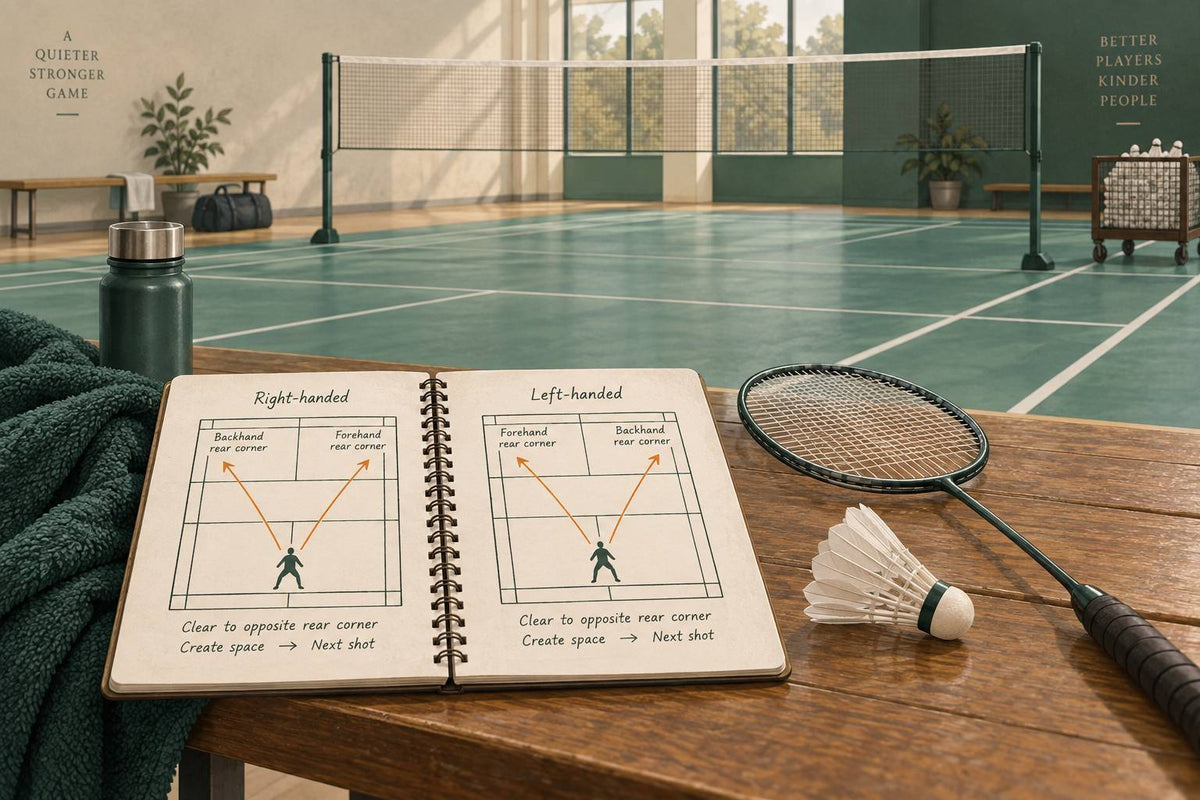
Their forehand and backhand corners are reversed. The corner your eyes may automatically read as a right-hander’s backhand can be a left-hander’s forehand. That means a habitual cross-court shot that normally targets a right-hander’s backhand may instead feed a lefty’s stronger attacking side.
The useful mental reset
- Against a right-hander: your usual “backhand corner” target is likely built into your habits.
- Against a left-hander: that same visual target may be their forehand, especially in the rear court.
- Your first job: identify which rear corner is actually their backhand before committing to a pattern.
This matters because many players train for years against right-handers. If most of your practice partners are right-handed, the shuttle often arrives from familiar angles. When a left-hander changes the angle of serve, smash, drive, or slice, the surprise can come less from the left-hander being “better” and more from your own pattern recognition being late.
So do not treat handedness as an automatic win condition for them, or as an automatic weakness for you to exploit. Being left-handed can create an edge through rarity, reversed angles, and unpredictability, but the player across the net still has individual habits. Some left-handers have excellent backhands. Some prefer straight rallies. Some hunt forehand intercepts. Some are uncomfortable when the shuttle is driven into the body or played through the middle.
“Do not play the label; play the player, using mirror-image geometry as your starting map.”
What to watch in the first few rallies
Use the opening rallies to collect information instead of forcing a pre-planned tactic. You are looking for the real version of the left-handed player in front of you:
- Rear-court preference: do they step around confidently for forehand smashes, or do they clear and reset?
- Backhand response: when you finally find their true backhand corner, do they lift safely, drive out, or struggle to recover?
- Middle-ball comfort: when you play through the middle, do they take it early or hesitate?
- Serve and return angle: does their left-handed serve arrive on a line you are reading late?
- Net spin: do their sliced net shots tumble in the opposite direction from what your hands are ready for?
A practical first adjustment is to make your straight shots more deliberate. Straight clears, straight drops, and straight smashes can hold the line toward the left-hander’s backhand side when your usual cross-court reflex would accidentally feed their forehand. Cross-court is still useful, but it should be earned by observation, not fired automatically from habit.
If you want to tighten the base skills behind this plan, review your shot options in Badminton Shot Types Explained and your corner-control habits in Badminton Singles Tactics: Four-Corner Control. The tactic against a lefty starts with the same fundamentals — you are just flipping the map before choosing the target.
Singles Positioning and Rally Patterns Against a Lefty
In singles, the adjustment is less about “lefties are tricky” and more about choosing rally patterns that do not let your habits aim for the wrong corner. If your normal right-hander pattern is cross-court pressure into the backhand side, pause before you use it automatically. Against a left-handed player, that familiar diagonal can become their forehand side instead.
The safer starting plan is simple: build more rallies with straight length, straight drops, and straight smashes when those shots keep the shuttle on the lefty’s backhand line. Then use the middle when you are unsure which corner your instinct is reading. The middle reduces the angle confusion because the left-handed and right-handed court maps overlap most there.
Singles default against a lefty
Start with straight and middle pressure, then add cross-court shots only when you have checked that the diagonal is actually attacking the side you want.
Make straight shots your “reset pattern”
When the rally becomes fast or stressful, most players return to their trained patterns. That is exactly when the left-handed matchup can punish you. Instead of trying to solve every angle in real time, give yourself a reset pattern:
- Straight clear: use it to regain length without opening the opposite diagonal too early.
- Straight drop: use it when you have the lefty moving back and you want to keep the shuttle on the same side.
- Straight smash: use it when the straight lane attacks the lefty’s backhand side and gives you a predictable follow-up.
This does not mean cross-court shots are banned. It means you earn them. If the left-handed player starts over-covering the straight lane, then the cross-court clear, drop, or punch clear can become a change-up rather than a reflex.
Use the middle when the corners feel confusing
The corners are where the mirror-image problem shows up most clearly. A cross-court shot that feels like it should go to a backhand corner may arrive on the lefty’s forehand side instead. The middle is more forgiving. A deep clear toward the centre line, a punch to the body lane, or a controlled lift through the middle gives you time to see how the opponent chooses their next shot.
Middle pressure also helps you avoid giving away huge angles. If you lift or clear too wide without purpose, a strong left-handed player can attack from a different release angle than you are used to seeing in club play. Keeping more shuttles near the centre channel makes their reply easier to read and your recovery position easier to hold.
| Rally situation | Better first choice | Why it works |
|---|---|---|
| You are under pressure in a rear corner | Straight clear or high lift | It buys time and avoids an automatic diagonal that may feed the forehand side. |
| You have a half-court attacking chance | Straight smash or steep straight drop | It keeps the rally on the intended side and gives you a cleaner net follow-up. |
| You are unsure which corner is safer | Flat middle, body lane, or centre clear | It reduces corner-angle confusion and forces the lefty to create the next angle. |
| The lefty starts waiting on your straight shots | Delayed cross-court clear, drop, or slice | Now the diagonal is a planned variation, not a habit error. |
Recover a little more centrally after wide shots
Against a right-hander, you may already “feel” which reply is likely after you hit to a corner. Against a lefty, that read can be delayed because the shuttle comes off the racket from the opposite side. After you play wide, recover with extra discipline: split-step on balance, keep your racket in front, and avoid leaning toward the reply you usually expect from a right-handed opponent.
A useful cue is: hit wide with a reason, recover to cover the middle first. If your wide shot creates a weak reply, move forward and take it. If it does not, do not admire the shot or drift toward the wrong diagonal.
Observe the individual, not just the hand
Being left-handed is not an automatic advantage in every rally. Some left-handed players are excellent around the head. Some dislike taking shuttles late on the backhand. Some counterattack cross-court confidently; others prefer straight replies. Your first few rallies should test, not assume.
- Test length: can they clear comfortably from both rear corners?
- Test the straight backhand line: do they lift safely, block short, or cough up a loose reply?
- Test the body lane: do they make clean forehand/backhand decisions under flat pressure?
- Test patience: do they attack early because they expect you to be uncomfortable with the matchup?
For the broader singles map, pair this section with our guide to four-corner control in singles. If you want to review the shot options mentioned here, see Badminton Shot Types Explained.
Canadian club-night cue: if you only face a lefty once in a while at drop-in, keep your plan simple for the first game: straight to the intended backhand line, recover centrally, and use the middle whenever the diagonal picture feels rushed.
Serve and Return Choices: Change the Default Target
Against a left-handed badminton player, the serve is often where your right-handed habits show up first. A low serve that you normally drift toward a right-hander’s backhand can land directly on a left-hander’s forehand side instead. That does not mean you should avoid serving there forever; it means your default target needs to be intentional, not automatic.
Think of the left-hander as a mirror image. The same low serve line that feels safe against most right-handers may give a lefty a comfortable forehand push, drive, or fast net interception. Start by changing the question from “where do I usually serve?” to “which side is actually their backhand from this court position?”
Simple serve rule against a lefty: if your usual low serve target is aimed at a right-hander’s backhand, test the opposite side early. For serve mechanics, see How to Serve in Badminton.
Low Serve: Move the “Safe” Target
In doubles, many players are trained to serve low and tight toward the receiver’s backhand hip or backhand service-box area. Against a right-hander, that often means serving toward one familiar side. Against a left-hander, that same visual target may be their forehand. If they are quick at the tape, you have just given them the easiest first attack of the rally.
Use the first few service points to map their comfort:
- Serve once to the adjusted backhand side. Watch whether they can still take it early, or whether their contact point drops.
- Serve once into the body line. This is useful if the lefty is overcommitting to one forehand interception lane.
- Keep the serve tight before you get clever. A perfect target does not help if the serve sits up above the tape.
The goal is not to prove that the left-hander has a weak backhand. The goal is to stop donating a forehand return because your eyes are still reading a right-handed opponent.
Flick Serve: Aim for the Backhand Shoulder, Not the Habit Corner
A flick serve can still work against a left-handed receiver, but the useful target may be mirrored. If you flick to the corner you normally use to surprise a right-hander, you may be lifting to a left-hander’s forehand overhead. That can turn your surprise serve into an invitation to attack.
A more reliable test is the backhand shoulder or the space just behind the receiver’s non-racket-side shoulder, provided your flick is legal, disguised, and high enough to pass their reach. For the low-versus-flick decision in doubles, use the serving patterns in Badminton Doubles Serve Guide: Low & Flick.
| Serve choice | Right-handed habit | Left-handed adjustment |
|---|---|---|
| Low serve | Drift toward the receiver’s usual backhand side. | Mirror the target so you are not serving straight onto the lefty’s forehand. |
| Body serve | Use it when the receiver lunges early to the tape. | Aim into the racket-side hip or body line to force a forehand-or-backhand decision. |
| Flick serve | Flick over the receiver’s backhand shoulder. | Re-check which shoulder is actually the backhand shoulder before choosing the corner. |
| Wide serve | Use occasionally to stretch the receiver and open the court. | Only use it after checking whether the wide line feeds their forehand drive. |
Doubles Serve Side: Even and Odd Points Matter
In doubles, the first server serves from the right court on even points and from the left court on odd points. That scoring rule matters more against a lefty because the same receiver may see the shuttle arriving from a different angle depending on the score and serving side.
If you are serving to a left-handed receiver from the right court, the low serve line, the body line, and the flick angle will not feel the same as when you serve from the left court. Do not use one automatic target for both sides. Before you serve, make a quick three-part check:
- Score side: am I serving from the right court on an even score or the left court on an odd score?
- Receiver hand: where is the left-hander’s forehand from this exact angle?
- Partner plan: if the return comes flat through the middle, who takes the next shot?
That last question is especially important in Canadian club-night doubles, where many pairs rotate partners often and do not have fixed serve-return patterns. A clear pre-serve plan prevents the first three shots from becoming a scramble.
Returning a Left-Handed Serve
Left-handed serves can create different arrival angles. The shuttle may approach your racket face from the side you are less used to reading, even if the serve itself is legal, low, and ordinary. The common mistake is to react late, then compensate with a risky cross-court return.
Make your first return pattern simple:
- Take the shuttle early if it is loose. A left-handed server does not change the basic rule: loose serves should be pressured.
- Push straight or through the middle when unsure. This reduces the chance of feeding the lefty’s preferred forehand counter-angle.
- Use cross-court returns only when you have read the racket face. The diagonal that normally finds a backhand may be the wrong diagonal against a lefty.
- Watch the server’s partner. If the partner is hunting your straight push, mix in a tight net return or body push.
For a deeper first-three-shots plan, pair this adjustment with Badminton Doubles Return of Serve Guide. The structure is the same; the target map is mirrored.
Pre-serve reminder against a lefty
Do not serve to the picture in your memory. Serve to the actual racket hand in front of you. If your normal low serve would land on the left-hander’s forehand, shift the target, tighten the line, and make them prove they can attack from the mirrored backhand side.
Net, Front Court, and Flat Middle Tactics
At the net, the left-handed problem is less about “they are left-handed” and more about your first reflex. Once the mirror-image geometry is in your head, do not rush into the automatic cross-court reply you would use against a right-hander. In front-court exchanges, that panic reach-across often gives the lefty the angle they wanted.
Front-Court Rule Against a Lefty
When the shuttle is tight and spinning, make the safe, disciplined answer first: straight, tight, and controlled. Earn the cross-court only when you are balanced and early.
Respect the opposite net spin
A left-hander’s sliced net shot can make the shuttle tumble the opposite way from what your hand expects. That is why many right-handed players look comfortable until the final split second, then stab across their body and pop the shuttle up. The fix is not to guess harder. The fix is to simplify the reply.
If the lefty plays a spinning net shot and you are late, keep the shuttle straight and tight. A straight net return gives you a larger margin for racket control, avoids exposing the open diagonal, and prevents you from feeding a loose cross-court reply into their preferred forecourt angle.
- If you are early: hold your racket face, threaten the straight net, then choose between a tight straight net shot, lift, or controlled cross-court.
- If you are level with the shuttle: play straight and tight. Do not force the highlight-reel cross-court.
- If you are late: lift with height or play a safe straight net reply rather than reaching across and brushing the shuttle upward.
For the technical base, review badminton net shot technique. For the decision-making side, the shot-choice framework in badminton net play strategy is especially useful here: the right shot is the one you can play with balance, not the one that looks clever.
Use straight net pressure to set up the next ball
A straight net reply is not passive if it is tight. Against a left-handed opponent, it does three useful things: it keeps the rally in a channel you can read, it limits the reversed-corner surprise, and it asks them to play up from close to the tape.
The goal is not to win every front-court exchange outright. The goal is to stop donating loose cross-court shuttles. Make the lefty prove they can net back tightly, lift accurately, or push past you under pressure. If their reply sits up, then you can move forward for the kill or push quickly into space.
| Situation | Better choice | Why it works |
|---|---|---|
| Lefty plays a tight spinning net shot | Straight net or high lift | You avoid the rushed cross-court contact that often turns into a loose sitter. |
| You arrive early and balanced | Hold, then choose straight net, push, or cross-court | The cross-court becomes a planned option, not a reflex. |
| The lefty waits on the forecourt | Fast push through the body or middle | You take away their favourite corner angle and make them decide forehand or backhand quickly. |
| You are stretched wide at the net | Recover with a safe lift or straight block | You reset the rally instead of handing over a clean interception. |
Attack the racket-side hip and flat middle
The middle of the court is your friend against a left-hander because it avoids the biggest reversed-corner problem. Instead of trying to remember which diagonal is safe in every fast exchange, drive the shuttle hard and flat at the body, especially toward the racket-side hip, or send it through the flat middle channel.
That target can force an awkward decision: forehand or backhand? If the shuttle is too close to the body for a full swing and too fast to step around, the lefty has to shorten the stroke. Even if they return it, you often get a flatter, more predictable ball instead of a sharp angled counter.
- In singles: use the flat body push after a tight net exchange, especially when the lefty is leaning toward a corner.
- In level doubles exchanges: drive through the middle lane rather than feeding the outside forehand.
- When defending a half-smash: block or drive back into the body line, not automatically cross-court into the lefty’s attacking side.
If this shot is not reliable yet, build it separately. The technique guide for badminton flat drives covers the short swing, compact contact, and recovery habits you need before using the tactic in a match.
Simple match cue. At the front court, think “straight first, middle next.” Keep the net reply tight, then look for the flat body or middle push when the lefty starts leaning into the corners.
Doubles Against a Left-Right Pair

A left-right pair can place both forehands on the outside or toward the middle, depending on which side each player occupies. Check their current positions before choosing the target. The right-hander covers one tramline with a forehand, the left-hander covers the other tramline with a forehand, and suddenly your usual “push wide to the backhand side” habit is less dependable.
That does not mean a left-right pair is unbeatable. It means the weakness is less likely to be the outside tramline and more likely to be the seam: the space between the two players, especially when both racket forehands are pointing away from the centre.
Left-Right Doubles Rule of Thumb
- Respect the outside forehands: wide flat shots to the tramlines may be easier for them than they would be against two right-handers.
- Attack the middle: drives, pushes, blocks, and half-court interceptions through the centre can create hesitation over who takes the shuttle.
- Watch the rally shape: the weak side can change as they rotate, defend, or switch front-back positions.
Why the Middle Becomes So Valuable
Against two right-handers, many players learn to aim toward the same general backhand-side patterns. Against a left-right pair, that shortcut breaks down. If both players are set side-by-side with forehands on the outside, a wide drive may feed a comfortable forehand counter.
The centre line is different. A flat shuttle into the middle can force both players to decide: “Is that mine or yours?” Even a tiny pause is enough to turn a strong defensive pair into a pair that lifts, blocks loose, or clashes rackets.
This is where your shot quality matters. Do not float the shuttle through the middle. Hit it with purpose: firm enough to rush their hands, low enough to stop an easy interception, and placed close enough to the body that neither player can swing freely.
Use Flat Drives, Body Pushes, and Centre Blocks
Your best tools are not always full-power smashes. In many club doubles rallies, the better choice is a fast, flat shot that stays below shoulder height and travels through the seam.
- Flat drive through the middle: aim between the two players, especially when they are side-by-side in defence.
- Body push at the racket-side hip: this can force an awkward forehand-or-backhand decision without giving them a clean corner angle.
- Soft centre block: when defending a smash, block toward the middle front court rather than automatically lifting cross-court to an outside forehand.
- Half-court push behind the front player: if the front player is cheating wide, push into the channel just behind them and make the rear player move forward.
For the mechanics behind that low, fast centre shot, review the badminton push shot technique guide. For broader placement ideas, pair this section with the doubles shot placement guide.
Do Not Assume the Same Weak Side All Rally
The tricky part is that the weak side can move during the rally. A left-right pair may start side-by-side with both forehands outside, then rotate into front-back attack, then recover into a different defensive shape. The “middle” you should attack is not always the painted centre line; it is the space where their responsibilities overlap.
A useful cue: after every shot you play, quickly check their racket positions. If both racket heads are outside their bodies, the seam is probably available. If one player has stepped forward to cover the centre, the better shot may be behind that player or into the other player’s body.
| Their Shape | What It Means | Better Reply |
|---|---|---|
| Side-by-side, forehands outside | Wide tramlines may be well covered | Flat drive or push through the middle seam |
| One player leaning wide | They are protecting the outside forehand | Push behind the front player or into the body |
| Both players hesitate on centre shuttles | The communication seam is exposed | Repeat the middle attack until they adjust |
| One player clearly takes charge of the middle | The seam has shifted or closed | Move the shuttle to the other body line, then test the seam again |
Rotation Still Comes First
Do not become so focused on “lefty tactics” that you forget doubles basics. If your side lifts, defend together. If your side forces a lift, attack with one player covering the rear and one player hunting the front. The left-right adjustment changes your target selection, not the whole structure of doubles.
If you are unsure whether you should be side-by-side, front-back, or rotating after your shot, revisit the badminton doubles positioning and rotation guide. The middle attack works best when both partners understand who follows the shuttle and who protects the next reply.
Canadian club-night cue. In fast drop-in doubles, keep the instruction short with your partner: “test the seam first.” If the left-right pair starts closing the middle, then widen the court again.
Practice Drills to Get Comfortable With Left-Handed Angles
The best fix is simple: get more left-handed reps. Players who mostly practise against right-handers build familiar timing, shot habits and recovery instincts around those contact angles. When a left-hander shows up, the shuttle does not need to be magical to feel uncomfortable — it is just arriving from the mirror image of what you normally read.
If you have a left-handed partner, build one short block into your next practice. If you do not, ask a coach or training partner to simulate the left-handed patterns: feed from the opposite rear-court side, aim the shuttle into the mirrored diagonals, and make you recover after shots that would normally feel automatic against a right-hander. For a full session structure, pair the drills below with our badminton practice session plan.
Simple setup before you start
- Mark the lefty backhand: place a cone or spare shuttle in the left-handed player’s backhand rear corner so the target is visible.
- Name the target out loud: before each rally, say “straight backhand,” “opposite diagonal,” or “middle body” so you are training recognition, not just hitting.
- Keep the rally realistic: the goal is not to win every drill point; it is to make the unfamiliar angle feel normal by the end of the block.
Drill 1: Straight Rear-Court Target Block
This drill builds the habit of using straight clears, straight drops, and straight smashes when that line holds the shuttle toward the left-hander’s backhand. Against many right-handed opponents, your cross-court reflex may feel natural; against a left-hander, that same reflex can send the shuttle straight into their forehand hitting zone.
- Feed: partner lifts to your rear court.
- Hit: play three straight shots on the lefty’s backhand-side lane: a deep clear, a short drop, then an attacking clear or smash if the feed allows it.
- Recover: return to base after every shot and split step before the next feed.
- Score it: count only shots that land straight enough to keep the lefty from stepping comfortably into a forehand.
For newer players, start with clears and drops only. Once the straight line is reliable, add a steeper attacking shot. If your footwork breaks down before the shot, review the recovery basics in Badminton Footwork Basics before increasing pace.
Drill 2: The Opposite Cross-Court-to-Backhand Diagonal
This is the pattern most right-handed players under-practise. Your familiar cross-court “to the backhand” against a right-hander can become a feed into a lefty’s forehand. The fix is not to avoid cross-court forever; it is to train the opposite diagonal until you can find the left-hander’s backhand on purpose.
- Set two targets: one cone in the lefty’s backhand rear corner and one cone in the hitting corner that creates the opposite cross-court line.
- Feed: partner lifts or tosses to your rear court on the correct side for that diagonal.
- Hit: play cross-court clears first, then cross-court drops once you can control the length.
- Progression: after five clean targets, your partner may block, lift, or drive the next shuttle so you must recover into a live rally.
Do not rush this one. The purpose is to overwrite the automatic right-handed-opponent pattern, so accuracy matters more than speed.
Drill 3: Middle and Body Drive Pressure
The corners are where the left-right geometry feels most different. The middle is where the geometry overlaps more, and where your instincts usually stay closer to normal. Use this drill to practise taking away the lefty’s corner advantage with flat, direct pressure.
- Feed: partner drives or tosses shuttles around shoulder to hip height.
- Hit: drive flat through the centre channel or toward the left-hander’s racket-side hip.
- Safety rule: aim body drives around the torso or hip line, not at the head.
- Progression: play 10 seconds live after the first body drive; you only win the rep if your next two shots stay through the middle or force a weak lift.
This also helps doubles players. Against a left-right pair, middle and body pressure can create hesitation because both players may have their forehands covering the outside lanes.
Drill 4: Serve-Target Change Reps
Do this slowly at first. Remember that serve side changes with the score, as covered in the serve section, so practise the lefty target from both service boxes instead of only your favourite side.
- Set the target: mark the receiving lane that takes the serve away from the left-hander’s forehand.
- From the right service box: hit 10 low serves to the marked target, then 3 flick serves to keep the receiver honest.
- From the left service box: repeat the same target discipline from the mirrored side.
- Add return pressure: your partner attacks any serve that drifts into the lefty forehand lane.
The goal is to stop serving on autopilot. If you can stand in either box and immediately identify the safer lefty target, you will give away fewer easy first attacks.
Drill 5: Recovery Footwork After the Mirrored Shot
Many players choose the right shot against a left-hander, then lose the point because their recovery still assumes a right-handed reply. This drill connects shot choice to the next movement.
- Feed: partner feeds one shuttle to your rear court.
- Hit: choose either straight to the lefty backhand, the opposite cross-court-to-backhand diagonal, or a middle/body drive.
- Recover: return to base, split step, then move to the next shuttle your partner sends.
- Call it: before your partner hits the next shuttle, call “forehand threat,” “backhand pressure,” or “middle neutral” based on where your shot landed.
That call-out step matters. It forces you to read the left-hander as an individual instead of assuming every lefty has the same strengths.
| Drill | Main habit | Best cue |
|---|---|---|
| Straight rear-court target | Trust the straight line when it holds the shuttle to the lefty backhand | “Straight first, cross only when earned.” |
| Opposite diagonal | Find the lefty backhand with the cross-court you rarely practise | “Check the corner before you swing.” |
| Middle/body drives | Remove corner-reading pressure and force quick decisions | “Through the middle, not into the trap.” |
| Serve-target changes | Stop drifting serves into the lefty forehand lane | “Both boxes, same discipline.” |
| Recovery footwork | Connect the mirrored shot to the next movement | “Hit, recover, read.” |
If you have access to a coach, these patterns are ideal for controlled feeding. Use one target per block, then mix the targets once your decision-making improves. For higher-volume feeding ideas, see our multi-shuttle badminton drills guide.
Practice with a familiar setup first. When you are learning new left-handed angles, use the racket, grip, and string tension you already trust so the variable is the tactic — not your gear. If you are comparing options for future training blocks, you can check live availability in our badminton racket collection.
Gear Setup for Practising the Plan
You do not need a special “lefty-beater” racket. The plan comes from reading the mirror-image geometry, changing your default targets, and getting enough repetitions that the left-handed angles stop feeling surprising.
That said, your setup should make the practice easier. If you are drilling flatter drives into the racket-side hip, controlled straight clears, and attacking patterns through the middle, choose gear that lets you repeat those shots without fighting the racket.
| Practice focus | Useful setup choice | Why it helps |
|---|---|---|
| Flat middle drives | A racket you can manoeuvre quickly | You need fast preparation and clean contact when aiming at the body or centre seam, especially in doubles. |
| Straight clears and drops | A familiar string tension and grip size | Against a left-hander, accuracy matters more than guessing. A predictable feel helps you keep the shuttle on the intended line. |
| Attacking patterns | A balance that matches your normal style | Do not switch to an unfamiliar racket just because the opponent is left-handed. Your observation and shot selection should change first. |
A simple setup checklist
- Use the racket you trust under pressure. If you are still choosing one, start with the decision points in our badminton racket selection guide.
- Keep string tension realistic. Controlled straight clears and tight net replies are harder if your setup is too demanding for your current timing. For a baseline, see our string tension guide.
- Refresh your grip before serious drilling. A slippery grip makes late forehand-backhand decisions worse, especially when you are driving at the body or defending flat exchanges.
- Bring enough shuttles for repetition. The goal is not one perfect rally; it is repeating the lefty-specific targets until they become normal.
Need a racket for these drills? Check live availability in the Badminton House badminton racket collection. For Canadian players comparing options in CAD, our team can help you think through weight, balance, flex, and string setup before you buy.
If you are unsure whether your current racket is helping or holding you back, send us your level, singles or doubles focus, and what feels difficult against left-handed opponents through our contact page. As a closing buying-help note, Badminton House offers free shipping within Canada on orders over $200, so it can be worth planning strings, grips, shuttles, and racket needs together rather than making separate small orders.
Which Plan Should You Choose Against a Left-Handed Player?
Use this as your match-day decision helper. The goal is not to label every left-hander as the same type of player. Start with the reliable geometry — forehand and backhand are reversed — then observe what this specific opponent handles well.
For most Canadian club players, the biggest adjustment is simply breaking the right-handed habit: the cross-court you normally trust may land on the left-hander’s forehand instead of their backhand.
| Situation | Choose this first | Why it works | Be careful with |
|---|---|---|---|
| First few rallies | Play straighter than usual | Straight shots reach the intended backhand side only from the matching starting side; identify the target before choosing straight or cross-court. | Auto-piloting your normal cross-court pattern. |
| You feel late reading corners | Play through the middle | The lefty advantage is largest in the corners, where the diagonal angles feel most unfamiliar. The middle overlaps more closely with your normal defensive instincts. | Chasing perfect corner placement before you have adjusted to the mirror image. |
| You want to attack safely | Use flat body drives, especially toward the racket-side hip | A hard, flat shuttle into the body can force an awkward forehand-or-backhand decision and avoids guessing the unfamiliar corner angle. | Lifting loosely to the side where their forehand smash is waiting. |
| You are serving low | Change the default target | A low serve you normally drift toward a right-hander’s backhand can go straight to a left-hander’s forehand. Aim the other way when the geometry calls for it. | Serving from habit instead of checking which hand is holding the racket. |
| You are at the net | Keep returns straight and tight | A left-hander’s sliced net shot can tumble the opposite way, so reaching across for a cross-court net reply is often riskier than a compact straight return. | Overreaching for a flashy cross-court net shot before you have read the spin. |
| You face a left-right doubles pair | Attack the middle seam and body | A left-right pair can protect both outside tramlines with forehands, but the middle can create hesitation because both forehands point away from the centre in that particular arrangement. | Assuming the same weak side stays open all rally. Against a mixed-handed pair, the weak side can shift as players rotate. |
| The lefty adapts well | Observe the individual, then vary | Being left-handed is not an automatic advantage in every rally. Once you know their real strengths, mix straight pressure, middle pressure, and earned cross-courts. | Treating “left-handed” as a complete scouting report. |
If you remember only one decision: start straight, stabilize through the middle, and earn the cross-court after you have confirmed where this left-handed player is actually vulnerable. For related shot work, review flat drives, net shot selection, and doubles shot placement.
Get 10% off your first order
Join the Badminton House list and we’ll email you a 10% welcome code — plus subscriber-only restock alerts, giveaways, and honest gear advice from players.
By subscribing, you agree to receive Badminton House emails and can unsubscribe anytime.
The big takeaway: do not play a left-hander as a stereotype. Play the mirror-image geometry first, then adjust to the person in front of you. We play badminton ourselves at Badminton House, so if you want help matching your racket, strings, or practice setup to this kind of tactical plan, contact us and tell us how you play.
Build a setup that helps you practise the plan: faster recovery, cleaner straight shots, and better control under pressure.
Check Live Racket AvailabilityCanadian badminton specialty shop · Player-to-player gear advice

Leave a comment
This site is protected by hCaptcha and the hCaptcha Privacy Policy and Terms of Service apply.